
StepFun's Step 3.5 Flash Hits Frontier Coding Scores on Just 11B Active Parameters
StepFun releases an Apache 2.0 sparse MoE that activates just 11B of 196B parameters, hitting 74.4% on SWE-bench Verified.
 Pro
Takeaways
- StepFun released Step 3.5 Flash, a 196B MoE with only 11B active parameters, Apache 2.0 licensed.
- Scores 74.4% on SWE-bench Verified, 51.0% on Terminal-Bench 2.0, 97.3 on AIME 2025.
- Reaches 100 to 350 tokens per second via 3-way Multi-Token Prediction and 288 routed experts per layer.
- 256K context window using a 3:1 sliding window to full attention ratio for cheaper long context.
- Runs locally on Mac Studio M4 Max or DGX Spark with int4 GGUF at 111.5 GB, plus vLLM and SGLang support.
- Plugs into OpenRouter, Claude Code, and Codex via OpenAI-compatible APIs.
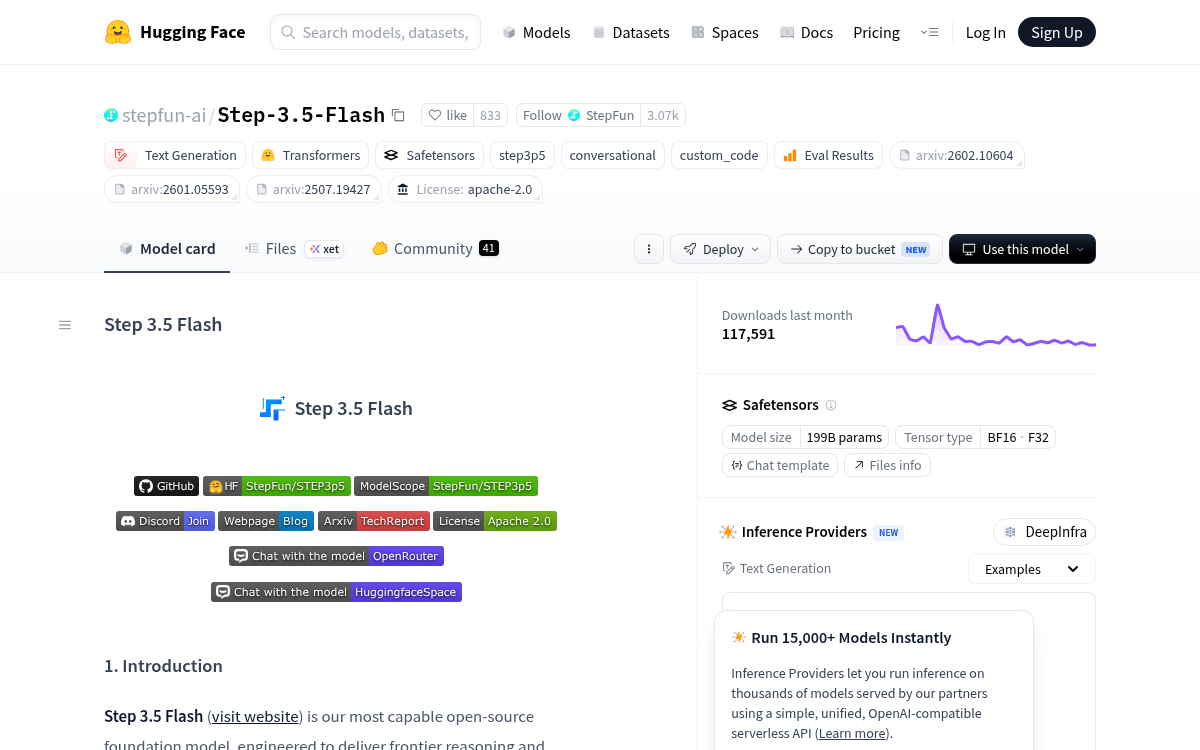
StepFun has released Step 3.5 Flash, an open-source foundation model that pushes sparse Mixture of Experts to an aggressive extreme: 196 billion total parameters, but only about 11 billion active per token. The pitch is frontier-tier reasoning and agentic behavior at the decoding cost of a mid-size model, under an Apache 2.0 license.
The headline numbers are competitive with much larger open models and several closed ones. Step 3.5 Flash scores 74.4% on SWE-bench Verified, 51.0% on Terminal-Bench 2.0, 97.3 on AIME 2025, and 86.4 on LiveCodeBench-V6. DeepSeek V3.2 uses 37B active parameters and Kimi K2 Thinking uses 32B active out of a trillion total, which makes hitting these scores on 11B active the central claim worth scrutinizing.
Tiny active footprint, large memory bill
The architecture is a 45-layer transformer with a 4,096 hidden dimension and a 128,896-token vocabulary. Each layer has 288 routed experts plus one shared expert that fires on every token; only the top 8 routed experts are selected per token. The result is a model that loads like a 196B parameter checkpoint but decodes at roughly the cost of an 11B model.
Fine-grained expert routing is not new, but 288 experts per layer sits at the aggressive end of current designs. More, smaller experts give the router finer control over what specialization to invoke, which is why StepFun frames this as an "intelligence density" play rather than a raw parameter race.

How throughput holds up
Two mechanisms drive the speed claims. A Multi-Token Prediction head with sliding-window attention and a dense FFN predicts four tokens simultaneously in a single forward pass, essentially baking speculative decoding into the model itself. Combined with 3-way MTP at serving time, StepFun reports 100 to 300 tokens per second in typical usage, peaking at 350 tokens per second on single-stream coding tasks.
Long context is handled by a 3:1 ratio of sliding-window attention to full-attention layers: three SWA layers for every one full-attention layer. This hybrid pattern, now common in long-context designs, keeps the KV cache manageable across the supported 256K context window.
The economic argument is clearest in the model card's decoding cost table:
| Model | Active / Total Params | Est. decoding cost @ 128K |
|---|---|---|
| Step 3.5 Flash | 11B / 196B | 1.0x |
| MiMo-V2 Flash | 15B / 309B | 1.2x |
| MiniMax M2.1 | 10B / 230B | 3.9x |
| DeepSeek V3.2 | 37B / 671B | 6.0x |
| Kimi K2 Thinking / K2.5 | 32B / 1T | 18.9x |
Running it locally or via API
The API is available through StepFun's platform and through OpenRouter, which currently offers a free tier. Local deployment is where the architecture starts to matter for individual developers. The int4 GGUF weights for llama.cpp come in at 111.5 GB, with roughly 7 GB of runtime overhead and a minimum of 120 GB VRAM, putting it in the range of a maxed-out Mac Studio M4 Max or DGX Spark rather than a single H100. For datacenter serving, vLLM and SGLang both have recipes ready, though full MTP-3 support in vLLM is still in progress.
A minimal call over the OpenAI-compatible endpoint:
from openai import OpenAI
client = OpenAI(
    api_key="YOUR_API_KEY",
    base_url="https://api.stepfun.ai/v1",
)
resp = client.chat.completions.create(
    model="step-3.5-flash",
    messages=[{"role": "user", "content": "Refactor this function..."}],
)
print(resp.choices[0].message.content)
The model plugs into Claude Code and OpenAI Codex through their config files, either as an Anthropic-style endpoint or via claude-code-router for OpenAI-style chat completions. For anyone already working inside those coding agents, that's likely the fastest integration path.
Strengths and known limits
Agent benchmarks are where Step 3.5 Flash pulls ahead of most peers: 88.2 on tau2-Bench, 84.5 on GAIA (no file), 83.7 on xbench-DeepSearch (May 2025), and 65.3 on ResearchRubrics. Reasoning scores are similarly strong, with 98.4 on HMMT 2025 February and 85.4 on IMOAnswerBench. These tasks reward long-horizon tool use and structured search, which appears to be where the RL post-training pipeline concentrated effort.
StepFun is candid about the tradeoffs. The model currently relies on longer generation trajectories than Gemini 3.0 Pro to reach comparable quality, so token consumption per task runs higher than the raw throughput numbers suggest. StepFun also notes reduced stability during distribution shifts, particularly in highly specialized domains or long-horizon multi-turn dialogues, where the model can exhibit repetitive reasoning, mixed-language outputs, or inconsistencies in time and identity awareness.
The ratio worth watching
A year ago, matching frontier coding scores below 20B active parameters looked like a stretch. The combination of very fine-grained MoE routing, built-in multi-token prediction, and hybrid sliding-window attention is producing models where the active-to-total ratio can reach roughly 1:18 without a significant quality drop. If the SWE-bench and Terminal-Bench numbers hold up under independent evaluation, self-hosted coding agents on a single high-memory node become considerably more realistic. The Apache 2.0 license and drop-in Claude Code and Codex configs make that scenario worth taking seriously.