
Stability AI Ships SDXL 1.0 to Beat Midjourney on Consumer GPUs
Stability AI drops SDXL 1.0, a 3.5B parameter base model paired with a 6.6B refiner, targeting 1024x1024 generation on 8GB consumer GPUs.
 Pro
Takeaways
- Stability AI released SDXL 1.0, a 3.5B base model plus 6.6B refiner for text-to-image generation
- Native 1024x1024 output with multiple aspect ratios, trained from scratch on high-res data
- Runs on consumer GPUs with 8GB VRAM, plus CPU offload and torch.compile speedups
- Dual text encoders (OpenCLIP-ViT/G and CLIP-ViT/L) improve prompt adherence over SD 1.5 and 2.1
- Open weights under CreativeML OpenRAIL++-M, also live on DreamStudio, ClipDrop, and Amazon Bedrock
- Technical report and code are available for reproduction and fine-tuning
Stability AI has released Stable Diffusion XL 1.0, the open-weights successor to the original Stable Diffusion line, and pushed the full checkpoint to Hugging Face under the CreativeML OpenRAIL++-M license. The model targets 1024x1024 native generation, ships with a companion refiner, and is designed to run on commodity GPUs rather than data-center hardware. The announcement came at the AWS Summit in New York, alongside news that SDXL will also be available on Amazon Bedrock.
Two models, one pipeline
SDXL 1.0 is not a single network. The architecture combines a 3.5B parameter base with a 6.6B parameter refiner, wired together as what Stability calls an ensemble of experts. In the first step, the base generates noisy latents, which are then processed by a refinement model specialized for the final denoising steps. The base can also run standalone if you want to skip the refiner and save compute.
Under the hood it remains a latent diffusion model, but with two fixed pretrained text encoders (OpenCLIP-ViT/G and CLIP-ViT/L) concatenated for prompt conditioning. That dual-encoder setup is a big part of why prompt adherence improves over 1.5 and 2.1. The original Stable Diffusion release was trained on 512x512 images; SDXL trains on 1024x1024 and supports additional aspect ratios per Stability's documentation, usable in portrait or landscape mode.
What the numbers say
Stability ran human preference evaluations against the previous generations, and the delta is not subtle.
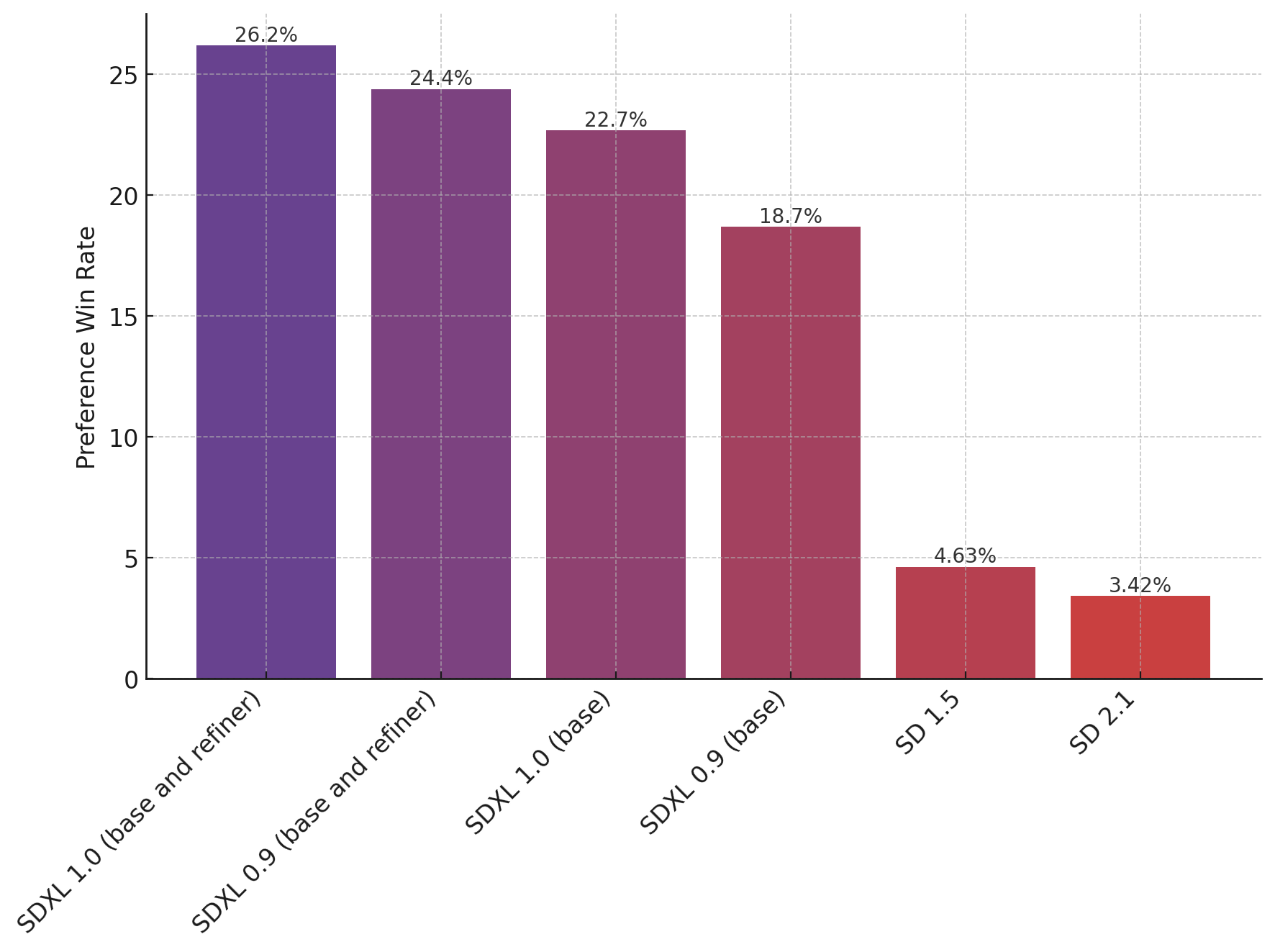
The base plus refiner combo tops the chart at a 26.2 percent win rate, with the base alone in second place. SD 2.1 sits at the bottom around 3.4 percent. In Stability's words, the base performs significantly better than previous variants, and pairing it with the refinement module achieves the best overall performance.
Running it in five lines
The model is wired into Hugging Face diffusers, so you can pull weights and generate an image without touching custom code:
from diffusers import DiffusionPipeline
import torch
pipe = DiffusionPipeline.from_pretrained(
    "stabilityai/stable-diffusion-xl-base-1.0",
    torch_dtype=torch.float16, variant="fp16", use_safetensors=True
)
pipe.to("cuda")
image = pipe(prompt="An astronaut riding a green horse").images[0]
For the full ensemble-of-experts flow, you load both networks and hand off latents at roughly 80 percent of the denoising schedule using denoising_end and denoising_start. If you are VRAM-limited, swapping pipe.to("cuda") for pipe.enable_model_cpu_offload() keeps the model on CPU and streams layers to GPU as needed. On PyTorch 2.0 or newer, wrapping the UNet with torch.compile in reduce-overhead mode buys another 20 to 30 percent inference speedup.
Consumer hardware, actually
The design constraint that matters most for practitioners is memory. SDXL 1.0 should work on consumer GPUs with 8GB VRAM or readily available cloud instances. That is a meaningful bar given the model has more than 3x the parameters of Stable Diffusion 1.5. It is achievable because most of the parameter growth sits in the UNet cross-attention layers, and the refiner is only invoked for a fraction of the steps.
Deployment paths are broad from day one. The release is available through Stability's API and consumer apps DreamStudio and ClipDrop, plus open source on GitHub. SDXL 1.0 will also be featured on Amazon Bedrock, AWS's managed service that provides API access to foundation models from leading AI startups and Amazon Titan. ONNX and OpenVINO variants are already published for CPU and Intel accelerator inference through Hugging Face Optimum.
Fine-tuning is the real story
Quality is the headline, but the practical breakthrough for anyone building on top of Stable Diffusion is customization cost. With SDXL 1.0, adapting the weights to custom data is easier than before. Custom LoRAs or checkpoints can be generated with less data wrangling. Stability is also shipping T2I adapter and ControlNet variants tuned for SDXL, though those are still in beta.
Practical use cases the team calls out:
- Generation of artworks and use in design and other artistic processes
- Applications in educational or creative tools
- Research on generative models
- Safe deployment of models with potential to generate harmful content
- Probing and understanding the limitations and biases of generative models
Where it still falls short
Stability is upfront about the ceiling. The model card lists current limitations directly:
- It does not achieve perfect photorealism
- It cannot render legible text reliably, though this is improved versus 2.1
- It struggles with compositional prompts, the classic example being a red cube on top of a blue sphere
- Faces and people in general may not be generated properly
- The autoencoding step is lossy, so fine detail can wash out
These are the same failure modes that have haunted latent diffusion since the beginning. The compositional weakness in particular is what pushed later systems toward stronger text encoders and, eventually, transformer-based diffusion backbones.
Where SDXL sits in the landscape
SDXL lands into a text-to-image field where closed models like Midjourney and DALL-E are pulling ahead on aesthetic polish, though open weights remain the only path for teams that need to fine-tune, self-host, or embed generation into a product without per-image API fees. The two-stage design is the interesting engineering bet: rather than scaling one monolithic UNet, Stability split the workload so the expensive refiner only sees the low-noise regime where detail actually matters. The architecture is documented in the SDXL technical report, and the training and inference code lives in the generative-models repository if you want to reproduce or extend it.