
Stability AI's SVD-XT Beats Runway and Pika in Open-Source Video Generation
Stability AI's open image-to-video model turns a single still into a 25-frame clip, and it beat Runway Gen-2 and Pika in human evaluations.
 Pro
Takeaways
- Stability AI released SVD img2vid-xt, an open image-to-video diffusion model.
- Generates 25 frames at 576x1024 from a single conditioning image, about 4 seconds at 6 FPS.
- Fine-tuned from the 14-frame SVD checkpoint with a temporally consistent f8 decoder.
- Preferred by human raters over Runway Gen-2 and Pika Labs in Stability's user study.
- 2B parameters, diffusers integration, roughly 180 seconds per clip on an A100 80GB.
- Limits: no text prompt, weak on faces and legible text, clips capped near 4 seconds.
Stability AI has released Stable Video Diffusion img2vid-xt, an open-weights image-to-video model that turns a single still frame into a short animated clip. It extends the base SVD checkpoint from 14 to 25 frames while holding the same 576x1024 resolution. Weights, code, and a diffusers pipeline are all publicly available, making this the first widely usable open source foundation model for image-to-video generation.
What is actually shipping
SVD-XT is a diffusion-based generative model that takes a still image and produces a short clip of 25 frames at 576x1024, up from 14 frames in the earlier checkpoint. Under the hood, it builds on SD 2.1's U-Net with added temporal attention layers, and the XT variant is a fine-tune of the 14-frame SVD checkpoint. Stability also fine-tuned the f8-decoder for temporal consistency, which cuts down on flicker between frames.
At the default 6 FPS, 25 frames works out to roughly 4 seconds of motion. The checkpoint weighs in at 2B parameters and ships in safetensors format under the stable-video-diffusion-community license, which permits non-commercial use and, with a separate Stability AI membership, commercial use.
Beating Runway and Pika in blind tests
Stability's chart shows user preference for SVD-Image-to-Video over Runway's GEN-2 and PikaLabs, with human voters favoring SVD for video quality. That is a notable claim for an open-weights checkpoint going up against two of the best-funded closed video generation startups at the time of release.
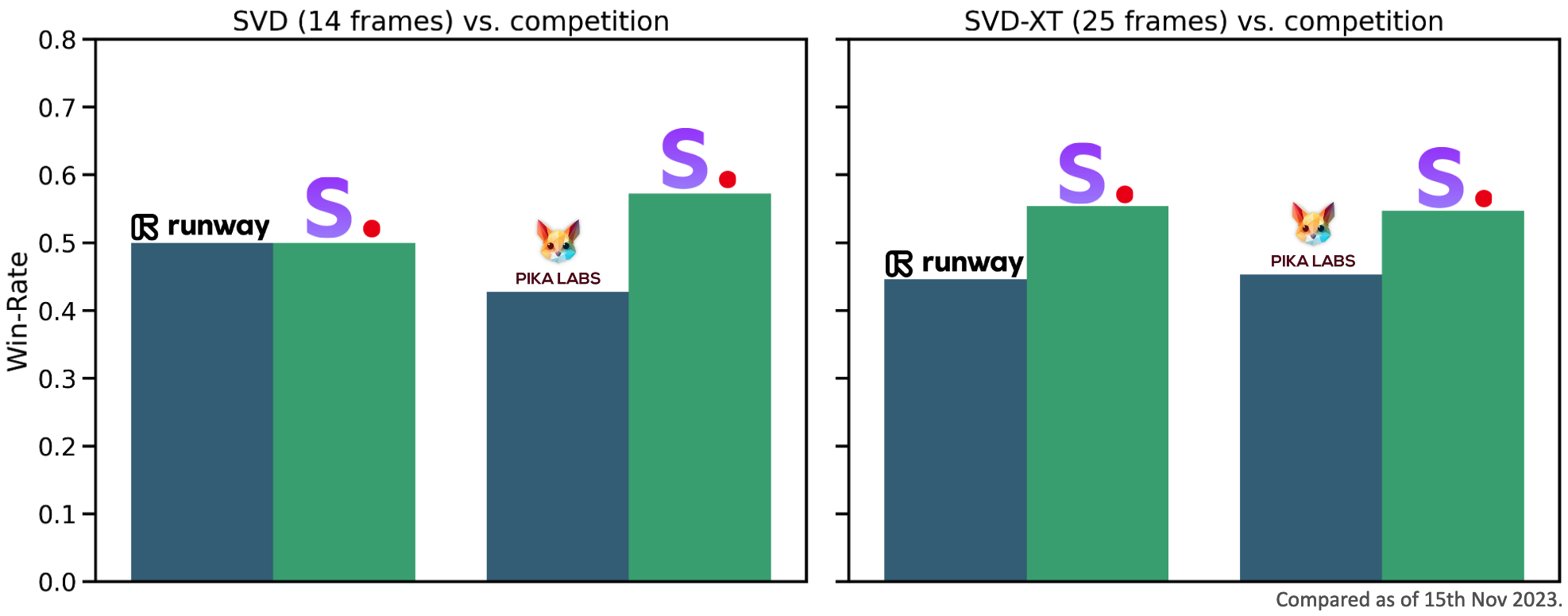
The evaluation was not casual. The model was fully developed in-house at Stability AI, and human raters were recruited through Amazon Mechanical Turk, SageMaker, and Prolific, paid $12/hr, and drawn primarily from the US, UK, and Canada.
Running it
The diffusers integration is a three-line install and a short Python snippet. You pass an image, get frames back, and export to MP4:
import torch
from diffusers import DiffusionPipeline
from diffusers.utils import load_image, export_to_video
pipe = DiffusionPipeline.from_pretrained(
    "stabilityai/stable-video-diffusion-img2vid-xt",
    dtype=torch.bfloat16, device_map="cuda")
image = load_image("guitar-man.png")
output = pipe(image=image).frames[0]
export_to_video(output, "output.mp4")
Inference is not cheap on a single GPU. According to Stability's own numbers, training the SVD checkpoints required roughly 200,000 A100 80GB hours, with the majority running on 48 x 8 A100s, and at release SVD-XT took about 180 seconds per clip on an A100 80GB card. Community reports peg the practical floor at 8 GB VRAM, comfortable at 24 GB. A TensorRT-optimized variant (stabilityai/stable-video-diffusion-img2vid-xt-1-1-tensorrt) exists for faster inference on NVIDIA hardware.
Where it breaks
The model card is unusually candid about failure modes. The main ones to plan around:
- Clips are capped at about 4 seconds and stop short of full photorealism.
- Output can be nearly static, with no motion or only a slow camera pan.
- There is no text prompt input, so you cannot steer motion with language.
- Rendered text in the output is not legible.
- Faces and full-body humans are often distorted.
- The autoencoder is lossy, so fine detail from the input image is not preserved perfectly.
The absence of text conditioning is the biggest structural limitation. Control comes almost entirely through the input image and a motion bucket ID, which is why community forks like the 1.1 update, fine-tuned at fixed 6 FPS and Motion Bucket ID 127, focus on stabilizing behavior (reducing temporal flicker and improving frame-to-frame consistency for faces and structured objects) rather than adding new controls.
Why this matters
Before SVD-XT, working with video diffusion mostly meant paying for API access to closed models or hacking together AnimateDiff-style extensions on top of image checkpoints. Shipping an open 2B-parameter model gave the research community something concrete to fine-tune, distill, and control. Predictably, it became the base for adapters like AnimateLCM-SVD, camera-control fine-tunes, depth-conditioned variants such as DepthCrafter, and face-focused derivatives, most of which live in the generative-models repository ecosystem.
The practical sweet spot is narrow but real. If you have a still asset (a product shot, an illustration, a piece of concept art) and need a few seconds of motion for a mood reel, an ad test, a game cinematic prototype, or a design mock, SVD-XT will do it locally without an API bill. Anything requiring dialogue, precise camera moves, or multi-shot sequences still calls for a newer, text-conditioned system. As a reference implementation of latent video diffusion that you can actually take apart and modify, it remains one of the most useful open checkpoints in the space.