
Stability AI's Stable Video Diffusion Runs Locally on One GPU for Free
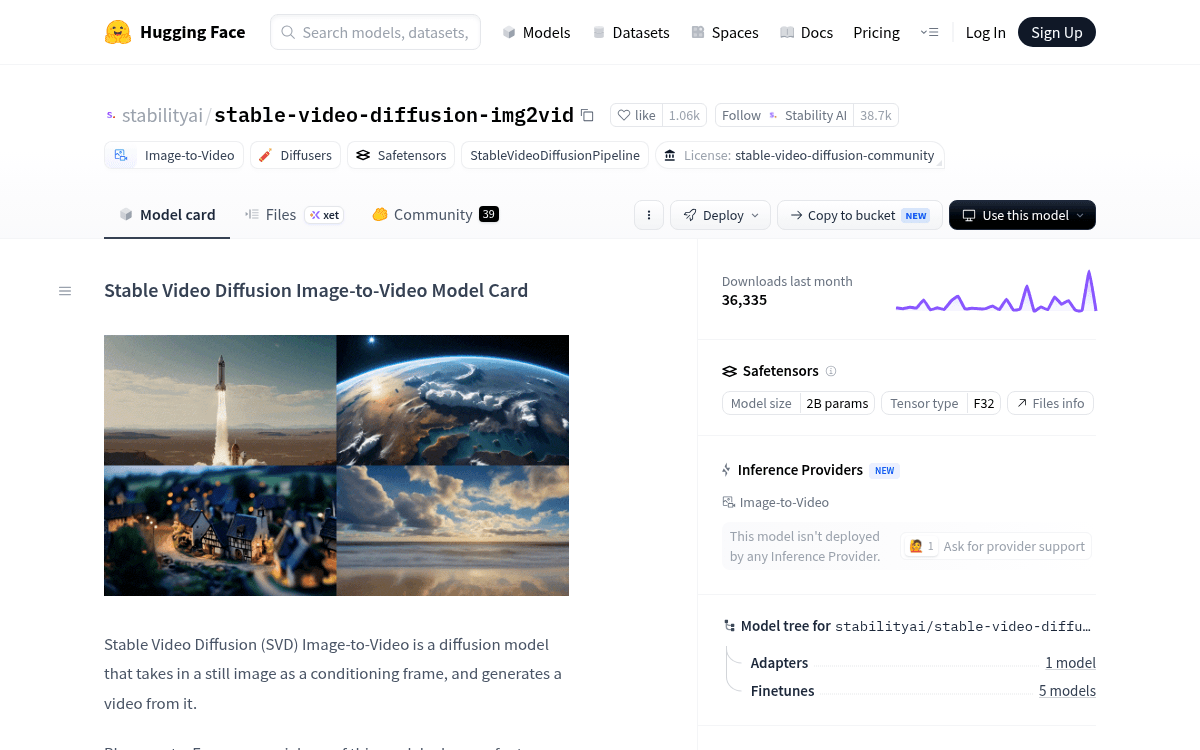
Stability AI's open image-to-video diffusion model turns a still frame into short cinematic clips, and it now runs directly from the diffusers pipeline.
 Pro
Takeaways
- Stable Video Diffusion img2vid is Stability AI's open image-to-video latent diffusion model.
- Base SVD outputs 14 frames at 576×1024; SVD-XT extends to 25 frames, roughly 4 seconds.
- Now runs as a one-liner through the
StableVideoDiffusionPipelinein Hugging Face diffusers. - Generation takes about 100s (SVD) or 180s (SVD-XT) on an A100 80GB.
- Human raters preferred SVD over Runway Gen-2 and Pika Labs at release time.
- Limits: under 4 seconds, no text control, fixed resolution, weak on faces and legible text.
Stability AI's Stable Video Diffusion is back in the trending charts on Hugging Face, and the model card has quietly picked up first-class support in the diffusers library. It remains one of the few open-weight image-to-video systems that runs locally on a single high-end GPU, and the surrounding tooling has matured enough to warrant another look.
A still frame in, a short clip out
Stable Video Diffusion (SVD) Image-to-Video is a latent video diffusion model with roughly 2B parameters that takes a still image as a conditioning frame and generates a short clip from it. Released as the first widely accessible open-source image-to-video model, it is built on SD 2.1's U-Net with added temporal attention layers. The base checkpoint generates 14 frames; SVD-XT extends that to 25.
Output resolution is fixed at 576×1024. With default 6 FPS conditioning, the base model produces about 2.3 seconds of video, and FPS conditioning can be pushed up to around 30 FPS for faster apparent motion. The SVD-XT finetune reaches about 4 seconds and generally shows cleaner temporal consistency on complex scenes.
Running it in five lines
SVD is now a one-liner in Hugging Face's diffusers library via the StableVideoDiffusionPipeline. A minimal working example:
import torch
from diffusers import DiffusionPipeline
from diffusers.utils import load_image, export_to_video
pipe = DiffusionPipeline.from_pretrained(
    "stabilityai/stable-video-diffusion-img2vid",
    dtype=torch.bfloat16, device_map="cuda"
)
image = load_image("guitar-man.png")
output = pipe(image=image).frames[0]
export_to_video(output, "output.mp4")
On an A100 80GB, the base model takes about 100 seconds per generation, and SVD-XT about 180 seconds at default settings. Community optimizations trade quality for memory and speed if you want to run on smaller cards. The weights ship under Stability's community license, which is free for non-commercial and research use, with a separate commercial license required for production.
Where it wins, and where it stumbles
In the user study Stability ran at release, human voters preferred SVD Image-to-Video to both Runway Gen-2 and Pika Labs on video quality. That was notable at the time because both competitors were closed hosted services.

The failure modes are well documented and matter if you plan to build on top of it:
- Clips are short (under about 4 seconds) and the model does not achieve full photorealism.
- It sometimes generates near-static output, or very slow camera pans.
- There is no text conditioning, so prompt engineering cannot steer motion the way it does in text-to-video systems.
- Legible text is beyond it, and faces frequently drift or morph.
- Resolution is locked to 576×1024 or 1024×576, with no variable resolution and no built-in upscaling. Input images at other aspect ratios get cropped or letterboxed.
Practitioners report the best results on slow, subtle animation: hair movement, fabric rippling, water surfaces, breathing, candle flames, plus steady camera pans and zooms on product and landscape photography. Live action with fast subject motion, hands, or crowds still breaks down.
The compute receipt
The training bill is a useful data point for anyone thinking about video diffusion research. According to the model card, training the SVD checkpoints required approximately 200,000 A100 80GB hours, with the majority running on 48×8 A100s, producing roughly 19,000 kg CO2-equivalent emissions and consuming about 64,000 kWh. Stability also finetuned the widely used f8-decoder for temporal consistency, which explains much of the reduction in frame-to-frame flicker compared with earlier latent video attempts.
On the safety side, the released inference code enables image-level watermarking by default via the imWatermark Python library, so outputs from unmodified pipelines are detectable.
Why it still matters
The open video generation space has moved fast, with Wan, CogVideoX, and Mochi pushing quality and length forward. SVD occupies a specific niche that none of them have displaced: a well-understood 2B-parameter image-to-video model that fits on one GPU, has an official diffusers integration, and comes with a permissive research license. It can be adapted to a range of downstream tasks, including finetuning on multi-view datasets for single-image novel view synthesis, and Stability positioned it as a base for an ecosystem similar to Stable Diffusion.
For prototyping an animation pipeline, generating short product loops, or finetuning your own temporal model on top of a solid base, SVD remains one of the cleanest starting points on the open side. Just do not expect it to replace a hosted service for dialogue scenes or anything longer than a few seconds.