
Stability AI's Stable Diffusion 3.5 Large Fixes the 8B Model Nobody Wanted
Stability AI ships an 8B-parameter Multimodal Diffusion Transformer with QK normalization, permissive licensing, and consumer-hardware inference through quantization.
 Pro
Takeaways
- Stability AI released SD 3.5 Large, an 8B-parameter MMDiT text-to-image model.
- Distilled Large Turbo generates images in 4 steps; a 2.5B Medium variant follows one week later.
- QK normalization stabilizes training at scale and improves typography and prompt adherence.
- Uses three text encoders in parallel: OpenCLIP-ViT/G, CLIP-ViT/L, and T5-xxl for long prompts.
- Free for commercial use under $1M revenue via the Stability Community License.
- Available on Hugging Face, GitHub, Replicate, DeepInfra, and ComfyUI.
Stability AI has released Stable Diffusion 3.5 Large, an 8-billion-parameter text-to-image model that ships alongside a distilled Turbo variant, with a smaller Medium version following a week later. The release answers the community backlash that greeted Stable Diffusion 3 Medium earlier this year, and it arrives with an unusually permissive commercial license for a model of this size.
The June release fell short of Stability's own standards and the community's expectations. Rather than push a quick patch, the team spent months retraining. The result is a family of models built to be customizable, efficient on consumer GPUs, and licensed for real commercial work.
What is actually in the box
Stable Diffusion 3.5 ships as three open-weights variants: SD 3.5 Large at 8.1 billion parameters, SD 3.5 Large Turbo, and SD 3.5 Medium. The Large and Large Turbo weights are downloadable from Hugging Face with inference code on GitHub. Medium follows a week later.
All three share the core architecture introduced with SD3:
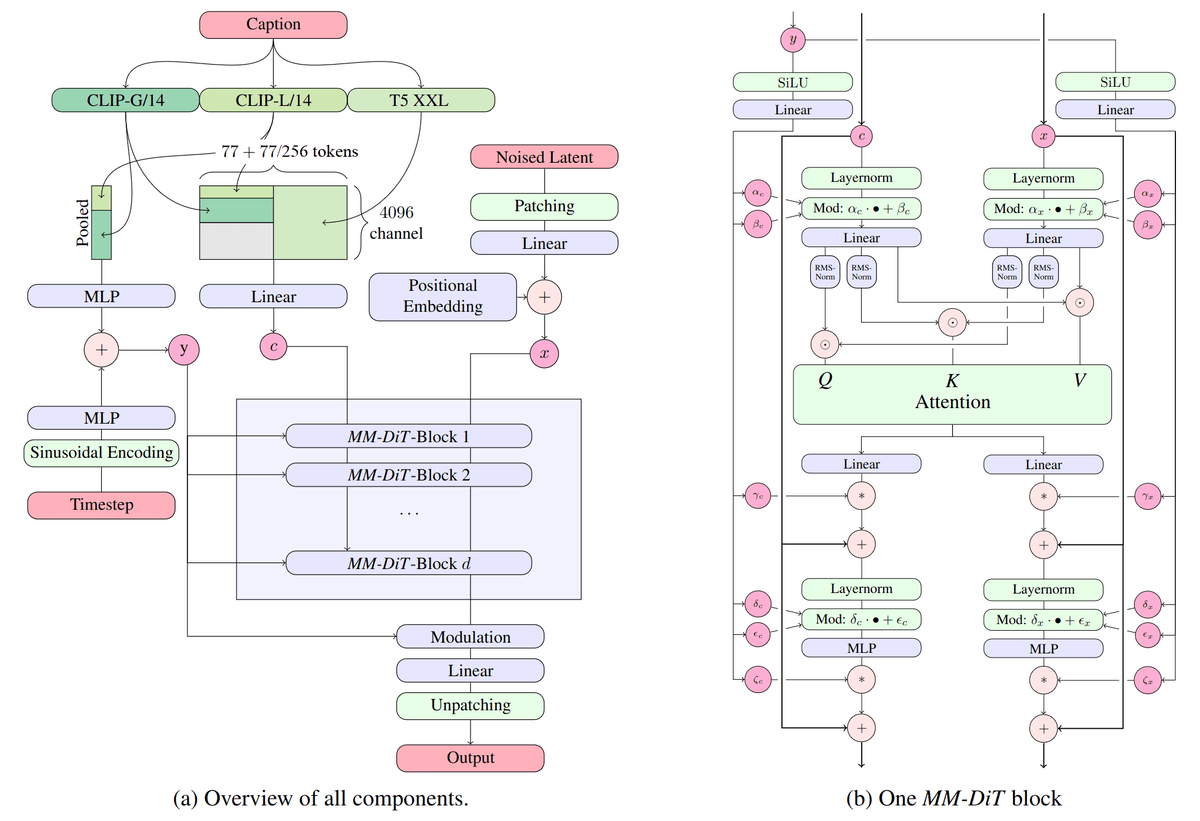
- MMDiT backbone. A Multimodal Diffusion Transformer that replaces the U-Net used in every prior Stable Diffusion release with a transformer that jointly attends over image tokens and text tokens.
- Rectified flow objective. Data and noise are connected by a linear trajectory rather than the classic noise-prediction schedule, and the noise schedule is reweighted toward perceptually relevant scales. In practice this means fewer sampling steps for the same quality.
- Three text encoders in parallel. OpenCLIP-ViT/G, CLIP-ViT/L, and T5-xxl, with T5 handling long-form prompts up to 256 tokens.
- QK normalization. Layer-norm applied to the query and key projections inside attention, which stabilizes training at the 8B scale and lets community fine-tuners push the model further without divergence.
Large targets 1-megapixel output. Large Turbo is a distilled version that produces high-quality images in 4 steps. The upcoming Medium model, at 2.5 billion parameters, features an improved MMDiT-X architecture, runs on consumer hardware, and generates images between 0.25 and 2 megapixels.
Running it without a datacenter
The default recipe is bf16 inference through the StableDiffusion3Pipeline in Hugging Face Diffusers. Recommended settings are 28 to 40 sampling steps with a guidance scale around 4.5 for Large, and 4 steps with low guidance for Large Turbo.
A minimal call looks like this:
import torch
from diffusers import StableDiffusion3Pipeline
pipe = StableDiffusion3Pipeline.from_pretrained(
    "stabilityai/stable-diffusion-3.5-large",
    torch_dtype=torch.bfloat16,
).to("cuda")
image = pipe(
    "A capybara holding a sign that reads Hello World",
    num_inference_steps=28,
    guidance_scale=3.5,
).images[0]
At full bf16 the transformer needs roughly 16 GB of VRAM before you load the T5 encoder, which is why the model card documents a 4-bit NF4 path using bitsandbytes and enable_model_cpu_offload(). That combination makes the 8B model tractable on a single 12 GB consumer card.
Where it shines and where it does not
Stability positions Large around three practical strengths, echoed by early integration partners:
- Customizability, so users can fine-tune for specific creative needs or build applications with tailored workflows.
- Efficient performance, optimized for standard consumer hardware without heavy resource demands.
- Diverse outputs across a wide variety of styles without complex prompting.
The tradeoffs are honest ones. That same output diversity means the model is less locked into a single aesthetic than heavily tuned competitors, so hitting a specific look often requires a LoRA or fine-tune rather than prompt engineering alone. Anatomy and hand rendering are noticeably better than in SD 3 Medium, though still imperfect. The model card is also explicit that the weights were not trained to produce factual or true representations of people or events, which rules out photoreal identity work.
The license is the real story
The technical upgrades matter, but the licensing shift may matter more for anyone building a product. The Community License is free for research, non-commercial, and commercial use for organizations or individuals with less than $1M in total annual revenue. Above that threshold, teams need an Enterprise License.
That is a meaningful contrast to the restrictive terms that shipped with SD3 Medium in June, and it puts SD 3.5 Large in direct competition with FLUX.1 for the open image-generation slot in commercial stacks. The weights also arrive already wired into the Stability AI API, Replicate, DeepInfra, and ComfyUI, so teams can prototype against a hosted endpoint and then self-host when latency or unit economics demand it.
Why QK normalization is the quiet win
The headline feature in the model card is the MMDiT architecture, but for anyone planning to fine-tune, the more consequential detail is QK normalization. Normalizing query and key vectors before attention keeps their magnitudes bounded, which prevents the attention logits from exploding partway through a training run.
For end users this shows up as better typography and cleaner rendering of complex prompts. For fine-tuners it shows up as a model that survives aggressive LoRA training and full-parameter tuning without the loss spikes that plagued earlier SD3 experiments. Stability has published a fine-tuning guide to lean into that.
Who should actually use it
SD 3.5 Large is the right pick when you need an open-weights model with strong prompt adherence, permissive commercial terms, and a healthy ecosystem of ControlNets and LoRAs to bend it to your domain. Concrete places it fits:
- Design tools that need to run image generation on customer GPUs rather than routing every request to a paid API.
- Content pipelines that need typography rendering for posters, ads, or UI mockups where earlier open models produced garbled text.
- Research on rectified flow, MMDiT scaling, or diffusion fine-tuning where an 8B open checkpoint is the artifact you want to iterate on.
- Startups under the revenue threshold who want to ship a commercial product without negotiating enterprise terms until they have to.
If you need a specific photoreal aesthetic out of the box, or you are generating at high throughput with tight latency SLAs, Large Turbo or a distilled competitor is the better starting point. For everyone else, this is the SD3 release the community was waiting for in June.