
Stability AI's Stable Cascade Beats SDXL While Running Faster With More Parameters
Stability AI's new text-to-image model uses a three-stage cascade to compress images 42x, cutting training costs while beating SDXL on quality.
 Pro
Takeaways
- Stability AI released Stable Cascade, a text-to-image model built on the Würstchen architecture under a non-commercial license.
- Uses a three-stage cascade (A, B, C) that compresses 1024x1024 images into 24x24 latents, a factor of 42.
- Ships Stage C at 1B and 3.6B parameters, Stage B at 700M and 1.5B, and a 20M parameter Stage A VAE.
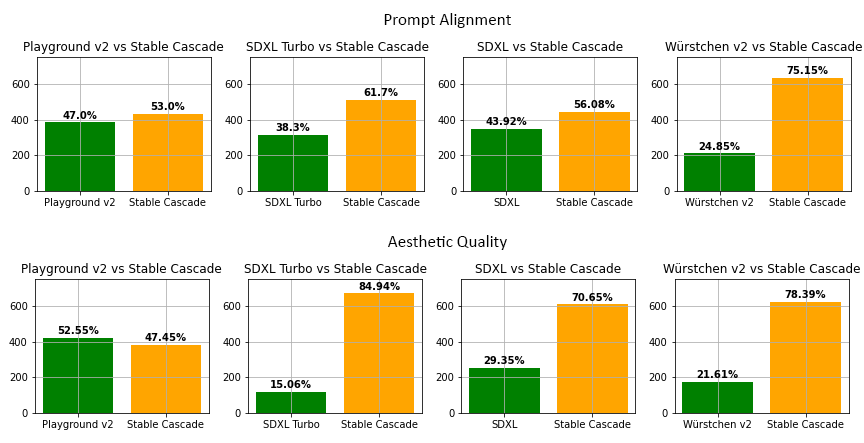
- Human evaluations show it beating SDXL, Playground v2, and SDXL Turbo on prompt alignment and aesthetic quality.
- Only Stage C needs fine-tuning for custom styles, LoRA, or ControlNet, drastically cutting training costs.
- Code, checkpoints, and training scripts are available on the official GitHub repository.
Stability AI has released Stable Cascade, a text-to-image model that takes a sharply different route from Stable Diffusion. Rather than one big diffusion model working over a moderately compressed latent, it chains three specialized networks together and squeezes images so aggressively that a 1024x1024 picture fits in a 24x24 grid of latents. That single design choice is what makes the model cheap to train, easy to fine-tune, and, according to the paper's evaluations, better looking than SDXL.
The release comes as a research preview under a non-commercial license. Weights, inference scripts, and training scripts for ControlNet and LoRA are on the official GitHub repo, and the model is available through the Hugging Face diffusers library.
Why a cascade instead of a monolith
The model is built on the Würstchen architecture, and its whole reason for existing is latent-space efficiency. Würstchen aims to learn an extremely compact image representation that can guide the diffusion process, because the size of that representation directly determines training and inference time. The previous Würstchen v2 already reduced training time by a factor of 8 and inference time by half compared to Stable Diffusion 2.1.
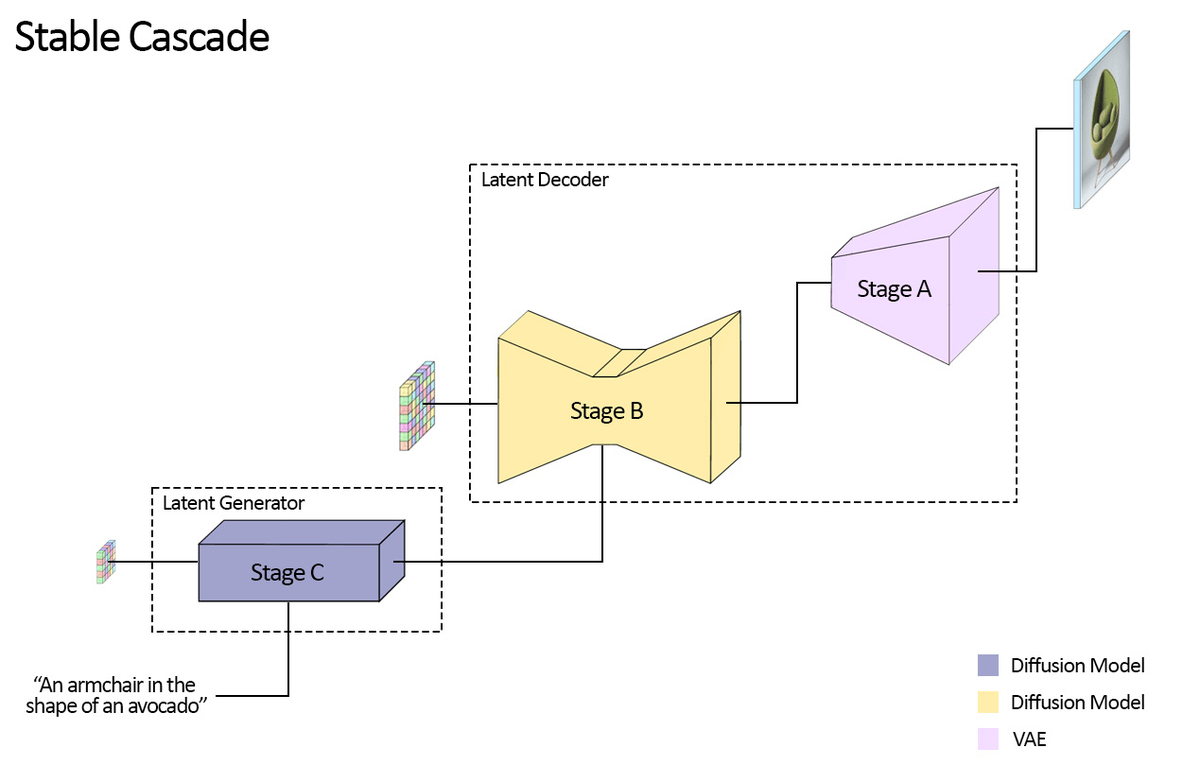
Stable Cascade pushes this further. Stages A and B compress images, similar to what the VAE does in Stable Diffusion, but at a much higher ratio. Stage C generates the small 24x24 latents from a text prompt. In numbers: Stable Diffusion uses a compression factor of 8 (1024x1024 becomes 128x128 latents), while Stable Cascade hits a factor of 42, encoding the same image into just 24x24 tokens without losing crisp reconstructions.
Three stages, three jobs
Here is how the pipeline is put together, roughly in reverse order of how you think about it:
- Stage C (the prior): A text-conditional diffusion model that generates the tiny 24x24 latent from your prompt. Ships in 1B and 3.6B parameter variants.
- Stage B (the decoder): A diffusion model that upsamples Stage C's compressed latent into a larger latent that Stage A can decode. Available in 700M and 1.5B versions, with the larger one better at fine details.
- Stage A (the VAE): A 20M parameter autoencoder that turns the final latent back into a full 1024x1024 image.
For most fine-tuning, LoRA training, or ControlNet work, you only touch Stage C, which operates on those tiny 24x24 latents. That is where the cost savings show up in day-to-day work.
Beating SDXL on quality at a bigger parameter count
Stability ran human evaluations against a mix of parti-prompts and aesthetic prompts. Stable Cascade at 30 inference steps was compared against Playground v2 at 50 steps, SDXL at 50 steps, SDXL Turbo at 1 step, and Würstchen v2 at 30 steps. Stable Cascade came out ahead on both prompt alignment and aesthetic quality in nearly every matchup.
The efficiency angle is more surprising. Despite the largest configuration carrying 1.4 billion more parameters than SDXL, it still runs inference faster. That inversion comes directly from the smaller latent space each diffusion step has to process.
Using it
The Hugging Face integration is straightforward. You can run the prior and decoder as separate pipelines, or use a combined pipeline for one-shot generation:
import torch
from diffusers import StableCascadeDecoderPipeline, StableCascadePriorPipeline
prompt = "an image of a shiba inu, donning a spacesuit and helmet"
prior = StableCascadePriorPipeline.from_pretrained(
    "stabilityai/stable-cascade-prior", variant="bf16", torch_dtype=torch.bfloat16)
decoder = StableCascadeDecoderPipeline.from_pretrained(
    "stabilityai/stable-cascade", variant="bf16", torch_dtype=torch.float16)
prior.enable_model_cpu_offload()
prior_output = prior(prompt=prompt, height=1024, width=1024,
                     guidance_scale=4.0, num_inference_steps=20)
decoder.enable_model_cpu_offload()
image = decoder(image_embeddings=prior_output.image_embeddings.to(torch.float16),
                prompt=prompt, guidance_scale=0.0, num_inference_steps=10).images[0]
Note the guidance settings: the prior does classifier-free guidance at 4.0, while the decoder runs at 0.0, since its job is faithful reconstruction rather than creative interpretation. Lite variants of Stage B and Stage C are available for lower-VRAM setups, and the repo ships full training scripts for ControlNet and LoRA.
Where it shines, and where it stumbles
Independent testing lines up with Stability's claims on quality. Like SDXL, Stable Cascade does reasonably well at generating legible text, and reviewers rated it as the stronger of the two on that front. The official user study also found evaluators preferred Stable Cascade's outputs over SDXL's overall.
The speed picture is more mixed in practice. Stability's press materials claim Stable Cascade is faster than SDXL, but at least one independent tester did not see that in ComfyUI, finding their speeds roughly equivalent. Where the efficiency story holds up cleanly is fine-tuning: because only Stage C needs to be retrained for a custom style or ControlNet, the architecture could ease the pain that has made SDXL notoriously difficult to train.
Stability is upfront about the weaknesses on the model card: faces and people may not generate properly, the autoencoder is lossy, and the model is not intended for factual representations of real people or events. The non-commercial license also rules out shipping it in a product without a separate agreement.
Why this release matters
The industry has been converging on one dominant recipe: latent diffusion with a VAE at compression factor 8, plus increasingly large UNets or DiTs on top. Stable Cascade is a bet that the bottleneck is the latent representation itself, and that pushing compression 5x further, then splitting the work across specialized stages, yields a better tradeoff than scaling one giant model.
For teams building on open image models, the practical takeaway is that customization gets cheaper. Fine-tuning a 3.6B Stage C on 24x24 latents lives in a very different budget from fine-tuning SDXL end-to-end at 128x128. If you have been priced out of training your own base-style variants or ControlNets, this architecture is worth a serious look, provided your use case fits within a research license.