
Stability AI's SDXL Turbo Generates Photorealistic Images in a Single Step
Stability AI's SDXL Turbo compresses text-to-image generation into a single sampling step using a new adversarial distillation training method.
 Pro
Takeaways
- SDXL Turbo generates 512x512 images from text in a single sampling step.
- Uses Adversarial Diffusion Distillation, combining GAN-style adversarial loss with score distillation from an SDXL teacher.
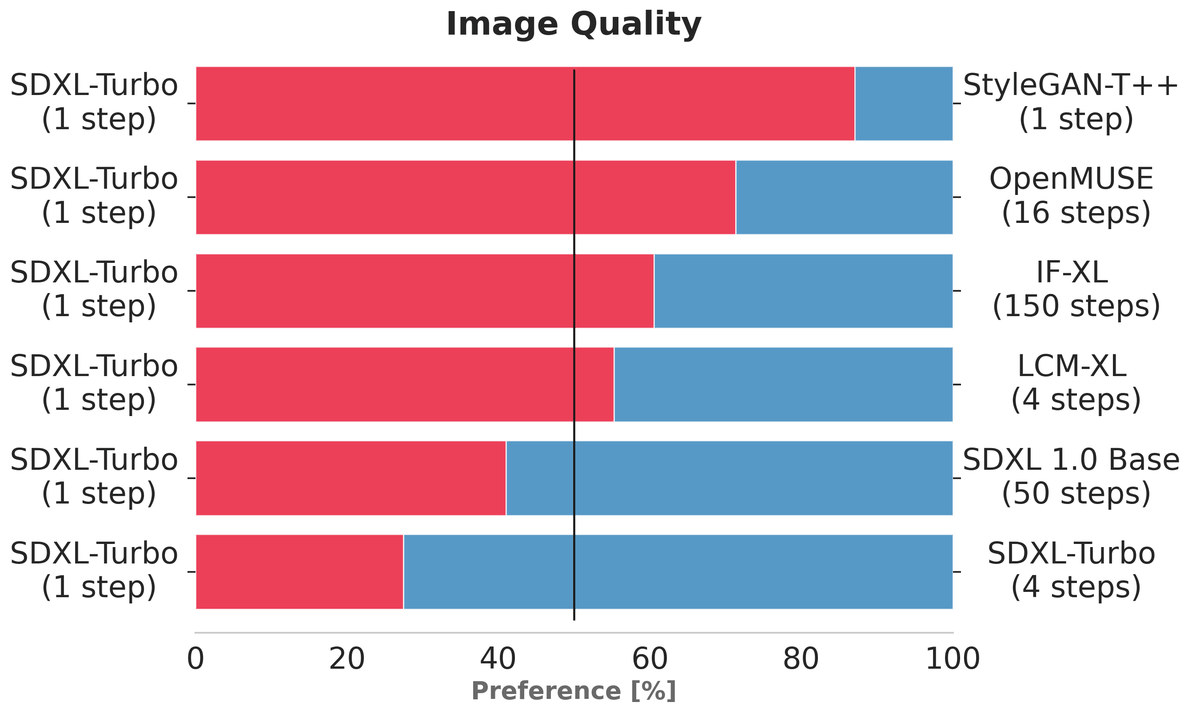
- Beats 4-step LCM-XL in a single step and 50-step SDXL in four steps on human preference tests.
- Runs with
guidance_scale=0.0andnum_inference_steps=1via the Diffusers library. - Limitations: 512x512 resolution, cannot render legible text, weak on faces, lower output diversity.
- Non-commercial community license; commercial use requires a separate Stability AI membership.
Stability AI released SDXL Turbo, a distilled variant of SDXL 1.0 that generates photorealistic images from text in a single network evaluation. The model has crossed 950,000 downloads on Hugging Face and sits at 2,600+ likes, making it one of the most adopted fast image generators available under an open weights release.
Real-time generation without the multi-step denoising loop has been the holy grail since diffusion models arrived. Stability's analyses show SDXL Turbo outperforms existing few-step methods like GANs and Latent Consistency Models in a single step, and reaches SDXL-level quality in only four. Adversarial Diffusion Distillation (ADD), the training method behind it, is the first approach to unlock single-step image synthesis with a foundation model.
The trick behind one-step diffusion
ADD samples large-scale foundational image diffusion models in 1 to 4 steps while maintaining high fidelity. It uses score distillation to leverage a large pretrained diffusion model as a teacher signal, combined with an adversarial loss that keeps outputs sharp even in the one- or two-step regime.
Diffusion models generate content iteratively and are typically far slower than GAN-based approaches. ADD borrows from both traditions, combining the sample quality of diffusion with the inherent speed of GANs.
Two loss signals drive training:
- Score distillation: a frozen SDXL teacher tells the student what a properly denoised image should look like, preserving prompt following and composition.
- Adversarial loss: a discriminator pushes the student to produce images perceptually indistinguishable from real data at every inference, which kills the blurriness you normally get from aggressive step reduction.
The result is single-step outputs with the crispness GANs are known for, without the artifacts that plague other distillation methods.
How it stacks up
Stability ran blind human preference studies against the strongest few-step and multi-step baselines, including StyleGAN-T++, OpenMUSE, IF-XL, SDXL, and LCM-XL. Evaluators saw two outputs generated from the same prompt in random order and picked the one that followed the prompt more closely. SDXL Turbo beat a 4-step LCM-XL configuration with a single step, and beat 50-step SDXL with only 4 steps.
Using it in code
Integration through the Diffusers library is a two-line affair. One detail matters: classifier-free guidance is disabled, which is what lets Turbo skip the usual second forward pass per step.
from diffusers import AutoPipelineForText2Image
import torch
pipe = AutoPipelineForText2Image.from_pretrained(
    "stabilityai/sdxl-turbo", torch_dtype=torch.float16, variant="fp16"
)
pipe.to("cuda")
prompt = "A cinematic shot of a baby racoon wearing an intricate italian priest robe."
image = pipe(prompt=prompt, num_inference_steps=1, guidance_scale=0.0).images[0]
For image-to-image, the pipeline runs for int(num_inference_steps * strength) steps, so make sure that product is at least 1. Skipping classifier-free guidance also lowers memory requirements alongside the speed gains.
Where it falls short
The tradeoffs are worth knowing before wiring this into anything user-facing:
- Fixed low resolution: outputs are 512x512 by default and quality degrades above that, a step down from SDXL's native 1024x1024.
- No legible text: the model cannot render readable words inside images.
- Faces and people: general human generation quality is inconsistent.
- Less diversity: single-step sampling produces narrower variation across seeds compared to multi-step SDXL.
- Lossy autoencoder: fine detail can wash out through the VAE decode.
Licensing and when to reach for it
The weights ship under Stability's non-commercial community license. SDXL Turbo is open-access but not open-source, so shipping it in a commercial product requires a paid license. Downloads are free for research, personal projects, and evaluation.
Reach for SDXL Turbo when latency matters more than pixel-perfect fidelity: live paint-to-image canvases, interactive prompt exploration, batch previews before committing to a full SDXL render, or embedded creative tooling where a 1-step generator fits your compute budget. For final assets that need 1024x1024 output, legible text, or clean faces, the base SDXL pipeline remains the safer target.