
SpeechBrain Ships v1.1.0 Making LLaMA-Powered Speech AI Faster to Train
SpeechBrain v1.1.0 adds LLM-based ASR and translation recipes, disk-based feature caching, streaming self-supervised training, and a new neural audio codec.
 Pro
Takeaways
- SpeechBrain v1.1.0 released, pivoting the toolkit toward SpeechLLM training workflows.
- New
CachedDynamicItemsaves SSL features to disk so LLM training does not recompute them each epoch. - First ASR SpeechLLM recipe on LibriSpeech and a LLaMA-based speech translation recipe on CoVoST.
- Streaming BestRQ recipe added for self-supervised pretraining on continuous audio.
- FocalCodec (NeurIPS 2025) integrated as a new discrete audio codec, alongside SENSE models.
- soundfile-based audio I/O wrapper, k2 CTC alignment, and per-key padding in
PaddedBatch.
The SpeechBrain team has shipped v1.1.0 of its open-source PyTorch speech toolkit, and the release pivots toward SpeechLLMs, the class of systems that feed audio embeddings into a language model backbone. The release notes describe it as a major update that extends support for SpeechLLMs and introduces new features, recipes, and improvements on top of the 1.0 line.
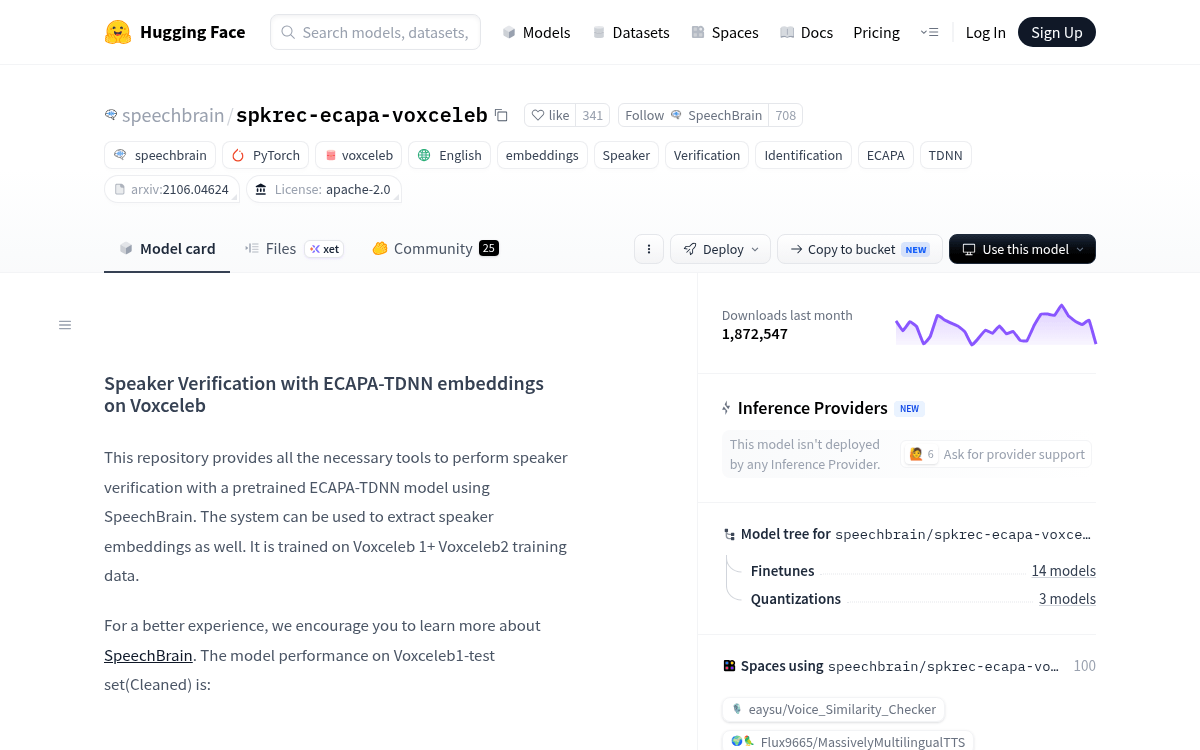
For anyone building on top of the toolkit, or currently pulling one of its widely used pretrained checkpoints like the ECAPA-TDNN speaker embedding model, this is the first minor version to break away from incremental cleanup and introduce workflows aimed at speech-plus-LLM pipelines.
What actually landed
The headline items in v1.1.0 center on making it practical to train and run systems where a large language model consumes precomputed speech representations. Feature Caching is the piece that unlocks the rest. The release also adds recipes for SpeechLLM-based ASR and translation, streaming SSL, FocalCodec, and SENSE models, alongside a large batch of internal fixes.
The highlights:
- Feature caching (
CachedDynamicItem): extract wav2vec-style embeddings once, dump them to disk, then reload them at training time instead of recomputing every epoch. - SpeechLLM recipe on LibriSpeech: the first ASR recipe in the toolkit built around a language model consuming precomputed speech embeddings.
- SpeechLLM with LLaMA on CoVoST: a speech translation recipe using a reforged LLaMA lobe contributed from Samsung AI Center Cambridge.
- Streaming BestRQ: a streaming self-supervised learning recipe that lets you pretrain speech encoders on continuous audio.
- FocalCodec: integration of the NeurIPS 2025 neural audio codec.
- SENSE models: new architectures added by community contributor MaryemBouziane.
- k2-powered CTC alignment: forced alignment on CTC models using the k2 FST library.
- soundfile-based audio I/O: a wrapper that replaces the torchaudio I/O path.
- Per-key padding in
PaddedBatch: finer control over how different fields in a batch get padded.
Why feature caching is the real story
Training a SpeechLLM typically involves running audio through a heavy self-supervised encoder like wav2vec 2.0, WavLM, or HuBERT, then feeding those embeddings into a language model. If you rerun the encoder on every training step, you burn most of your GPU budget recomputing frozen features. Feature caching sidesteps that by writing encoder outputs to disk once and streaming them back during training.
The release notes are explicit about the workflow this unlocks: it powers the first ASR SpeechLLM recipe on LibriSpeech, enabling LLM-based training with pre-computed embeddings. A companion PR adds compression and file management on top, so cached feature stores stay manageable on typical training rigs.
In practice, you can now compose something like this inside a recipe:
from speechbrain.dataio.dataset import DynamicItemDataset
# CachedDynamicItem wraps an expensive feature extractor
# and persists its outputs to disk for reuse across epochs.
dataset.add_dynamic_item(
    CachedDynamicItem(
        func=ssl_encoder,          # e.g. WavLM forward
        takes=["sig"],
        provides=["ssl_feats"],
        cache_dir="feats/wavlm",
    )
)
The payoff is that iteration on the LLM half of a SpeechLLM stops being bottlenecked by the SSL half.
LLaMA lobes, streaming SSL, and a new codec
The LLaMA integration is a reforging of the architecture into a native SpeechBrain lobe, contributed from Samsung AI Center Cambridge, along with a Conformer recipe for speech translation on CoVoST. That means the toolkit now ships end-to-end recipes for training and fine-tuning speech-to-text and speech-to-translation systems where an LLM serves as the decoder.
The streaming BestRQ recipe extends the self-supervised story. BestRQ is a random-projection quantizer used to train speech encoders without labels, and the streaming variant targets scenarios where the resulting encoder must run on live audio rather than fixed utterances.
FocalCodec, contributed by lucadellalib, is a neural codec accepted at NeurIPS 2025. Codecs like this convert continuous audio into a stream of discrete tokens, which is the interface modern multimodal LLMs consume. Its inclusion sits alongside existing support for discrete wav2vec, HuBERT, WavLM, EnCodec, DAC, and Speech Tokenizer.
Where SpeechBrain sits
SpeechBrain is one of the larger open-source speech stacks alongside NVIDIA NeMo and ESPnet. The 1.0 milestone brought the toolkit past 200 recipes for speech, audio, and language processing tasks, and more than 100 models on Hugging Face. Its speaker recognition checkpoint, spkrec-ecapa-voxceleb, has become a de-facto baseline for voice biometrics and diarization work, with millions of Hub downloads.
The philosophical bet has been consistency: one training loop (the Brain class), one config format (HyperPyYAML), and recipes that ship with data prep, training, and inference. Models are released together with the full recipes used to train them from scratch, so the entire pipeline is reproducible rather than just the final weights.
v1.1.0 provides a clean answer to what a SpeechBrain pipeline looks like when the decoder is an LLM rather than a Transformer trained from scratch. The pattern: SSL encoder to disk cache to LLM lobe, with recipes that show it end to end.
When it is worth adopting
The update earns its keep in a few concrete cases:
- You are training a SpeechLLM from scratch or fine-tuning one. The feature caching path plus the LibriSpeech and CoVoST recipes are the shortest route to a working baseline.
- You need streaming self-supervised pretraining. The streaming BestRQ recipe is one of the few open, reproducible options for training encoders that work on live audio.
- You are working with discrete audio tokens. FocalCodec joins the existing lineup of codecs, giving you more room to compare tokenizers before committing to one.
- You run inference on Windows or in restricted environments. The soundfile-based audio_io wrapper reduces reliance on the torchaudio backend, and companion changes make
fetchmore predictable when loading models from the Hub.
If you are only consuming one pretrained model, say the speaker embedding checkpoint for verification or diarization, nothing about your code needs to change. For anyone eyeing the SpeechLLM direction and waiting for a training stack that treats it as a first-class citizen rather than a research fork, this is the release worth pinning.