
Softcatalà's wav2vec2 Brings Catalan Speech Recognition to 872K Developers
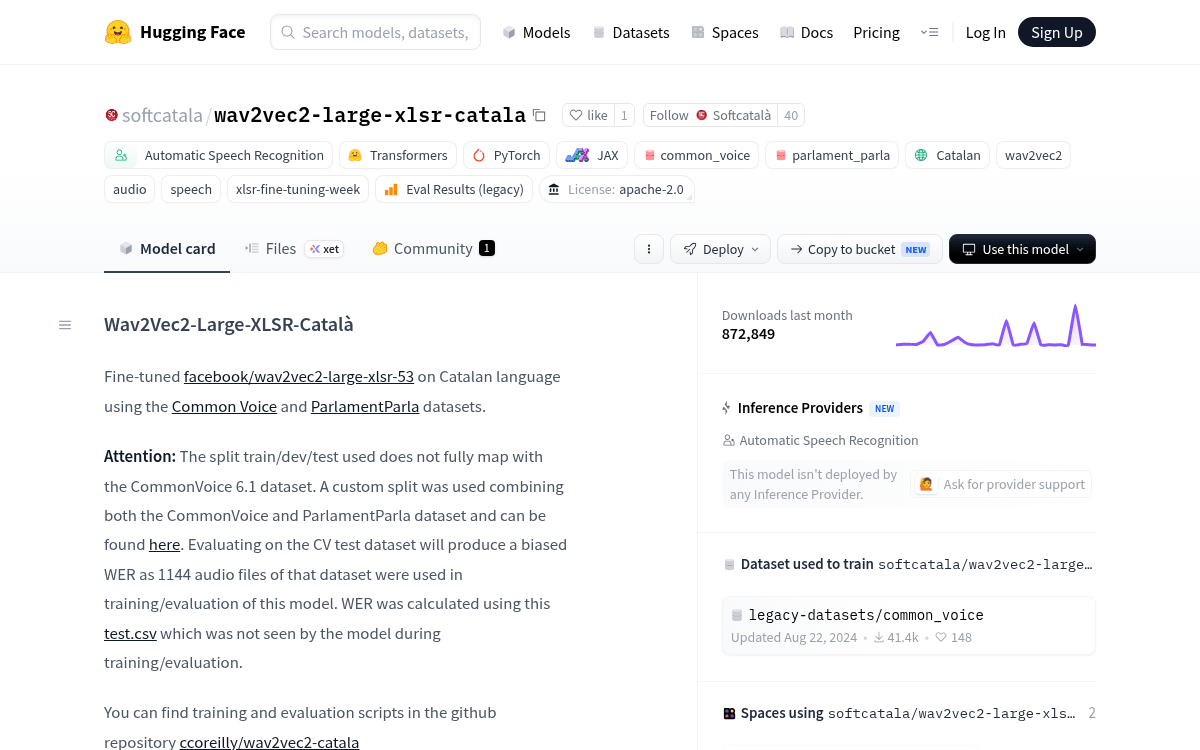
A community-built Catalan speech recognition model built on Facebook's XLSR-53 has quietly racked up 872K downloads by filling a real language gap.
 Pro
Takeaways
- Softcatalà's Catalan wav2vec2 model has crossed 872,000 downloads on Hugging Face.
- Fine-tuned from Facebook's XLSR-53 on Common Voice plus ParlamentParla.
- Reaches 6.92% WER on in-domain test, 12.99% on Google's crowdsourced Catalan corpus.
- Apache 2.0 licensed, runs via standard Transformers pipeline, requires 16 kHz audio.
- Training scripts and dialect-level evaluation available in the GitHub repo.
- Fills a real gap for Catalan speech tech underserved by commercial APIs.
A Catalan automatic speech recognition model from the volunteer group Softcatalà has become one of the most-downloaded audio models on Hugging Face, with more than 872,000 pulls and over 3,000 likes. It is a fine-tuned version of Facebook's multilingual wav2vec2-large-xlsr-53, adapted specifically to Catalan, released under Apache 2.0, because the big commercial ASR stacks still treat the language as an afterthought.
The model, softcatala/wav2vec2-large-xlsr-catala, is free to use and callable through the standard Transformers pipeline in a few lines of Python, which is a large part of why it has spread so widely.
Plugging it in
The usage pattern matches any other CTC-based wav2vec2 checkpoint. Speech input must be sampled at 16 kHz, so most real-world audio needs a resample step first.
from transformers import pipeline
pipe = pipeline(
    "automatic-speech-recognition",
    model="softcatala/wav2vec2-large-xlsr-catala",
)
print(pipe("audio_ca.wav"))
Under the hood it is a Wav2Vec2ForCTC model with a Wav2Vec2Processor tokenizer. CTC (Connectionist Temporal Classification) is a training objective that aligns variable-length audio frames to text without requiring per-character timestamps in the training data.
How it was built
The checkpoint fine-tunes facebook/wav2vec2-large-xlsr-53 on Catalan using the Common Voice and ParlamentParla datasets. XLSR-53 is Facebook's cross-lingual self-supervised model pretrained on raw audio from 53 languages, giving the fine-tune a strong phonetic prior even when Catalan-specific labeled data is limited.
ParlamentParla is a corpus of speeches from the Catalan Parliament, and it pairs well with crowd-sourced Common Voice data to cover both formal and everyday speech. The authors used a custom train/dev/test split combining both datasets, and warn that evaluating on the raw CommonVoice test set will produce a biased word error rate because 1,144 of those clips were pulled into training. Training scripts live in the ccoreilly/wav2vec2-catala repo.
The numbers
On held-out audio, the model posts the following word error rates:
| Dataset | WER |
|---|---|
| Custom CV + ParlamentParla test split | 6.92% |
| Google Crowdsourced Corpus | 12.99% |
| Audiobook La llegenda de Sant Jordi | 13.23% |
The near-doubling of error rate between the in-domain test and the Google corpus reflects a real limitation: parliamentary speech and read Common Voice sentences are cleaner than spontaneous or literary audio. A companion breakdown in the training repo slices error by age, gender, and dialect (Balear, Central, Nord-occidental, Septentrional, Valencià), which is unusually transparent for an open ASR release.
Strengths and limits
- Strong on clean, read Catalan across the main regional accents, with dialect-level WER staying in the 5 to 7 percent band.
- Slightly worse on male voices than female in the reported breakdown, and weaker at the age extremes where training data is thin.
- No built-in language model, so decoding is pure greedy CTC. Pairing it with a KenLM n-gram decoder via pyctcdecode typically shaves several points off WER.
- Hosted on no Hugging Face Inference Provider, so you run it yourself.
Who actually needs this
Catalan has around 10 million speakers and is chronically underserved by proprietary ASR APIs, which either omit it entirely or charge per-minute for mediocre accuracy. A permissively licensed model with sub-7 percent WER that runs on a single GPU changes the economics for local transcription, accessibility tooling, voice interfaces, subtitling pipelines, and dataset labeling for downstream Catalan NLP work.
The same XLSR-53 recipe, combined with a Common Voice slice and a domain corpus like a parliamentary archive, has become the default playbook for bringing any low-resource European language to usable ASR quality without a research team. Over 872,000 downloads suggests demand for that approach is nowhere near saturated.