
Sentence Transformers' paraphrase-mpnet-base-v2 Hits 1.9M Monthly Downloads With Refreshed Runtime Support
A four year old embedding model still pulls nearly two million monthly downloads, driven by SetFit few-shot workflows and fresh runtime support
 Pro
Takeaways
- paraphrase-mpnet-base-v2 keeps trending on Hugging Face with roughly 1.9M monthly downloads despite being years old
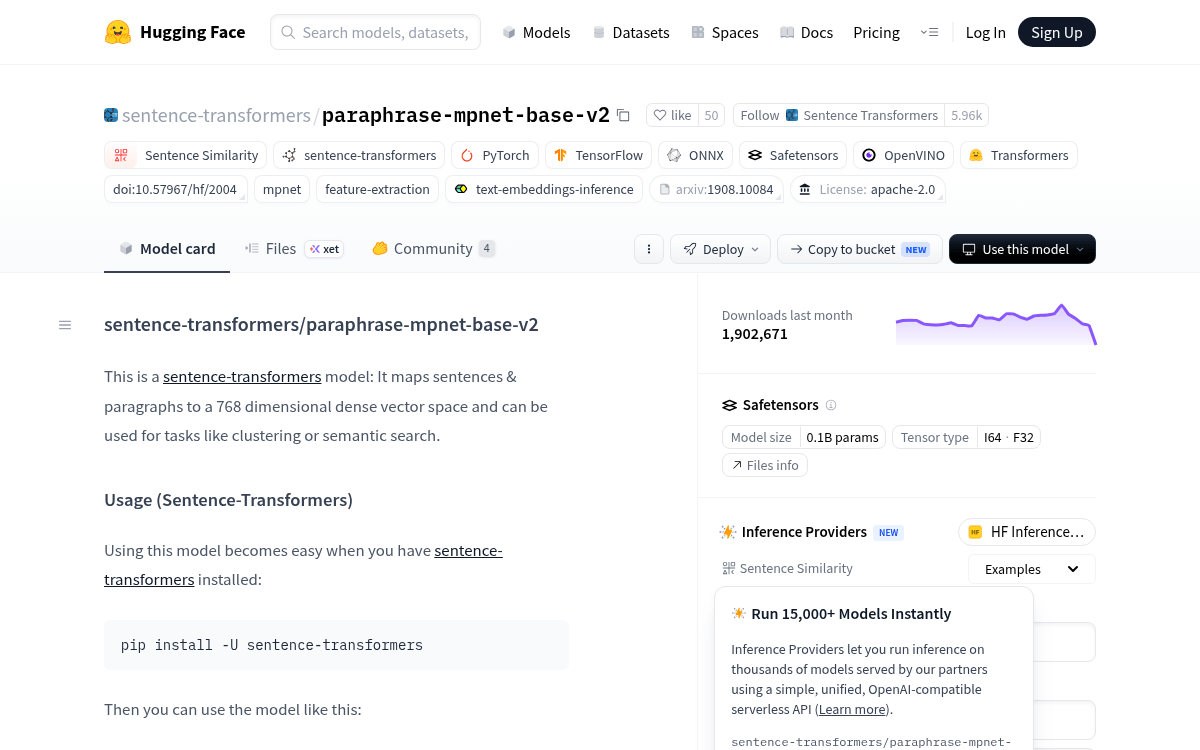
- Refreshed model card adds ONNX, OpenVINO, safetensors, and Text Embeddings Inference Docker paths
- Produces 768-dim embeddings from a 110M parameter MPNet backbone under Apache 2.0
- Default backbone for SetFit few-shot classification with as few as 8 labeled examples per class
- Built on Microsoft's MPNet, which unifies masked and permuted language modeling
- Best for English semantic search, clustering, and CPU-friendly deployments, not long documents or multilingual retrieval
Not every trending model on Hugging Face is a shiny new release. paraphrase-mpnet-base-v2 from the sentence-transformers team is a compact 110M parameter text embedding model that keeps drawing close to 1.9 million downloads per month, and it just picked up a refreshed model card with expanded runtime support. The reasons this quiet workhorse still beats flashier alternatives for a specific slice of problems are worth unpacking.
The model is a fine-tuned MPNet backbone that maps sentences and paragraphs to a 768-dimensional dense vector space, suited for clustering or semantic search. What changed recently is not the weights but the packaging: the repository now ships pytorch, tf, onnx, safetensors, and openvino variants, and the model card documents a first-class path through Hugging Face's Text Embeddings Inference server.
Two lines to embeddings
Usage stays deliberately boring. Install the library and call encode:
from sentence_transformers import SentenceTransformer
model = SentenceTransformer("sentence-transformers/paraphrase-mpnet-base-v2")
sentences = ["That is a happy person", "That is a happy dog", "Today is a sunny day"]
embeddings = model.encode(sentences)
similarities = model.similarity(embeddings, embeddings)
For production deployments, the updated card walks through spinning up Text Embeddings Inference in Docker on CPU or NVIDIA GPU, with mean pooling and float16 flags baked in. The server exposes an OpenAI-compatible /v1/embeddings endpoint, so existing client code that already talks to OpenAI's embedding API can be repointed at a local instance with no code changes. The weights are Apache 2.0 licensed, so hosting cost is whatever your own hardware bill looks like.
Why an old model refuses to die
The reason downloads stay this high comes down to a single downstream library: SetFit. SetFit trains classifiers using an efficient few-shot technique that fine-tunes a Sentence Transformer with contrastive learning, then trains a classification head on features from that fine-tuned encoder. paraphrase-mpnet-base-v2 is the default backbone in nearly every SetFit tutorial and reference implementation, including the one in Hugging Face's official SetFit repo.
The recipe is short enough to fit on a napkin:
from setfit import SetFitModel, Trainer, TrainingArguments, sample_dataset
from datasets import load_dataset
dataset = load_dataset("sst2")
train_dataset = sample_dataset(dataset["train"], label_column="label", num_samples=8)
model = SetFitModel.from_pretrained(
    "sentence-transformers/paraphrase-mpnet-base-v2",
    labels=["negative", "positive"],
)
trainer = Trainer(model=model, train_dataset=train_dataset, metric="accuracy")
trainer.train()
Eight labeled examples per class, no prompts, no LLM in the loop, and you get a text classifier that runs on CPU. That workflow explains why the encoder still dominates industrial NLP pipelines for intent detection, ticket routing, and content moderation.
The backbone underneath
The base architecture is Microsoft's MPNet, described in a 2020 NeurIPS paper. MPNet is a pre-training method that combines masked and permuted language modeling: it shuffles the prediction order to capture dependencies between predicted tokens (something BERT's masked LM misses), while also feeding position information for the full sequence so the model knows how long the sentence actually is (something XLNet's permuted LM hides). BERT ignores that masked tokens depend on each other; XLNet loses track of total sentence length. MPNet fixes both.
The base model was pre-trained on over 160GB of text and beat BERT, XLNet, and RoBERTa under the same model setting on GLUE and SQuAD. The sentence-transformers team then fine-tuned it on a paraphrase-heavy sentence pair dataset using Siamese contrastive training from the Sentence-BERT paper, producing an encoder tuned for semantic similarity rather than token-level tasks.
Where it wins and where it does not
The specs are honest about the tradeoffs. The model produces 768-dimensional vectors with a 512 token maximum sequence length and roughly 110M parameters. Good fits include:
- Few-shot classification with SetFit when you have 8 to 64 labeled examples per class
- Semantic search over short documents, FAQ retrieval, and duplicate detection
- Clustering user feedback, support tickets, or survey responses
- CPU-only or edge deployments where hosting a 7B embedding model is a non-starter
Where it falls short:
- English-only. For multilingual work, the paraphrase-multilingual-mpnet-base-v2 variant covers 50+ languages via parallel data
- Long-document retrieval, since it truncates hard at 512 tokens
- Instruction-tuned retrieval scenarios where newer models like BGE, E5, or Nomic embed benefit from task prefixes
- Modern MTEB leaderboard benchmarks, where it now sits well below purpose-built 2024 and 2025 embedding models
Where it fits in the current embedding landscape
Embeddings have consolidated into two camps. On one end, giant instruction-tuned encoders push MTEB scores higher every month, often at the cost of latency and VRAM. On the other, small workhorses like this one keep quietly powering the classification and retrieval features shipped inside real products. The 321 downstream fine-tunes and 24 public Spaces linked from the model card show the ecosystem around it has never really stopped growing.
The refreshed runtime support, particularly the OpenVINO and ONNX exports plus the TEI Docker path, signals that the maintainers expect it to stay in service for a while. If your pipeline needs a cheap, well-understood English encoder that plays nicely with SetFit and runs on a laptop, this remains the pragmatic default. If you are building a new retrieval stack in 2026 with a GPU budget and quality as the primary constraint, benchmark against newer encoders before committing.