
Segmind's SSD-1B Cuts Stable Diffusion XL in Half and Runs 60% Faster
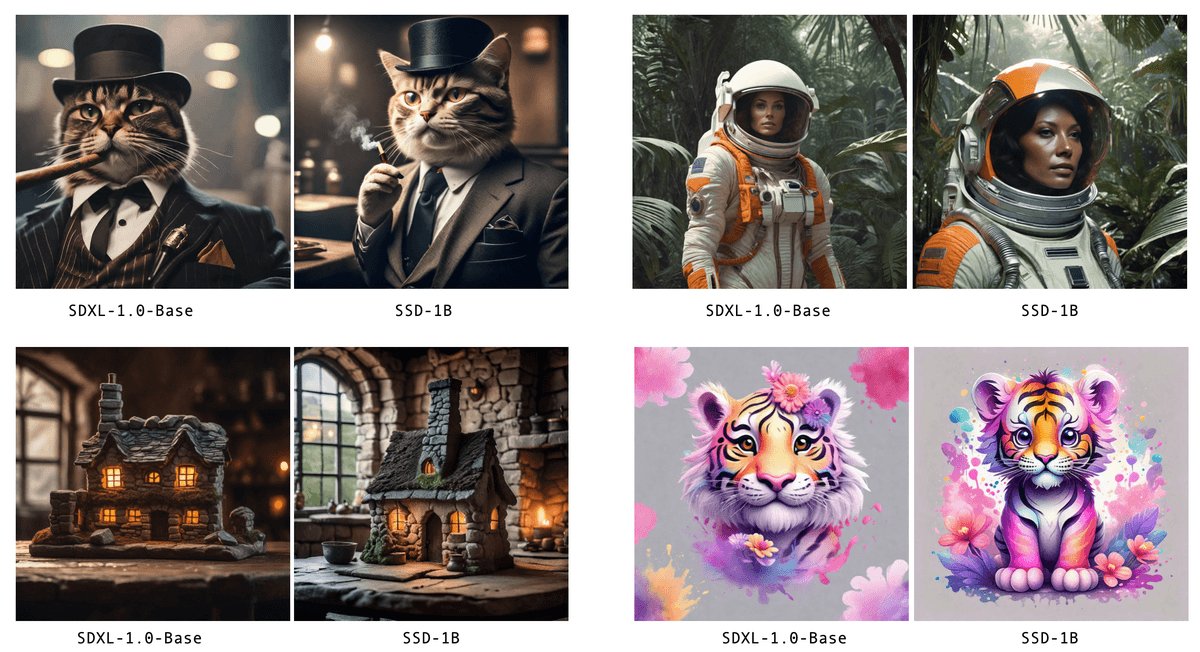
Segmind's distilled SDXL variant strips half the U-Net parameters to hit a 60% speedup on A100 while keeping generation quality close to the teacher.
 Pro
Takeaways
- Segmind released SSD-1B, a distilled SDXL variant with a 1.3B parameter U-Net.
- 50% smaller and up to 60% faster than SDXL on A100 and RTX 4090.
- Drop-in replacement using the standard
StableDiffusionXLPipelinein Diffusers. - Distilled progressively from SDXL, ZavyChromaXL, and JuggernautXL using layer-level losses.
- Apache 2.0 license, works with ComfyUI, AUTOMATIC1111, and existing SDXL LoRA training scripts.
- Details in the technical report on progressive knowledge distillation.
Segmind released SSD-1B, a distilled text-to-image model that trims Stable Diffusion XL down to roughly half its size while running about 60% faster. It is a drop-in replacement for SDXL in the Diffusers pipeline, ships under Apache 2.0, and targets anyone paying the SDXL latency tax on 1024x1024 generations.
Half the U-Net, most of the quality
SSD-1B is a 1.3B parameter model produced by pruning residual networks and transformer blocks from SDXL's U-Net, cutting parameter count by 50% and latency by 60%. The full pruning methodology is in Segmind's technical report. Rather than training against a single teacher, the distillation pipeline runs the student through several expert models in sequence: SDXL, ZavyChromaXL, and JuggernautXL, transferring knowledge from each to compensate for the removed capacity.

Benchmark numbers
Segmind benchmarked SSD-1B against SDXL on both datacenter and consumer hardware. On an A100 80GB it leads across every batch size tested. On an RTX 4090, throughput jumps from 8.69 it/s for SDXL to 14.01 it/s for SSD-1B at identical settings.

Multi-resolution behavior carries over from SDXL, so widescreen and portrait ratios like 1152x896, 1344x768, and 1536x640 work without retraining.
Dropping it into your pipeline
SSD-1B uses StableDiffusionXLPipeline, so existing SDXL code paths work with a one-line swap:
from diffusers import StableDiffusionXLPipeline
import torch
pipe = StableDiffusionXLPipeline.from_pretrained(
    "segmind/SSD-1B",
    torch_dtype=torch.float16,
    use_safetensors=True,
    variant="fp16",
).to("cuda")
image = pipe(
    prompt="An astronaut riding a green horse",
    negative_prompt="ugly, blurry, poor quality",
).images[0]
From the model card: use a negative prompt and push CFG toward 9.0 for best quality. The model is compatible with Deforum, ComfyUI, and Diffusers, and AUTOMATIC1111-compatible safetensors are available on the model page. Training details: 251,000 steps, batch size 32 with 4 gradient accumulation steps, 1e-5 learning rate, fp16 mixed precision at 1024 resolution.
Fine-tuning still works
The SDXL-compatible architecture means standard Diffusers training scripts carry over unchanged. You can point train_text_to_image_lora_sdxl.py, the full fine-tune script, or the Dreambooth LoRA script at segmind/SSD-1B and reuse existing recipes, typically with madebyollin/sdxl-vae-fp16-fix as the VAE. Teams already invested in SDXL LoRAs get to keep their tooling.
Where it falls short
The model card is candid about the tradeoffs. SSD-1B struggles with strict photorealism, particularly human faces and hands, embedded text, and complex multi-subject compositions. Training data drew from Grit and Midjourney scrapes, which tilts outputs toward a stylized aesthetic rather than documentary realism, and the model is unsuited to anything requiring factual accuracy about real people or events.
A different axis of compression
Diffusion distillation has mostly meant step reduction: methods like LCM and Turbo cut sampling from 30 steps to 4. SSD-1B compresses the U-Net itself instead. Segmind also released a smaller sibling, Segmind-Vega, at 0.74B parameters, produced by the same progressive layer-removal process. Both techniques are orthogonal, so a smaller U-Net stacked with a fewer-step scheduler compounds the gains.
For anyone running SDXL in production, operating a batch generation service, or iterating on LoRAs from a single 4090, SSD-1B is worth benchmarking against your current setup. The quality gap is real but narrow, and the throughput gain shows up directly in GPU costs.