
ResNet-50 Hits 80.4% Accuracy by Stealing Transformer Training Tricks
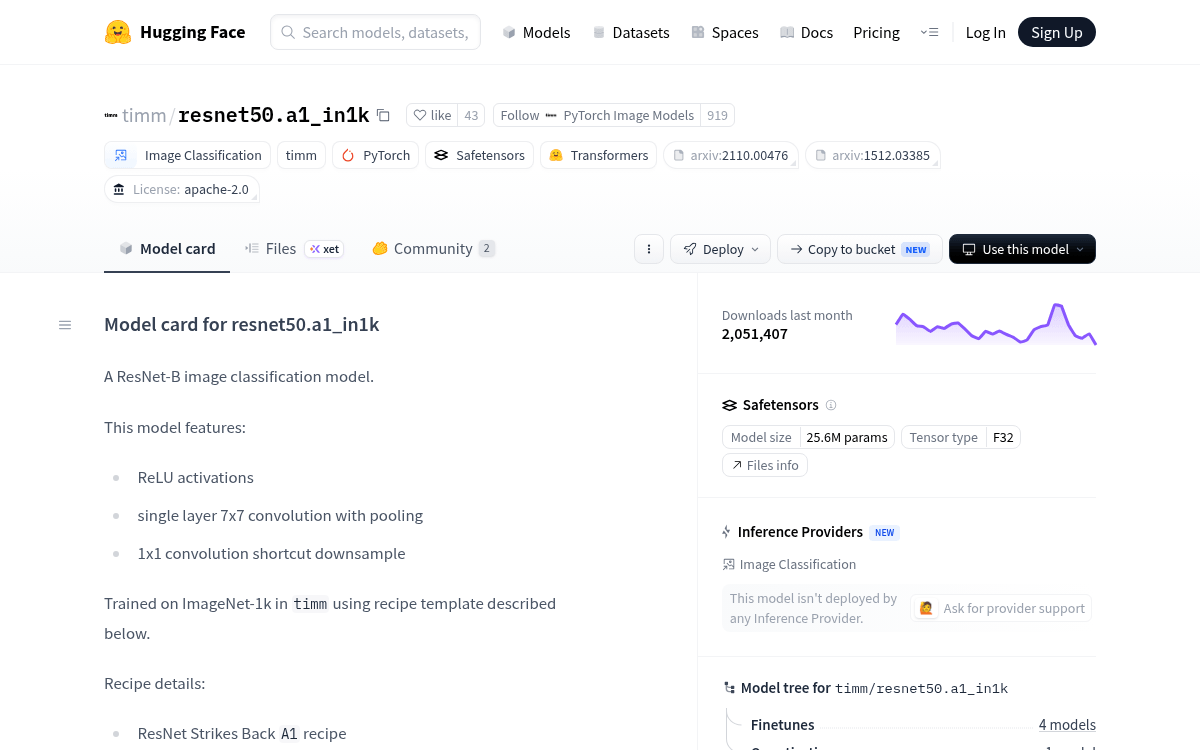
A vanilla ResNet-50 retrained with modern recipes hits 80.4% ImageNet top-1 and now sits at over 2M monthly downloads on the Hub.
 Pro
Takeaways
- The timm/resnet50.a1_in1k checkpoint has crossed 2M downloads on Hugging Face.
- It uses the A1 recipe from the ResNet Strikes Back paper by Wightman, Touvron and Jegou.
- Reaches 80.4% ImageNet top-1 at 224x224 and 81.22% at 288x288 with 25.6M params.
- Trained with LAMB optimizer, binary cross-entropy loss and cosine LR schedule with warmup.
- Usable as classifier, multi-scale feature backbone or 2048-dim embedding extractor via timm.
- Ships under Apache 2.0, works out of the box with timm and transformers pipelines.
A ResNet-50 checkpoint keeps quietly outrunning the flashier vision transformers on the Hugging Face charts. The timm/resnet50.a1_in1k model has crossed two million downloads and holds a like count in the thousands, which is remarkable for an architecture that first shipped in 2015. What draws attention is not the network itself but the training recipe attached to it.
The checkpoint comes from the ResNet Strikes Back effort by Ross Wightman, Hugo Touvron and Herve Jegou. Their argument: best practices for training neural networks have moved on significantly since 2015, and novel optimization and data augmentation techniques deserve a fresh evaluation of the vanilla ResNet-50 when trained with a procedure that integrates those advances. The A1 tag in the model name refers to the most demanding of their three recipes.
The recipe, not the wiring
The architecture is textbook ResNet-B: ReLU activations, a single 7x7 stem convolution with pooling, 1x1 shortcut downsampling, 25.6M parameters and 4.1 GMACs at 224x224. What changed is everything around it. The card lists three ingredients that carry most of the weight:
- LAMB optimizer with binary cross-entropy loss instead of the classic SGD plus softmax cross-entropy pairing.
- Cosine learning rate schedule with warmup, borrowed from the transformer training playbook.
- Train at 224x224, test at 288x288, a train/test resolution mismatch trick that squeezes extra accuracy from the same weights.
The payoff is concrete. Under this more demanding training setting, a vanilla ResNet-50 reaches 80.4% top-1 accuracy at 224x224 on ImageNet-val without extra data or distillation. Bumping evaluation to 288x288 pushes the same weights to 81.22% top-1 and 95.11% top-5, according to the comparison table on the model card. For reference, the original 2015 ResNet-50 hovered around 76% top-1 with the same parameter count.
What it is actually good for
The checkpoint works as an image classification model and a general-purpose feature backbone. The timm API exposes three usage patterns from the same weights:
import timm
# 1000-way ImageNet classifier
clf = timm.create_model('resnet50.a1_in1k', pretrained=True).eval()
# Multi-scale feature maps for detection or segmentation heads
feat = timm.create_model('resnet50.a1_in1k', pretrained=True, features_only=True).eval()
# Pooled 2048-dim embeddings for retrieval or downstream classifiers
emb = timm.create_model('resnet50.a1_in1k', pretrained=True, num_classes=0).eval()
The features_only=True path returns five feature maps at strides 2, 4, 8, 16 and 32, which is the interface most detection and segmentation frameworks expect from a backbone. The embedding path gives a 2048-dimensional vector per image for similarity search, clustering or as input to a lightweight downstream head. Weights ship under Apache 2.0 and are callable through both timm and the transformers pipeline("image-classification") helper.
Where it falls short
The A1 recipe is tuned specifically for ResNet-50 and comes with caveats. The authors note that the procedure must be adapted for deeper or larger models, which benefit from more regularization, so it is not a drop-in recipe for every architecture. The BCE-plus-LAMB combination also assumes a fairly long schedule and heavy augmentation, so a short fine-tuning run with vanilla cross-entropy will not reproduce the numbers. At the top of the leaderboard, larger backbones like seresnextaa101d fine-tuned from ImageNet-12k reach above 86% top-1, so A1 is a strong baseline rather than a frontier model.
Why the download counter keeps climbing
ResNet-50 remains the default backbone in a huge fraction of computer vision code, from Detectron-style detectors to CLIP-adjacent retrieval pipelines and medical imaging baselines. The stated goal of the paper was to share competitive training settings and pre-trained models in the timm open-source library so they would serve as better baselines for future work, and that is exactly the role this checkpoint plays. When a new paper reports numbers against a ResNet-50 baseline, using the a1_in1k weights closes roughly four points of the accuracy gap that older torchvision checkpoints leave on the table.
The broader takeaway is one the field has been slowly absorbing: a large share of the reported gains from novel architectures over the past few years came from better training recipes rather than new inductive biases. Reusing this checkpoint as a baseline is a cheap way to check whether a proposed model actually improves on the architecture or just on the recipe attached to it.