
Redis Creator antirez Brings GLM-5.2's 744B Open Model to Local Hardware
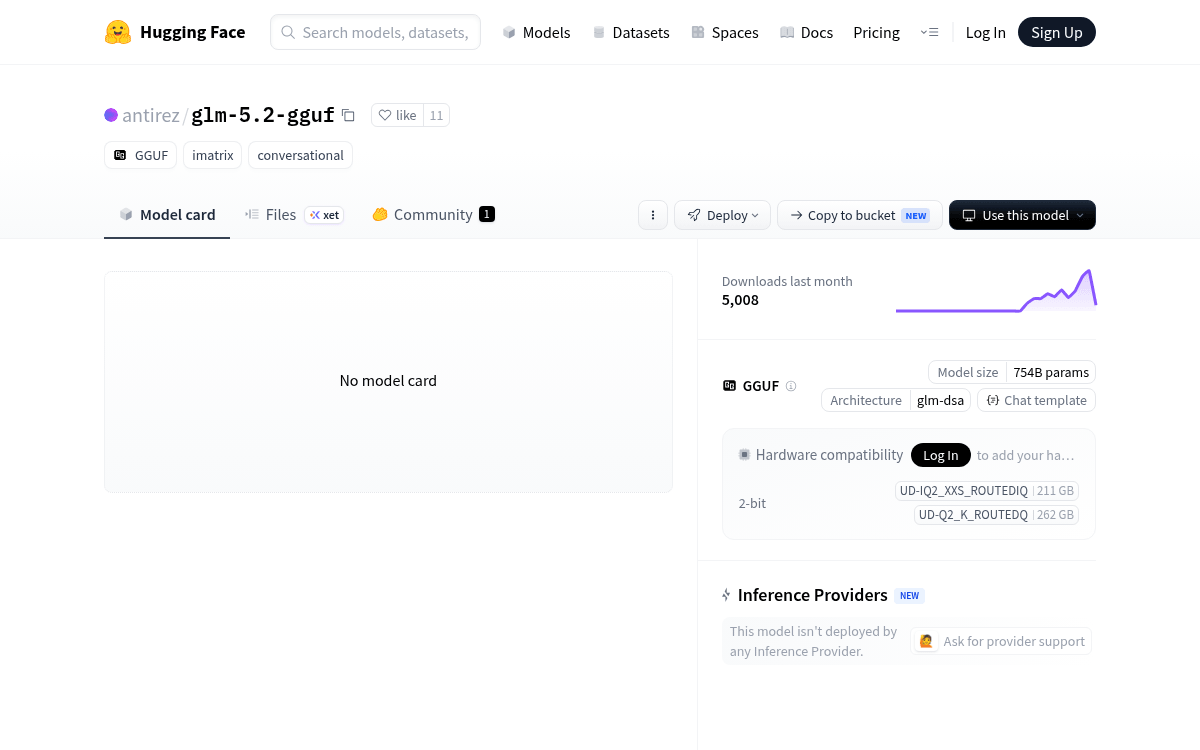
Salvatore Sanfilippo (antirez), creator of Redis, releases imatrix-calibrated GGUF quants of GLM-5.2 — the strongest open-weight coding model — making the 754B frontier model runnable locally.
Takeaways
- antirez (Redis creator) releases imatrix-calibrated 2-bit GGUF quants of GLM-5.2 on Hugging Face, compressing the 1.51 TB model to 211–262 GB.
- GLM-5.2 is the strongest open-weight coding model, scoring 81.0 on Terminal-Bench 2.1 — within 4 points of Claude Opus 4.8 (85.0).
- IndexShare architecture cuts per-token compute by 2.9x at 1M context by sharing one attention indexer across every four transformer layers.
- MIT-licensed, 754B parameter MoE model with only ~40B active parameters per token; API pricing starts at $0.95/M input tokens via DeepInfra.
- Runs via llama.cpp, Ollama, LM Studio, and Docker — community reports ~18 tok/s on 8x RTX 3090 at Q2 quantization.
- Imatrix calibration preserves quality by measuring real activation statistics before quantizing, keeping critical weight channels at higher precision.
Salvatore Sanfilippo , better known as antirez, the creator of Redis , has quietly published imatrix-calibrated GGUF quantizations of GLM-5.2 on Hugging Face. If that name doesn't ring a bell in the AI context, it should: antirez has been carving out a second act as one of the most technically rigorous voices in local inference, previously building a custom Metal inference engine for DeepSeek V4 Flash from scratch. His GLM-5.2 GGUF upload is a signal worth paying attention to.
What GLM-5.2 actually is
GLM-5.2 was released by Z.AI, the company formerly known as Zhipu AI, and has climbed to the top of design-focused AI evaluation leaderboards, outscoring proprietary models including GPT-5.5 in head-to-head comparisons. But the design arena result is almost a footnote. The real story is coding.
GLM-5.2 is Z.AI's flagship foundation model built for long-horizon tasks, delivering a solid 1M-token context. It improves substantially over GLM-5.1, becoming the strongest open-source model on standard coding benchmarks , scoring 81.0 on Terminal-Bench 2.1 and 62.1 on SWE-bench Pro. To put that in perspective: on Terminal-Bench 2.1, it lands within a few points of Claude Opus 4.8 (85.0), while staying ahead of Gemini 3.1 Pro.
Such a focal point of discussion among the community has only been so clear with an open model release once before , DeepSeek R1. This is not a comparison the author makes lightly. The CEO of Vercel said: "Genuinely impressed, almost shocked, at how good GLM-5.2 by @zai_org is at coding. This changes things."
The architecture doing the heavy lifting
GLM-5.2 features 744 billion total parameters with approximately 40 billion active parameters per token via Mixture-of-Experts, a 1-million-token context window, and architectural innovations that make it competitive with , and in several categories better than , frontier proprietary models. The MoE design (Mixture of Experts) means only a fraction of the network activates per token , which is exactly what makes aggressive quantization viable without catastrophic quality loss.
Two architectural innovations are worth understanding:
- IndexShare: Standard sparse attention mechanisms use a lightweight "indexer" component to identify which tokens matter most before performing full attention calculations. Normally, every transformer layer runs its own indexer , expensive at a million tokens. IndexShare shares one indexer across every four transformer layers. The top-k token indices selected by the first layer get reused by the next three layers, meaning 75% of layers skip the expensive indexing step entirely. The result: a 2.9x reduction in per-token FLOPs at 1M context length.