
Qwen3.5-27B Uncensored Variant Claims Zero Refusals on 465 Benchmarks
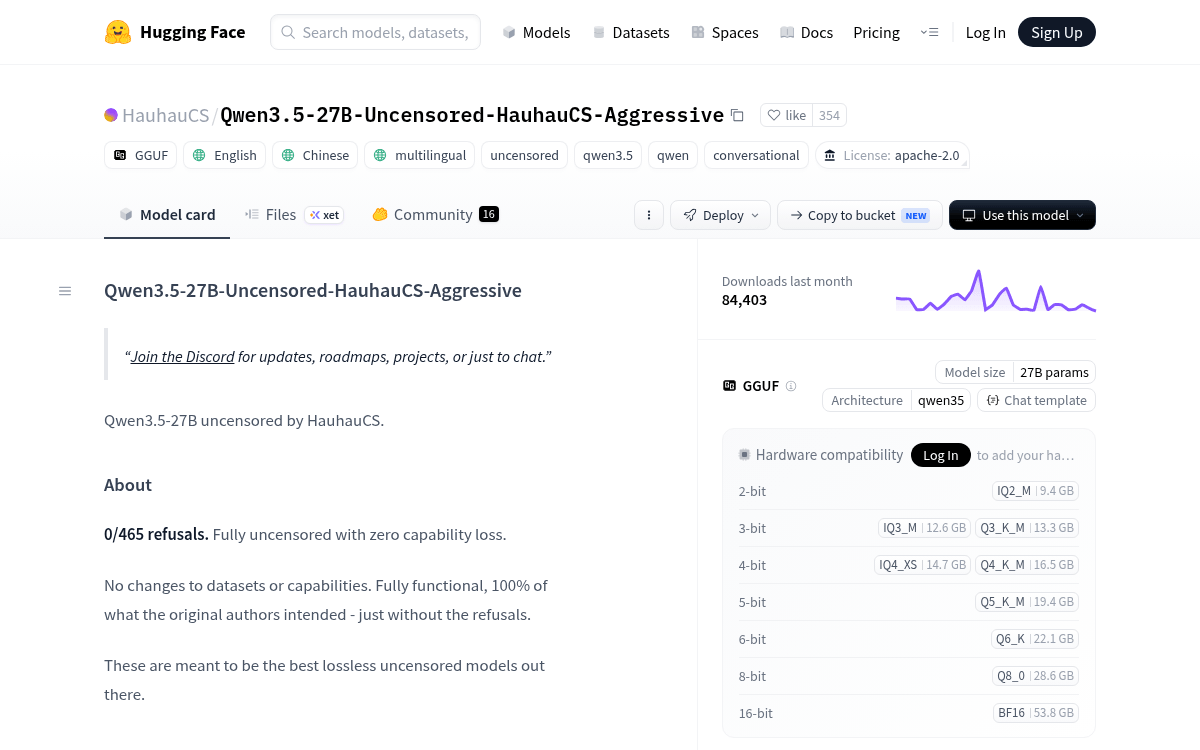
An uncensored GGUF release of Qwen3.5-27B ships with zero refusals on 465 test prompts, native vision support, and a 262K context window.
 Pro
Takeaways
- Uncensored GGUF of Qwen3.5-27B hitting 0/465 refusals on the maintainer's benchmark.
- Hybrid Gated DeltaNet plus softmax attention (3:1), 27B params, 64 layers.
- 262K native context, extendable to 1M with YaRN, 201 languages.
- Native multimodal support via separate
mmprojvision encoder file. - Full quant lineup from BF16 (51GB) to IQ2_M (8.8GB), IQ variants use importance matrix calibration.
- Lossless claim contested by an independent 85-hour benchmark comparison.
A community fine-tune called Qwen3.5-27B-Uncensored-HauhauCS-Aggressive has landed on Hugging Face, targeting one specific frustration with modern instruct models: refusal behavior. The maintainer claims 0/465 refusals on their benchmark, zero capability loss, and no changes to datasets, meaning 100% of what the original authors intended minus the refusals. It ships as GGUF, so it drops into llama.cpp, LM Studio, Ollama, Jan, and koboldcpp without conversion.
What is actually inside
The release modifies the base Qwen3.5-27B, which itself is a fairly aggressive architectural departure from the original Qwen3 line. It uses a hybrid design combining Gated DeltaNet linear attention with full softmax attention in a 3:1 ratio across 64 layers and 27B parameters, understands 201 languages, and can handle thinking-mode operations when given sufficient context. Gated DeltaNet is a linear-attention variant that scales sub-quadratically with sequence length, so mixing three linear blocks per one softmax block is what lets this model advertise a giant context window cheaply.
Context length lands at 262K tokens natively, extendable to 1M with YaRN, a positional-encoding trick that stretches a model's trained context at inference without retraining. The base is also multimodal: a separate mmproj vision encoder file (885 MB) can be loaded alongside the main GGUF to process images and video in llama.cpp compatible runtimes.
Quant lineup and hardware fit
The release covers the full quant spectrum, so you can pick based on the VRAM you actually have:
| Quant | Size | Rough fit |
|---|---|---|
| BF16 | 51 GB | A100 80GB / dual 3090 |
| Q8_0 | 27 GB | Single 32GB card |
| Q5_K_M | 19 GB | 24GB card (3090/4090) |
| Q4_K_M | 16 GB | 16GB card, tight |
| IQ4_XS | 14 GB | 16GB comfortable |
| IQ2_M | 8.8 GB | 12GB card or CPU |
The low-bit variants avoid naive round-to-nearest behavior. IQ quants (IQ2_M, IQ3_M, IQ4_XS) were generated with importance matrix calibration for better quality at low bit rates. That calibration step measures which weights matter most for a representative dataset and preserves their precision selectively.
Getting it running
The fastest path is llama.cpp with the model pulled directly from the Hub:
llama serve -hf HauhauCS/Qwen3.5-27B-Uncensored-HauhauCS-Aggressive:Q4_K_M
# or for Ollama:
ollama run hf.co/HauhauCS/Qwen3.5-27B-Uncensored-HauhauCS-Aggressive:Q4_K_M
The model card recommends the official Qwen sampling settings: temperature=0.6, top_p=0.95, top_k=20 for thinking mode, and temperature=0.7, top_p=0.8 for non-thinking. One catch worth noting: this architecture is new enough that runtime support only recently landed, so bump your llama.cpp build before troubleshooting weird tokenizer errors.
How aggressive means aggressive
The maintainer offers a family of variants under different uncensoring intensities. The Aggressive build applies stronger refusal removal, and a Balanced variant may follow if this one runs too loose for your use case. One subtle behavior to watch: the model is fully unlocked and will not refuse prompts, but it may occasionally append a short disclaimer at the end of a response, for example noting information is not legal advice. That behavior is baked into the base model's training rather than being a refusal, since the actual content is still generated in full.
Smaller siblings are available if 27B is overkill. The 9B and 4B variants at HauhauCS use the same recipe.
The lossless claim, contested
Abliteration, the technique typically used to remove refusal directions from a model's activations, is known to occasionally degrade reasoning or introduce looping. An independent evaluation posted as DreamFast's benchmark repo pushes back on the marketing. The author states the lossless claims are debunked and that these models rank lower than other uncensoring methods in benchmarks, with the exception of the 2B and 4B versions where they were on par. The reviewer compared five different uncensoring methods applied to one base model and ran 85 hours of tests to see which method removes safety filters without breaking the model's ability to think. Worth reading if you plan to deploy this in anything reasoning-heavy.
When it earns its slot on disk
Practical fits for a model like this are narrower than the headline suggests:
- Red-teaming and adversarial testing where refusals block the actual research.
- Long-context document analysis on sensitive material (medical, legal, security) where cautious hedging blocks answers you need.
- Creative writing agents where mid-generation refusals derail a workflow.
- Local, air-gapped assistants where you own the compliance layer and want it above the model rather than inside it.
- Multimodal offline tools that need image or video understanding alongside long text context.
For coding, math, and general agentic tool use, the uncensoring is probably beside the point, and you may be better off with the stock Qwen3.5-27B or a Balanced variant when it ships. The Aggressive tag is a targeting choice rather than a quality upgrade, and choosing it on autopilot is how you end up with a benchmark surprise later.