
Qwen Shrinks Qwen3-8B 3x to Fit on a Single Consumer GPU
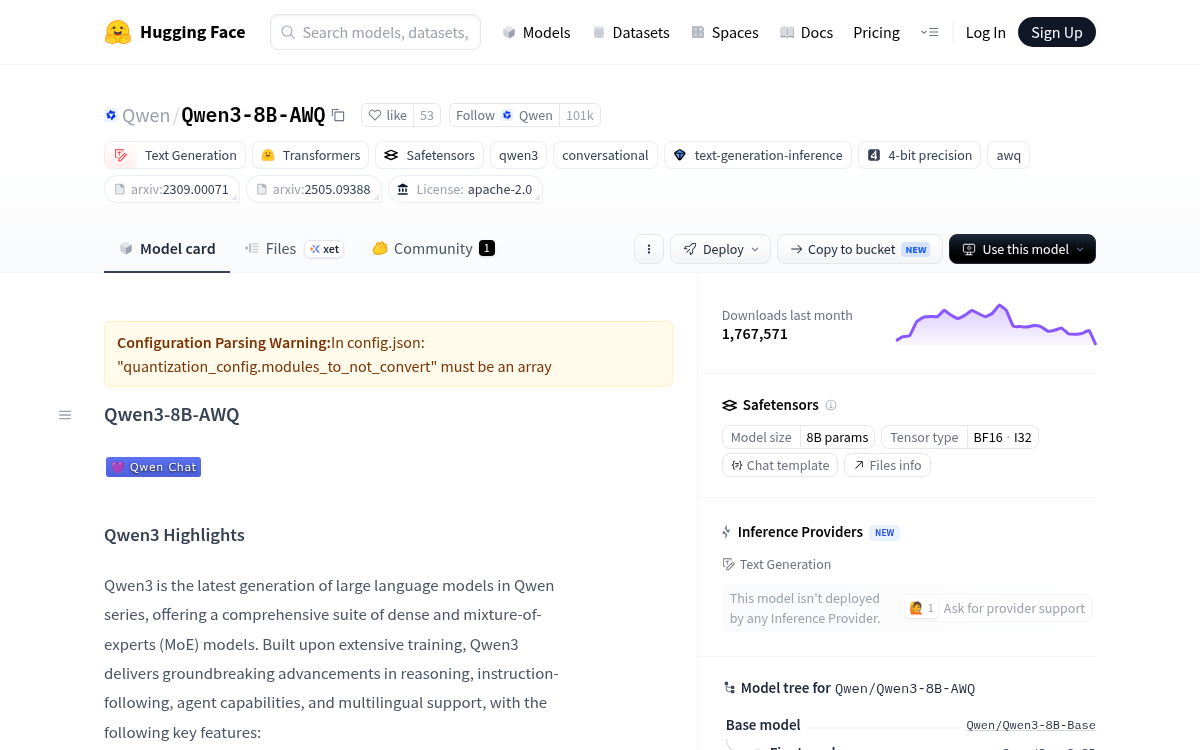
Qwen ships an official 4-bit AWQ build of Qwen3-8B, shrinking VRAM to about 6GB while keeping thinking mode, tool use, and 131K context intact.
 Pro
Takeaways
- Official Apache-2.0 4-bit AWQ build of Qwen3-8B from the Qwen team.
- Shrinks VRAM from about 16GB to roughly 6GB, fits one 24GB GPU.
- Keeps switchable thinking mode, tool calling, and 100+ languages.
- Thinking mode benchmarks drop only 1 to 5 points versus bf16.
- Native 32K context, extends to 131K via YaRN rope scaling.
- Deploys directly through vLLM, SGLang, and Hugging Face transformers.
The Qwen team has published an official 4-bit AWQ build of their 8B reasoning model, and it ships with the full Qwen3 feature set: switchable thinking mode, 100+ language support, native tool calling, and long context via YaRN. The goal of the release is straightforward. Take the same weights everyone already likes, compress them roughly 3x, and let people serve the model on a single 24GB GPU without giving up much accuracy.
The checkpoint is available on Hugging Face under Apache 2.0 as Qwen/Qwen3-8B-AWQ, with no gating and no usage fees beyond your own compute. It slots in as a drop-in replacement for the bf16 weights anywhere transformers, vLLM, or SGLang is already wired up.
What is actually in the box
The underlying Qwen3-8B is a causal LM with 8.2B parameters (6.95B non-embedding), 36 layers, grouped-query attention with 32 Q heads and 8 KV heads, and a 32,768 native context that stretches to 131,072 tokens with YaRN. This build adds AWQ 4-bit quantization on top. AWQ, short for Activation-aware Weight Quantization, picks which weight channels matter most based on activation magnitudes and protects them during the round to 4-bit, which is why it tends to lose less accuracy than naive round-to-nearest.
The headline feature carried over from full-precision Qwen3 is the dual-mode design. A single model supports seamless switching between a thinking mode for complex reasoning and a non-thinking mode for general dialogue. You flip it with an enable_thinking flag in the chat template, or inline with /think and /no_think tags in a user message.
How much accuracy you actually lose
Qwen published a side-by-side benchmark of the bf16 and AWQ-int4 versions in both modes. The drop is real but modest in thinking mode, and slightly larger for non-thinking:
| Mode | Precision | LiveBench | GPQA | MMLU-Redux | AIME24 |
|---|---|---|---|---|---|
| Thinking | bf16 | 67.1 | 62.0 | 87.5 | 76.0 |
| Thinking | AWQ int4 | 65.5 | 59.0 | 86.4 | 71.3 |
| Non-Thinking | bf16 | 53.5 | 39.3 | 79.5 | - |
| Non-Thinking | AWQ int4 | 48.9 | 35.9 | 79.1 | - |
That AIME24 gap of nearly 5 points is the one to watch if you care about competition math. Everything else lands within a couple of points, and MMLU-Redux barely moves.
Context matters here too. An empirical study of Qwen3 quantization found that the family shows more pronounced degradation than LLaMA3 under low-bit quantization, and the authors hypothesize that a more thorough pre-training process leaves fewer redundant representations for quantization to lean on. The fact that the official AWQ build holds up this well is partly a compression-recipe achievement, so do not assume the same result for every future Qwen release.
Why the memory math changes what you can run
Community VRAM measurements for the 8.2B family land at roughly 16GB for FP16, 8GB for FP8, and about 6GB for AWQ or GPTQ int4. That reshuffles the deployment options:
- Fits comfortably on an L4, A10, or single RTX 4090, with headroom left for KV cache.
- Lighter weights free up memory for KV cache, meaning more concurrent requests or longer context per request.
- Runs on consumer 12GB and 16GB cards with room for a real batch, not just a demo.
- GPTQ is currently marked as to-be-updated for Qwen3 with known issues, so AWQ is the recommended int4 path for this family.
Serving it without drama
The quickstart is boring in a good way. For vLLM:
vllm serve Qwen/Qwen3-8B-AWQ --enable-reasoning --reasoning-parser deepseek_r1For SGLang:
python -m sglang.launch_server --model-path Qwen/Qwen3-8B-AWQ --reasoning-parser qwen3Both expose an OpenAI-compatible endpoint and honor the thinking-mode toggle through the chat template. If you go past 32K tokens, enable YaRN by adding a rope_scaling block to config.json or by passing it as a CLI flag.
One footgun the model card calls out: for quantized Qwen3, the team strongly recommends setting presence_penalty to 1.5 to avoid endless repetitions, and greedy decoding is explicitly discouraged in thinking mode. If you see loops, that is almost always the fix.
When to actually use it
This build aims at a specific sweet spot: you want Qwen3-level reasoning and tool use, you are serving on a single GPU or a small cluster, and you care about tokens-per-second and concurrency more than the last two points on GPQA. Good fits include agentic pipelines with MCP tools, RAG systems that need long context, on-prem chatbots, and any workload where the bf16 version was already close to what you needed but too expensive to serve at scale.
If your workload is heavy competition math, code-golf style problems, or research evals where every point matters, the bf16 checkpoint is still the safer default, and the 5-point AIME24 gap is the reason. For almost everything else, the 3x memory saving is hard to argue with.