
QuantTrio Shrinks Alibaba's Qwen3.5-9B to 12 GiB With 1M Downloads
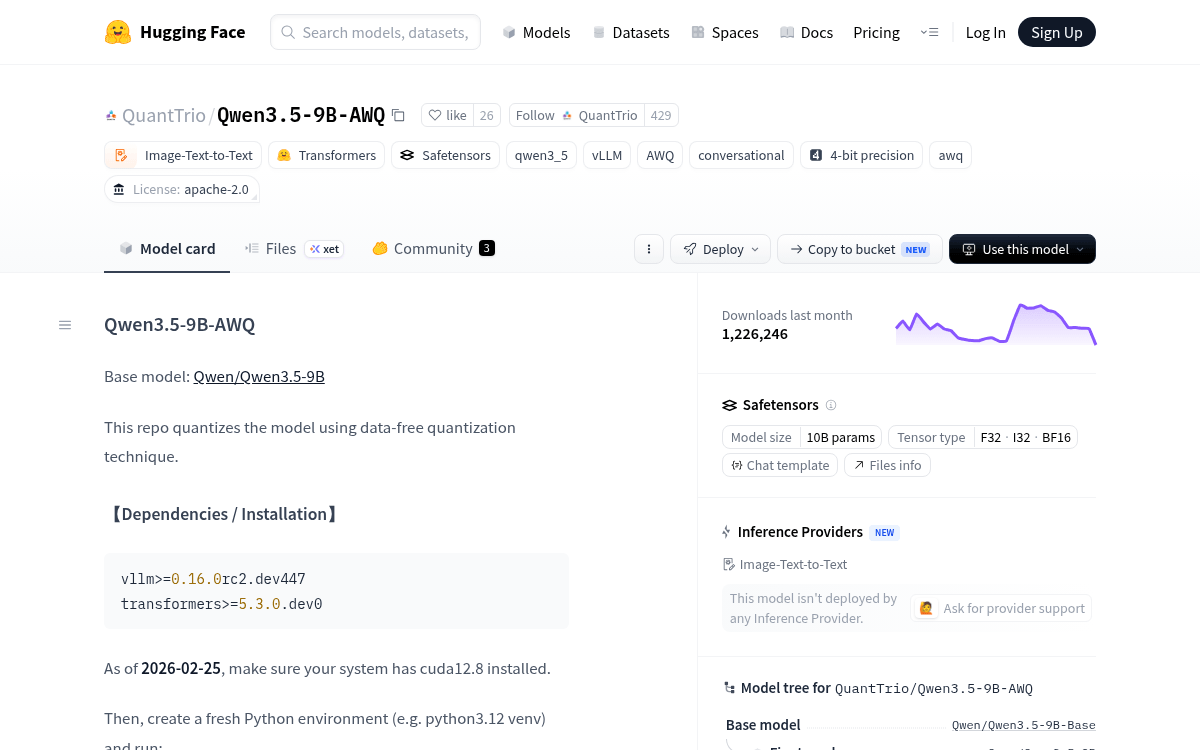
Community group QuantTrio released a 4-bit AWQ build of Qwen3.5-9B that fits the multimodal model into roughly 12 GiB for vLLM and SGLang.
 Pro
Takeaways
- QuantTrio published a community 4-bit AWQ quantization of Qwen3.5-9B on Hugging Face.
- Uses data-free quantization, no calibration dataset needed, Apache 2.0 license.
- Roughly 12 GiB on disk with native 262K context extensible to 1M via YaRN.
- Requires nightly vLLM 0.16 and transformers 5.3, CUDA 12.8, plus a small RoPE patch.
- Multimodal image-text-to-text pipeline, tool calls via qwen3_coder parser, MTP speculative decoding.
- Already past 1.2M downloads, one of many QuantTrio Qwen3.5 AWQ builds.
A community group of quantization enthusiasts called QuantTrio has pushed a 4-bit AWQ build of Alibaba's Qwen3.5-9B onto Hugging Face, and it is already pulling more than a million downloads. The repo shrinks the multimodal 9B model down to roughly 12 GiB on disk and wires it up for the current nightly builds of vLLM and SGLang, which is what most people running Qwen3.5 in production actually care about.
QuantTrio describes itself on Hugging Face as a trio of AI enthusiasts who build LLM quantization models (GPTQ, WNA16) in their spare time and bridge ModelScope and Hugging Face by porting quantized weights across. Their Qwen3.5-9B-AWQ card lists Qwen/Qwen3.5-9B as the base and says the weights were produced with a data-free quantization technique. Data-free means no calibration dataset was pushed through the model to pick scale factors, which is unusual for AWQ and skips the usual step of curating a small representative dataset before quantizing.
What is actually in the repo
The release is a straightforward drop-in quantization, not a new fine-tune. The weights are Apache 2.0, tagged for the image-text-to-text pipeline, and shipped as 4-bit AWQ safetensors so the same checkpoint handles both text and vision inputs. A few things worth pulling out:
- Roughly 12 GiB on disk, down from the ~20 GiB bf16 version of the 10B-parameter base.
- Compatible with Transformers, vLLM, SGLang, and KTransformers via the standard Qwen3.5 recipes.
- Native 262,144-token context, extensible to about 1M tokens with YaRN RoPE scaling.
- Supports the Qwen3 tool-call parser and the
qwen3_next_mtpspeculative decoding config for multi-token prediction.
The install path is picky. The card asks for vllm at least 0.16.0rc2.dev447 and transformers 5.3.0.dev0, with CUDA 12.8 on the host. There is also a note about patching a single line in modeling_rope_utils.py to avoid a validation error around partial_rotary_factor, so this is a bleeding-edge nightly setup rather than something you drop into an existing stable environment.
Serving it
Once the dependencies line up, standing the model up is a one-liner through vLLM's OpenAI-compatible server:
vllm serve QuantTrio/Qwen3.5-9B-AWQ \
    --max-model-len 262144 \
    --tensor-parallel-size 1 \
    --enable-auto-tool-choice \
    --tool-call-parser qwen3_coder \
    --reasoning-parser qwen3 \
    --speculative-config '{"method":"qwen3_next_mtp","num_speculative_tokens":2}'
SGLang works the same way through sglang.launch_server, and there is a docker model run hf.co/QuantTrio/Qwen3.5-9B-AWQ path for Docker Model Runner users who would rather not touch Python at all.
Why this quant is interesting
The base Qwen3.5-9B is not a plain transformer. Its layout interleaves Gated DeltaNet linear-attention blocks with periodic Gated Attention blocks, plus a multi-token prediction head trained end-to-end. That hybrid design is what makes the checkpoint competitive with much larger dense baselines on the Qwen team's numbers, but it also makes it harder to quantize cleanly, because AWQ's per-channel scaling was designed around vanilla attention. A community port shipping working 4-bit weights for that architecture is a useful data point on how well AWQ generalizes to gated linear-attention hybrids.
VRAM budgeting benefits too. A 12 GiB checkpoint plus a KV cache that scales with the 256K context window puts serious 9B-class multimodal inference within reach of a single 24 GB consumer card for short contexts, or a single 40 GB A100 for long ones, without falling back to CPU offload.
Where it holds up, where it slips
The underlying Qwen3.5-9B is a strong small model on the Qwen team's own reporting. On text, it lands at 82.5 on MMLU-Pro, 81.7 on GPQA Diamond, and 91.5 on IFEval; on vision, it hits 78.4 on MMMU and 89.2 on OCRBench. Those numbers come from Qwen's release, not from QuantTrio, and they were measured on the unquantized weights. Independent testing of Qwen3.5 quants suggests outcomes depend heavily on algorithm, data type, and which modules are left in 16-bit. Qwen's official FP8 and GPTQ INT4 builds keep the shared expert and attention layers in 16-bit, so a uniformly 4-bit AWQ will lag FP8 accuracy on the hardest reasoning or coding tasks.
Practical downsides to know before you deploy it:
- The dependency stack is nightly-only right now, and the transformers patch is required to get tool calls firing.
- Data-free AWQ trades some accuracy on tail tokens for zero calibration overhead, so expect small regressions on niche domains versus calibrated AWQ or FP8.
- Thinking mode is on by default, which inflates output length. For latency-sensitive endpoints, set
enable_thinking: falsein the chat template kwargs.
If you were already planning to serve Qwen3.5-9B on vLLM or SGLang and did not want to run your own AWQ pass, this repo saves you a day of work and a chunk of VRAM. Just hold off on upgrading production containers, because the required vLLM and transformers versions are both pre-release.