
Qdrant's BM25 Hits 1M Monthly Downloads by Reviving a 30-Year-Old Search Algorithm
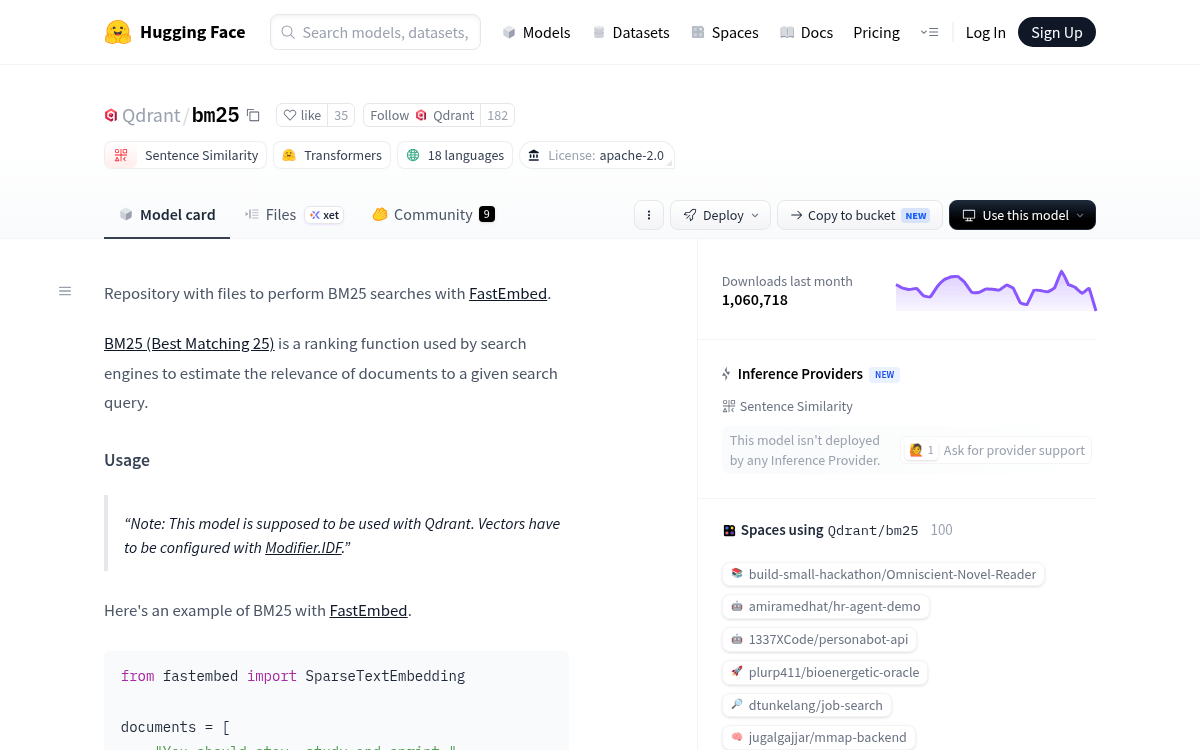
Qdrant's BM25 sparse embedding model has quietly crossed a million monthly downloads on Hugging Face, becoming the default keyword leg in modern hybrid RAG pipelines.
 Pro
Takeaways
- Qdrant's BM25 sparse embedding model crossed 1M+ monthly downloads on Hugging Face.
- Ships as a FastEmbed-compatible sparse encoder, Apache 2.0, covering 18 languages.
- Requires
Modifier.IDFon the Qdrant collection or the sparse leg silently underperforms. - Typical use: hybrid RAG combining dense embeddings, BM25 sparse vectors, and RRF fusion.
- Alternatives from Qdrant: miniCOIL, SPLADE++, and BM42 for semantic-aware sparse retrieval.
- Fixes dense retrieval's blind spots on exact identifiers, code, SKUs, and rare terminology.
A 30-year-old ranking algorithm is one of the most downloaded models on Hugging Face this month. Qdrant's BM25 model is pulling in over a million downloads a month, an odd number for something with no neural network inside it. Dense vector search alone falls short for production retrieval, and this package is the easiest way to bolt classical keyword matching onto a vector database.
Old algorithm, new packaging
BM25 (Best Matching 25) is a bag-of-words ranking function search engines have used for decades to score how relevant a document is to a query. What Qdrant published is not a new algorithm but a FastEmbed-compatible artifact that produces sparse vectors through the same interface as a neural embedding model. The same client code that generates dense embeddings can also generate BM25 sparse vectors, and both can live in the same Qdrant collection.
Getting embeddings out of it is a three-line affair:
from fastembed import SparseTextEmbedding
model = SparseTextEmbedding(model_name="Qdrant/bm25")
embeddings = list(model.embed(["You should stay, study and sprint."]))
The output is a SparseEmbedding with token indices and their term-frequency values. It covers 18 languages including English, Arabic, Chinese, French, German, Russian, Spanish, Tamil, and Turkish, and it ships under Apache 2.0.
The IDF gotcha nobody talks about
One configuration detail separates a working setup from a broken one. BM25 needs inverse document frequency to weight rare terms higher than common ones, and IDF depends on the whole corpus, which changes on every ingest. FastEmbed's BM25 produces the term-frequency component client-side, so Qdrant handles IDF server-side, but only if you flag the collection correctly:
from qdrant_client import models
client.create_collection(
    collection_name="docs",
    sparse_vectors_config={
        "bm25": models.SparseVectorParams(
            modifier=models.Modifier.IDF
        )
    },
)
Skip Modifier.IDF and nothing errors out. The sparse leg just goes mediocre in a way you'll blame on BM25 rather than on your config. This single line is why the model page insists on Qdrant rather than a generic vector store.
Why sparse is back in fashion
Hybrid retrieval is what drove BM25's revival. Sparse keyword-based retrieval is simple, fast, and cheap, but it relies on lexical matching and struggles to capture semantic meaning. Dense embeddings have the opposite problem: they capture meaning but miss exact identifiers, product codes, error messages, and rare proper nouns. Combine the two and you cover both failure modes.
Practical situations where the BM25 leg earns its keep:
- Codebases and technical docs where API names, flags, and error strings must match exactly
- Legal, medical, or scientific text with domain-specific terminology dense models never saw
- Product catalogs where SKUs and model numbers matter more than semantic similarity
- Multilingual corpora where dense models drop off in coverage
- RAG pipelines that need reproducible, explainable retrieval decisions
A common hybrid Qdrant stack now pairs a dense embedder like Qwen3 or BGE with BM25 sparse vectors, uses reciprocal rank fusion to merge the two result lists, and finishes with a CPU FastEmbed cross-encoder reranker.
What it will not do
BM25 is a lexical scorer with no semantic sense. It cannot bridge vocabulary mismatches: if a user searches for hard grated cheese and the document says parmesan, BM25 will not connect them. Solving that is exactly what newer sparse neural retrievers aim at. Qdrant itself has released two alternatives worth knowing about:
- SPLADE++: a BERT-based sparse model that expands documents and queries with related terms, addressing the vocabulary mismatch problem but essentially English-only
- miniCOIL: an open-sourced sparse neural retrieval model that behaves as if a BM25 retriever understood the contextual meaning of keywords, with scoring based on the BM25 formula scaled by the semantic similarity between matched keywords in a query and a document
- BM42: an earlier attention-based variant, now largely superseded by miniCOIL for new projects
Qdrant's own recommendation is miniCOIL for new work, though plain BM25 remains the default for teams that want zero model dependencies, deterministic behavior, and no GPU on the retrieval path. The download numbers suggest most teams are choosing exactly that. Classical information retrieval has not gone anywhere; it just moved into the sparse vector slot of your database.