
Qdrant's bge-small-en-v1.5 Shrinks to 32MB and Hits 950K Downloads
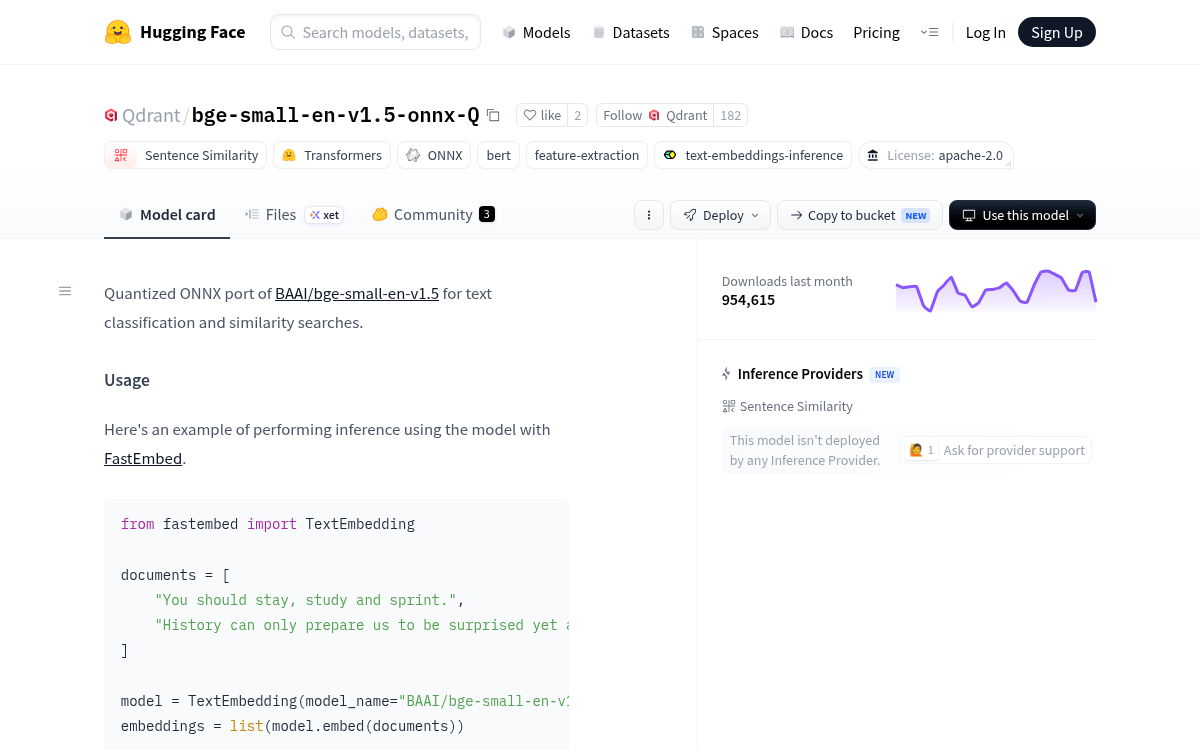
Qdrant's INT8 quantized ONNX build of BAAI's popular embedding model shrinks it to 32 MB while keeping semantic search accuracy intact.
 Pro
Takeaways
- Qdrant published an INT8 quantized ONNX build of BAAI/bge-small-en-v1.5 under Apache 2.0.
- Model size drops from about 127 MB in FP32 to roughly 32 MB after quantization.
- Produces 384-dimensional embeddings with a 512 token input limit, optimized for CPU inference.
- Distributed through FastEmbed, which auto-downloads the ONNX weights via ONNX Runtime.
- Small enough to run inside AWS Lambda or on Mac Metal without a GPU.
- Has crossed 950,000 downloads on Hugging Face, powering many production RAG stacks.
If you have shipped a retrieval pipeline in the last year, chances are you have touched bge-small-en-v1.5. It is the default text embedding model behind Qdrant's FastEmbed library and a fixture near the top of the MTEB leaderboard for its size class. The Qdrant/bge-small-en-v1.5-onnx-Q repo takes that model, converts it to ONNX, and quantizes the weights down to 8-bit integers so it fits comfortably inside a serverless function. It has quietly crossed 950,000 downloads on Hugging Face, making it one of the more heavily used embedding artifacts in production today.
A tiny model, made tinier
The base model is BAAI/bge-small-en-v1.5, a lightweight English encoder from the Beijing Academy of Artificial Intelligence. It packs 33M parameters into 12 transformer layers, with 384 hidden dimensions and a 512 token context window. On the MTEB benchmark it holds its own, especially in retrieval and classification, offering a strong balance of accuracy and speed for English-only workloads.
Qdrant's contribution is packaging. The repo ships a quantized ONNX build optimized for text classification and similarity search, running through ONNX Runtime for portable, high-performance inference across platforms. The size difference matters: the original weighs about 127 MB in FP32 ONNX, while the INT8 and UINT8 variants drop to roughly 32 MB.
Why quantize an already small model
Small embedding models are usually CPU-bound in production. You are not GPU-limited, you are memory-bandwidth-limited and cold-start-limited. Shrinking the weights by 4x and swapping matrix multiplies for INT8 kernels changes the economics of serving embeddings from a container or a Lambda function.
FastEmbed converts models to ONNX because the runtime is tuned for inference on CPUs, and quantization compresses weights from 32-bit floats down to 8-bit integers, cutting memory use and speeding up inference while keeping accuracy close to the baseline. The Qdrant team is explicit about the target hardware: they quantize for CPU and Mac Metal, the default model is small enough to run inside AWS Lambda, and Hugging Face's Optimum library did the heavy lifting on the conversion itself.
Three lines to a vector
The model card points you to FastEmbed, which downloads the quantized weights automatically when you reference the base model name:
from fastembed import TextEmbedding
documents = [
    "You should stay, study and sprint.",
    "History can only prepare us to be surprised yet again.",
]
model = TextEmbedding(model_name="BAAI/bge-small-en-v1.5")
embeddings = list(model.embed(documents))
Those three lines pull the quantized model, load it through ONNX Runtime, and run batched embedding over your documents. Each output is a 384-dimensional float32 vector, ready to drop into a vector database.
Where it shines
- Semantic search and RAG retrieval over English corpora, where 384 dimensions keep your index small and your ANN queries fast.
- CPU-only deployments including serverless functions, edge containers, and laptops running local pipelines.
- High-throughput ingestion when you need to embed millions of chunks without renting a GPU.
- Clustering, deduplication, and classification tasks that consume dense vectors downstream.
- Similarity ranking without special query instructions, since v1.5 improved similarity distribution over the original release.
Where it falls short
General-purpose encoding is off the table. The model is English-only, which rules out multilingual retrieval unless you pair it with a translation step. The 512 token cap means longer documents need chunking, and 384 dimensions leave less headroom than 768 or 1024-dim models when you are dealing with very fine-grained distinctions or specialized domains like legal or biomedical text. Quantization also introduces small numerical drift versus the FP32 baseline, which is fine for retrieval but worth measuring if you are using the vectors as features in a downstream classifier.
The bigger picture
The real story here is the maturing of the embedding stack around ONNX Runtime, more than any single new model. FastEmbed's pitch is that bge-small-en-v1.5 outperforms OpenAI's text-embedding-ada-002 on retrieval tasks, and converting it to ONNX with quantization pushes throughput further. The FastEmbed article spells out the design goals: fast inference across hardware via ONNX, better accuracy and recall than Ada-002, models selected from strong MTEB results, and support for dense, sparse, multi-vector, and multilingual variants.
For teams weighing embedding options, the practical question is rarely whether to use a proprietary API or a local model in the abstract. It is whether a 32 MB artifact running on the same CPU as your app can deliver acceptable retrieval quality without a network hop. For most English RAG workloads, this repo is the concrete answer, and the download counter suggests a lot of teams have already reached it.