
pysentimiento's RoBERTuito Beats Every Open Spanish Sentiment Model by 9 Points
The pysentimiento project maintains a RoBERTa-based Spanish sentiment classifier trained on 500M+ tweets, offering a drop-in tool for social NLP work.
 Pro
Takeaways
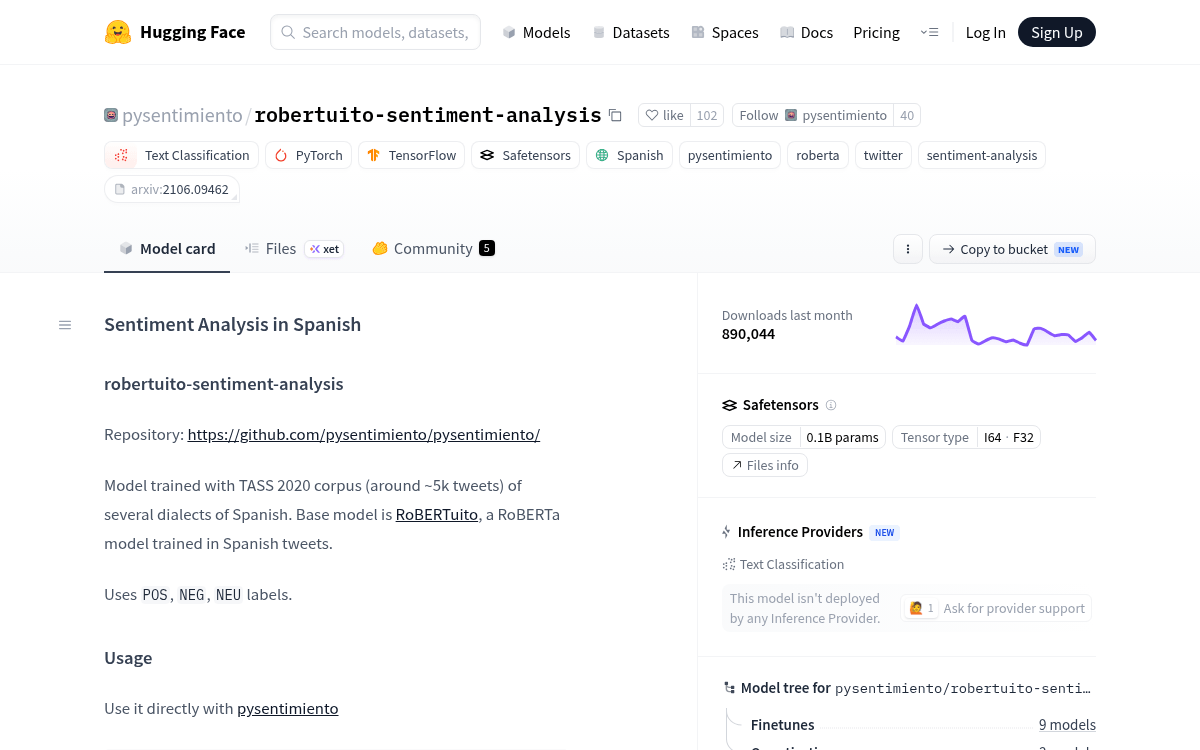
- pysentimiento's robertuito-sentiment-analysis is a Spanish sentiment classifier built on RoBERTuito.
- Backbone was pre-trained on 500M+ Spanish tweets, giving strong dialect and slang coverage.
- Achieves 0.705 macro F1 on TASS 2020 sentiment, beating BETO, BERTin, and mBERT.
- Predicts three classes: POS, NEG, NEU, tuned for short social media text.
- Ships via the pysentimiento library with built-in tweet preprocessing.
- Direct HF loading requires manual preprocessing; use the wrapper to avoid silent degradation.
Sentiment analysis in English has dozens of solid off-the-shelf models, but Spanish social media text has historically been trickier: dialect variation, code-switching, emojis, hashtags, and informal spelling all break generic multilingual classifiers. The pysentimiento RoBERTuito model is the pysentimiento group's answer, and it has become one of the default open-source options for Spanish opinion mining pipelines.
It is a fine-tuned classifier built on RoBERTuito, a RoBERTa variant pre-trained specifically on Spanish tweets. The fine-tune produces a three-way sentiment head with POS, NEG, and NEU labels, aimed squarely at short, noisy, user-generated text.
What it actually is
Training used the TASS 2020 corpus (around 5k tweets) covering several dialects of Spanish, layered on top of the RoBERTuito base. The underlying encoder is what makes it interesting: RoBERTuito was pre-trained on more than 500 million Spanish tweets, so the tokenizer and embeddings already understand jajaja, dropped accents, and regional slang before the sentiment head is added. On a benchmark of Spanish user-generated text tasks, it outperforms BETO, BERTin, and RoBERTa-BNE.
The numbers
Macro F1 scores on the pysentimiento benchmark:
| Model | Emotion | Hate speech | Irony | Sentiment |
|---|---|---|---|---|
| robertuito | 0.560 | 0.759 | 0.739 | 0.705 |
| roberta | 0.527 | 0.741 | 0.721 | 0.670 |
| bertin | 0.524 | 0.738 | 0.713 | 0.666 |
| beto (cased) | 0.516 | 0.724 | 0.705 | 0.662 |
| mBERT (uncased) | 0.493 | 0.718 | 0.681 | 0.617 |
The 0.705 macro F1 on sentiment is state-of-the-art among openly available Spanish encoders on this task. The gap over multilingual BERT (roughly 9 F1 points) is substantial for anyone currently relying on mBERT as a Spanish fallback.
Using it in three lines
The path of least resistance is the pysentimiento wrapper, which handles tweet preprocessing (user mentions, URLs, emoji normalization) before tokenization:
from pysentimiento import create_analyzer
analyzer = create_analyzer(task="sentiment", lang="es")
analyzer.predict("Qué gran jugador es Messi")
# AnalyzerOutput(output=POS, probas={POS: 0.998, NEG: 0.002, NEU: 0.000})
One gotcha worth flagging: RoBERTuito is not fully integrated into huggingface/transformers. Install pysentimiento and preprocess text with pysentimiento.preprocessing.preprocess_tweet before feeding it into the tokenizer. Loading the checkpoint directly with vanilla AutoTokenizer can silently produce worse results because tweets are not normalized the way the model expects.
Where it fits, and where it does not
Good fits:
- Twitter/X, TikTok comments, WhatsApp-style short text in Spanish
- Brand and campaign monitoring across Latin American markets
- Content moderation pipelines, paired with the sibling hate-speech and irony models from the same group
- Academic social NLP work where reproducibility matters
Weak fits:
- Long-form documents like news articles or product reviews longer than a few sentences; the model was tuned on ~128-token tweet-length inputs
- Fine-grained star ratings; you only get three classes with no intensity scale
- Highly formal or domain-specific Spanish (legal, medical) where a general-domain encoder like BETO may transfer better
- Sarcasm and irony detection, which the authors explicitly separated into a different head with its own model
Why a 100M-parameter encoder still earns its keep
Most of the attention in NLP has moved to instruction-tuned LLMs, and yes, you can prompt GPT-4 or Llama to classify Spanish sentiment. A 100M-parameter encoder that runs on a single CPU, returns calibrated probabilities, and can be fine-tuned on a laptop remains the right tool for a lot of production workloads. The RoBERTuito paper covers the pre-training details, and the pysentimiento repo ships analyzers for emotion, hate speech, irony, and NER on the same backbone, so one dependency covers most social NLP tasks in Spanish.
For anyone reaching for multilingual BERT or paying per-token to prompt an LLM every time a Spanish tweet needs a label, this is the boring, reliable, benchmark-topping alternative worth keeping in the toolbox.