
pyannoteAI Ships community-1, Cutting Speaker Confusion Errors by 50%
pyannoteAI ships pyannote.audio 4.0 with community-1, a new open-source speaker diarization pipeline that halves speaker confusion and simplifies Whisper alignment.
 Pro
Takeaways
- pyannote.audio 4.0 ships with community-1, a new open-source diarization pipeline replacing 3.1.
- Speaker confusion cut roughly 50% versus 3.1, with segmentation quality preserved.
- New exclusive mode outputs one active speaker at a time for clean Whisper timestamp alignment.
- Pipeline now uses VBx clustering instead of agglomerative hierarchical clustering.
- Training infrastructure sees up to 15x speedup via metadata caching and optimized dataloaders.
- Model on Hugging Face under CC-BY-4.0, with one-line swap to hosted precision-2.
Speaker diarization, the task of figuring out who spoke when in a recording, has been one of those quietly critical pieces of the voice AI stack. If you have ever tried to stitch Whisper transcripts to speaker labels and watched the timestamps drift on overlapping speech, you know the pain. The team behind pyannote is shipping a substantial update aimed squarely at that problem.
pyannoteAI has released pyannote.audio 4.0 alongside community-1, its new open-source pretrained diarization pipeline. This arrives almost two years after pyannote.audio 3.1 and follows the recent upgrade of the premium precision-2 model. It is meant to be a drop-in replacement for the 3.1 pipeline that most production stacks are currently running.
What changed under the hood
The headline is accuracy on the messy parts of diarization. Community-1 cuts speaker confusion by roughly 50% while maintaining best-in-class segmentation. Speaker confusion, in diarization lingo, is when a chunk of speech gets attributed to the wrong person. It is the failure mode that makes a transcript feel unusable even when voice activity detection is technically correct.
The community-1 pipeline swaps agglomerative hierarchical clustering for VBx clustering, based on suggestions from BUT Speech@FIT researchers Petr Pálka and Jiangyu Han. VBx is a Bayesian HMM-based method that models speaker turns as a state sequence, which tends to be more robust than merging clusters greedily by embedding distance. The segmentation model itself keeps the same powerset formulation from the 3.x line, so voice activity and overlapped-speech detection stay at the quality people already rely on.
Exclusive mode fixes the Whisper handshake
The second big change is a new output mode designed for speech-to-text alignment. In exclusive mode, only one speaker, the most likely to be transcribed, is active at any given time, dramatically simplifying the alignment between STT word timestamps and speaker labels.
Anyone who has built a meeting transcription pipeline knows why this matters. STT models like Whisper tend to emit one word at a time from one speaker, while diarization output can flag two people talking simultaneously during a backchannel like a quick "yeah" or "mhm." Reconciling those views usually means writing brittle heuristics. Exclusive mode makes the diarization output structurally compatible with STT timestamps:
from pyannote.audio import Pipeline
pipeline = Pipeline.from_pretrained(
    "pyannote/speaker-diarization-community-1",
    token="huggingface-access-token",
)
output = pipeline("/path/to/conversation.wav")
# iterate over speech turns without overlapping speech
for turn, speaker in output.exclusive_speaker_diarization:
    print(f"{speaker} speaks between t={turn.start:.3f}s and t={turn.end:.3f}s")
You still get the regular overlapping diarization on the same output object if you need it. The feature was initially developed for precision-2 and has now been ported into community-1, where it forms the foundation for products pyannoteAI plans to release in the coming months.
Benchmarks
The GitHub repo publishes head-to-head diarization error rates against the 3.1 legacy pipeline and the commercial precision-2 model on standard datasets. Lower is better.
| Dataset | 3.1 (DER %) | community-1 (DER %) | precision-2 (DER %) |
|---|---|---|---|
| MSDWild | 25.4 | 22.8 | 17.3 |
| RAMC | 22.2 | 20.8 | 10.5 |
| REPERE (phase2) | 7.9 | 8.9 | 7.4 |
| VoxConverse (v0.3) | 11.2 | 11.2 | 8.5 |
Gains are meaningful on conversational, noisy datasets like MSDWild and RAMC, and more modest on cleaner data. Compared to the 3.1 legacy pipeline, community-1 brings significant improvement in speaker counting and assignment, while the precision-2 premium pipeline further improves accuracy as well as processing speed in its self-hosted version. On an H100, community-1 runs at about 31 seconds per hour of audio on AMI, versus 14 seconds per hour for precision-2.
Faster training for anyone fine-tuning
If you fine-tune pyannote on your own data, 4.0 ships infrastructure work that had previously only been used internally to build precision-2. Metadata caching and optimized dataloaders make training on large-scale datasets dramatically faster, delivering a 15x speed-up on large-scale training pipelines in internal benchmarks. The end-user changelog cites a more modest 40% reduction in training time for typical workloads, so mileage will vary based on dataset size.
Licensing, hosting, and the business model
A few things to note before you drop this into production:
- The community-1 pipeline is released under the CC-BY-4.0 license and will always remain freely accessible. That is a change from the MIT license used on the older 3.x models.
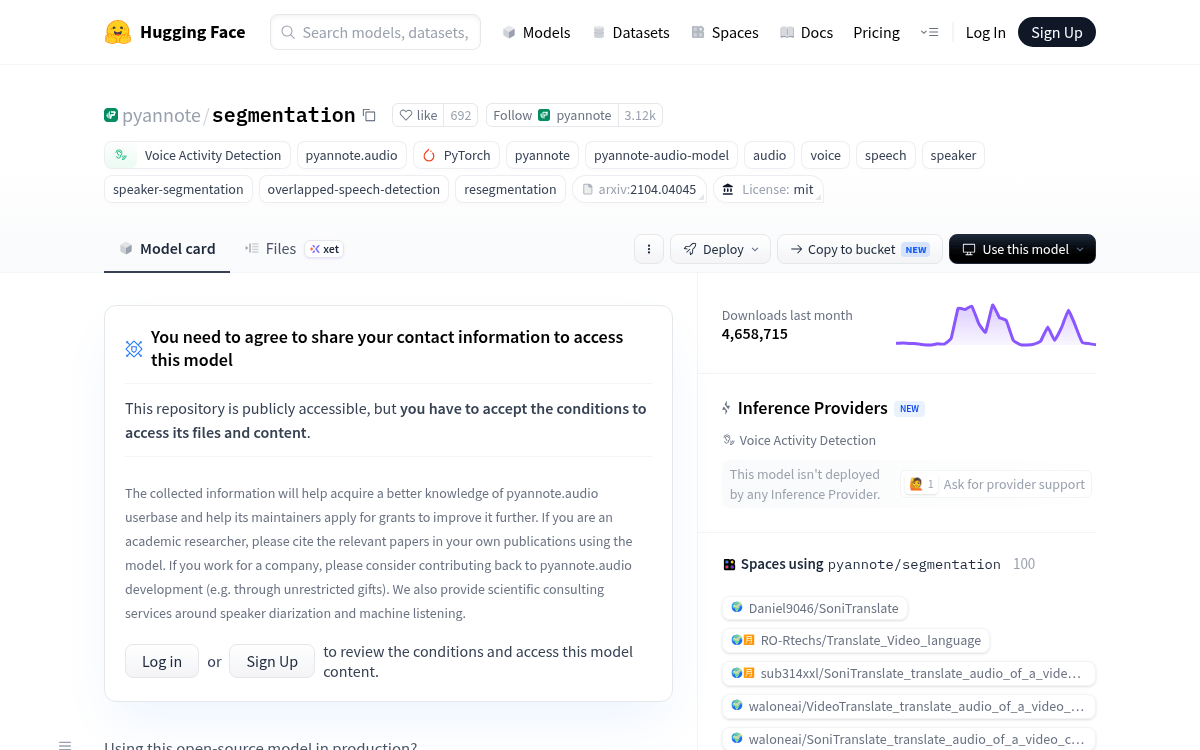
- The model is gated on Hugging Face, meaning you need to accept the user conditions and use an access token. Acceptance is free.
- pyannoteAI now offers
community-1hosted at cost on their platform, with a one-line swap to the paidprecision-2model if you need better accuracy or speed. - The pyannote.audio 4.0 toolkit itself stays open source and installable via
pip install pyannote.audio.
Swapping between local, hosted, and premium is genuinely one line, which lowers the switching cost if you want to start free and scale up:
pipeline = Pipeline.from_pretrained(
    "pyannote/speaker-diarization-community-1",  # or precision-2
    token="huggingface-access-token",            # or pyannoteAI-api-key
)
Who should care
If you are shipping meeting transcription, call center analytics, podcast tooling, or any product that needs speaker labels on conversational audio, this is worth an evaluation cycle. Exclusive mode alone can eliminate a category of alignment bugs that most teams end up patching with regex and prayer. If you are running speaker-diarization-3.1 today, the migration path is essentially changing the model ID string, which makes A/B testing on your own data cheap.
The wider signal here concerns the shape of open-source voice AI. pyannote sits at a numerically dominant position, with 8k+ GitHub followers, 140k unique registered users, and 45 million monthly downloads on Hugging Face. The company is now running a familiar dual-track playbook: keep the OSS pipeline competitive as the community entry point, and monetize a premium tier that is measurably better on hard audio. For teams building on the open pipeline, that dynamic is worth watching. It sets a strong floor on what you can do for free, and a clear ceiling that will keep moving.