
pyannote Ships community-1 to Fix Broken Speaker Counting for 140k Users
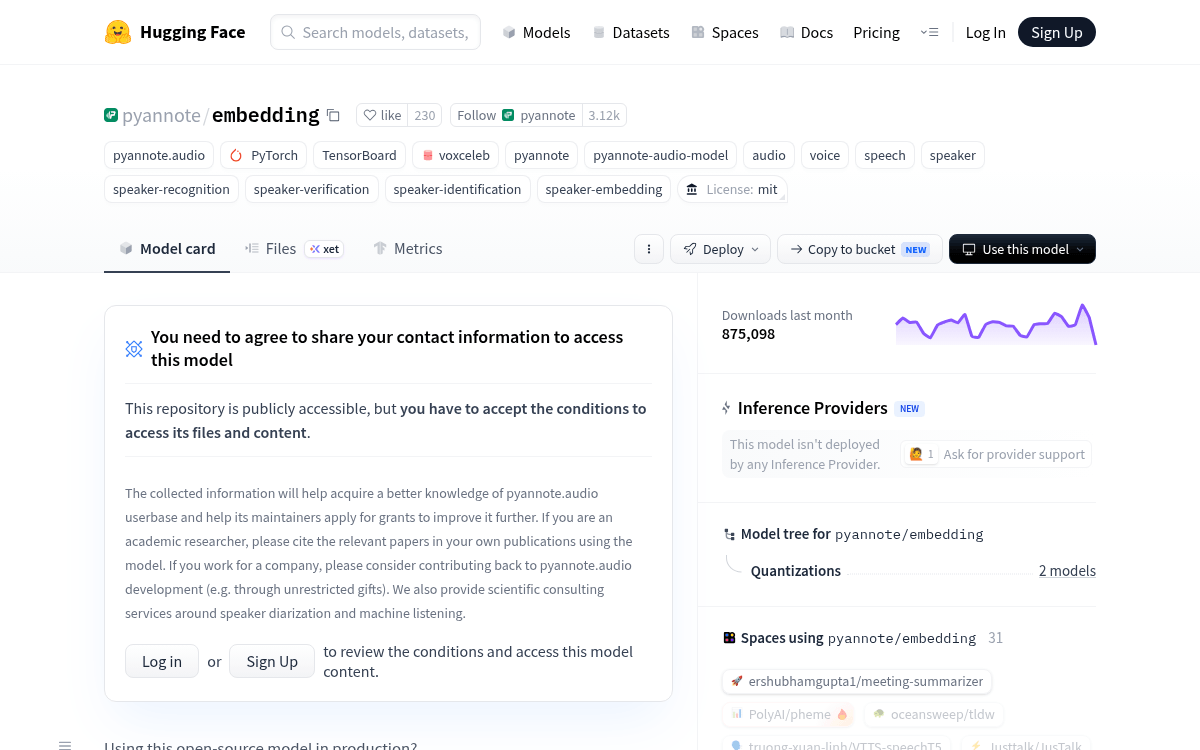
pyannote.audio 4.0 ships with Community-1, a new open-source speaker diarization pipeline that fixes speaker counting and simplifies Whisper alignment.
 Pro
Takeaways
- pyannote.audio 4.0 ships with community-1, the first major open-source diarization update in nearly two years.
- New VBx clustering replaces agglomerative hierarchical clustering, fixing long-standing speaker counting errors.
- Exclusive diarization mode outputs one speaker per frame, dramatically simplifying Whisper timestamp alignment.
- Metadata caching and optimized dataloaders deliver a 15x training speedup on large-scale datasets.
- Breaking changes: Python 3.10+, torchcodec replaces torchaudio, sox and soundfile backends removed.
- Hosted community-1 available at cost via pyannoteAI, with one-line upgrade path to premium precision-2.
The team behind pyannote, the open-source toolkit most speaker diarization stacks quietly depend on, has shipped its first major open-source pipeline upgrade in nearly two years. pyannote.audio 4.0 lands together with community-1, a new pretrained speaker diarization pipeline that targets two long-standing complaints from users: unreliable speaker counting and the headache of aligning diarization output with speech-to-text timestamps.
For anyone building meeting transcription, call analytics, or podcast tooling on top of Whisper, this release decides whether you keep gluing pipelines together with duct tape or finally get clean speaker labels.
What actually shipped
pyannote.audio 4.0 is the first major version bump since 3.1, and community-1 is the new default open-source pipeline that ships with it. It follows the recent upgrade of the premium precision-2 model and represents the latest iteration of the open-source pretrained pipeline.
The headline changes:
- Better speaker counting. The community-1 pipeline relies on VBx clustering instead of agglomerative hierarchical clustering, a change suggested by BUT Speech@FIT researchers Petr Pálka and Jiangyu Han.
- Exclusive diarization mode. A new output stream where only one speaker is active per moment, designed for reconciliation with STT word timestamps.
- 15x faster training. Metadata caching and optimized dataloaders, backported from the commercial precision-2 work.
- Offline use. Pipelines can now be stored alongside their internal models in one repo for fully air-gapped deployment.
- Hosted at cost. pyannoteAI is offering hosted community-1 on their own infrastructure with a one-line switch to premium precision-2.
Why speaker counting was broken
If you have ever run pyannote 3.1 on a real conversation, you know the failure mode: the model handles voice activity and overlap detection well, but it will confidently split one person into three speakers, or merge two people into one. The maintainers acknowledge this directly, pointing to feedback from a community that has grown to 8k+ GitHub followers, 140k unique registered users, and 45 million monthly Hugging Face downloads.
The fix is a clustering algorithm swap. Agglomerative hierarchical clustering greedily merges embeddings based on distance thresholds, which is fragile when speakers sound similar or recording conditions shift mid-conversation. VBx (variational Bayesian x-vector clustering) instead treats speaker assignment as a probabilistic inference problem over the whole recording, which tends to produce more stable counts. Segmentation quality, already the toolkit's strong suit, is preserved.
The exclusive mode fixes the Whisper problem
Anyone who has tried to merge Whisper transcripts with pyannote diarization has hit the same wall. Whisper emits one word at one timestamp, but pyannote correctly detects that two people were talking simultaneously. Which speaker gets the word?
The new exclusive mode forces a single-speaker answer per frame. The API is straightforward:
from pyannote.audio import Pipeline
pipeline = Pipeline.from_pretrained(
    "pyannote/speaker-diarization-community-1",
    token="huggingface-access-token")
output = pipeline("/path/to/conversation.wav")
# regular diarization (can have overlapping speakers)
print(output.speaker_diarization)
# exclusive diarization (one speaker at a time)
for turn, speaker in output.exclusive_speaker_diarization:
    print(f"{speaker} speaks from {turn.start:.3f}s to {turn.end:.3f}s")
Under the hood, exclusive mode picks the speaker most likely to be transcribed at each moment, so word-level timestamps from Whisper snap cleanly to one label. The feature was originally built for the commercial precision-2 model and has been backported.
Breaking changes worth knowing
Version 4.0 is not a drop-in replacement. If you are upgrading from the 3.x line, expect real migration work:
- Python 3.10 is the new minimum.
- Audio I/O switches from
torchaudiototorchcodec. Support forsoxandsoundfilebackends is removed; onlyffmpegor in-memory audio is supported. - The
use_auth_tokenparameter is renamed totoken. - The
OverlappedSpeechDetectionandResegmentationpipelines are gone; both are now handled inside theSpeakerDiarizationtask. - The
{pipeline_name}@{revision}syntax infrom_pretrainedis removed in favor of arevisionkeyword argument.
The hosted option, and what it costs
Alongside the open-source release, pyannoteAI is offering hosted versions of both community-1 (at cost) and the premium precision-2 model. The switch between local and cloud is one line of code, which is genuinely convenient if you want to prototype locally and scale to a managed API without rewriting your pipeline.
Pricing on the commercial side, per the pyannoteAI changelog: a Developer Plan at €19/month for up to 125 hours of premium processing with access to Precision-2 and Community-1, a Starter Plan at €99/month for up to 825 hours with 3 concurrent jobs, and an Enterprise Plan with custom pricing including self-hosted deployment. Community-1 itself remains MIT-licensed and free to self-host.
Where this sits in the landscape
Speaker diarization is one of the last audio ML problems where hosted services like Deepgram and AssemblyAI have held a meaningful accuracy lead over open source. The maintainers frame community-1 as returning the same optimizations that power the premium models to the open ecosystem. In practice, the gap between what you can build yourself for the cost of a GPU and what you pay per minute narrows again.
If you are already running pyannote 3.1 in production and speaker counting has been a recurring bug source, the upgrade is worth the migration cost. If you are starting fresh and need diarization plus Whisper transcription, the exclusive mode alone justifies picking community-1 over rolling your own alignment logic.