
Pyannote's Community-1 Cuts Speaker Confusion 50% and Fixes Whisper Alignment
Pyannote.audio 4.0 ships Community-1, cutting speaker confusion in half and adding an exclusive mode built for Whisper alignment.
 Pro
Takeaways
- Pyannote.audio 4.0 released with new open-source Community-1 diarization pipeline.
- Cuts speaker confusion by roughly 50% versus the previous 3.1 pipeline.
- Adds exclusive diarization mode that simplifies alignment with Whisper transcripts.
- Switches to VBx clustering, contributed by researchers at BUT Speech@FIT.
- Training pipeline is up to 15x faster thanks to metadata caching and optimized data loaders.
- Available free on Hugging Face, or hosted at cost via pyannoteAI.
The team behind pyannote has shipped a major open-source refresh of its speaker diarization stack. Pyannote.audio 4.0 arrives with a new pretrained pipeline called Community-1, the first significant update to the free tier since the 3.1 release nearly two years ago. It targets the two complaints developers have raised most loudly: shaky accuracy on real-world audio, and the pain of stitching diarization output back to transcripts from Whisper or other speech-to-text systems.
Speaker diarization is the task of answering who spoke when in an audio recording, which is what turns a raw transcript into something readable in meeting notes, call analytics, or podcast tooling. Pyannote has been the default open-source option for years, and Community-1 is designed to keep that position while pulling techniques back from the paid Precision-2 model.
What actually changed under the hood
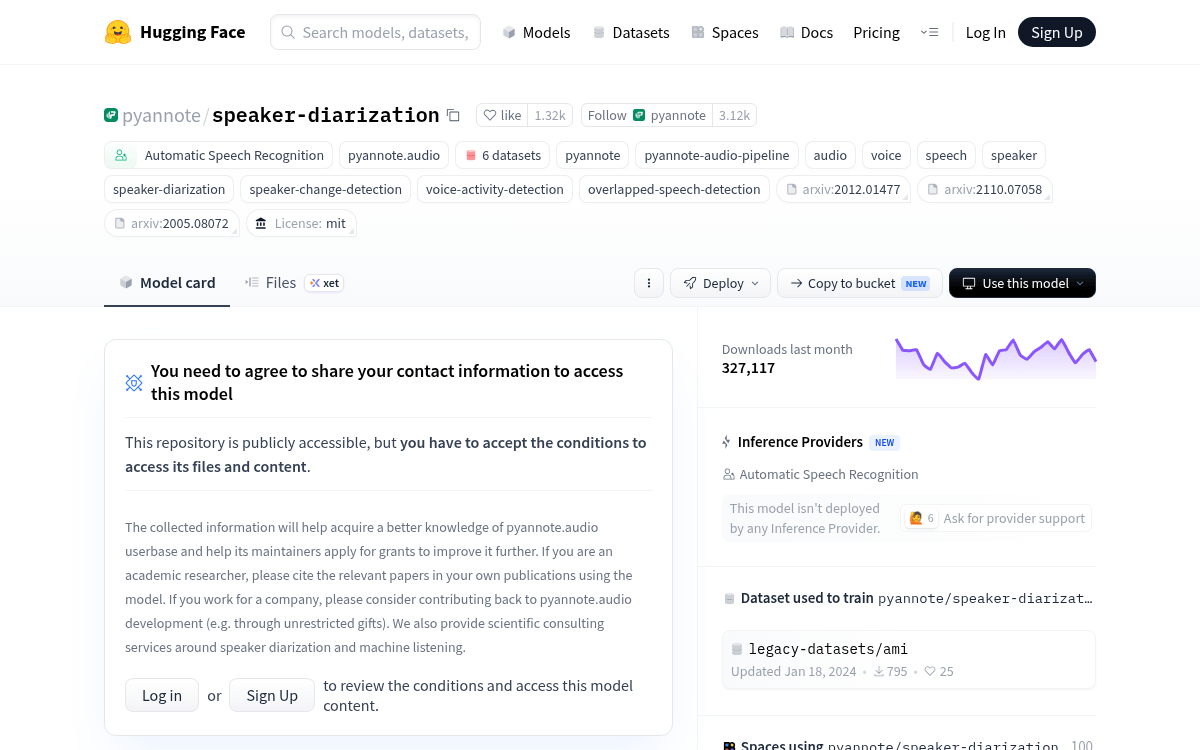
The pyannote/speaker-diarization-community-1 pipeline relies on VBx clustering instead of agglomerative hierarchical clustering, a switch contributed by researchers at BUT Speech@FIT. VBx is a variational Bayesian approach to grouping speaker embeddings that tends to handle longer conversations and speaker counting more gracefully than the greedy bottom-up clustering used in 3.1.
The headline accuracy claim is a roughly 50% reduction in speaker confusion while segmentation quality stays best-in-class. In plain terms, the model still finds speech boundaries about as well as before, but it is much less likely to mix up which speaker a given chunk belongs to. Voice activity and overlapped speech detection are held roughly at 3.1 levels on purpose, since that was already the strongest part of the pipeline.
An escape hatch for Whisper alignment
The most practically interesting piece is a new output mode. Alongside the regular speaker diarization, the community-1 pipeline returns an exclusive speaker diarization, a feature backported from the latest commercial model that simplifies the reconciliation between fine-grained speaker diarization timestamps and (sometimes not so precise) transcription timestamps.
In exclusive mode, only one speaker is marked active at any given moment, which removes the messy overlap regions that break naive alignment with Whisper word timestamps. Usage looks like this:
from pyannote.audio import Pipeline
pipeline = Pipeline.from_pretrained(
    "pyannote/speaker-diarization-community-1",
    token="HUGGINGFACE_ACCESS_TOKEN",
)
output = pipeline("/path/to/conversation.wav")
for turn, speaker in output.exclusive_speaker_diarization:
    print(f"{speaker}: {turn.start:.2f}s -> {turn.end:.2f}s")
If you have ever written custom logic to decide which speaker owns a Whisper word that lands inside a two-speaker overlap, this is the feature you have been building yourself.
Faster training, and a hosted option
The 4.0 library brings infrastructure work that had been sitting inside pyannoteAI's private stack. The release removes the deprecated pyannote-audio-train CLI, switches from torchaudio to torchcodec for audio I/O, adds VBx clustering support, adds k-means clustering, and adds a wav2vec_frozen option to freeze or unfreeze wav2vec in the SSeRiouSS architecture.
On the training side, the maintainers report 15x faster pipelines on large-scale datasets thanks to metadata caching and optimized data loaders. That mainly matters if you are fine-tuning on your own corpus rather than using the pretrained pipeline off the shelf.
There is also a new hosted route. Community-1 can be called through the pyannoteAI cloud at cost, and switching to the premium Precision-2 model is a one-line change:
pyannote/speaker-diarization-community-1runs locally, MIT-licensed, free.pyannote/speaker-diarization-community-1-cloudruns on pyannoteAI infrastructure at cost.pyannote/speaker-diarization-precision-2is the paid premium model, which the vendor claims is +14% more accurate than Precision-1 and +28% vs pyannote.audio OSS 3.1.
Where it fits, and where it does not
Community-1 is a solid default if you are building meeting transcription, call center analytics, podcast tooling, or any pipeline that pairs Whisper-family models with speaker labels. The exclusive mode alone removes a class of reconciliation bugs that used to require hand-written heuristics.
The honest limits are worth flagging. This remains a batch pipeline rather than a streaming one, so live captioning use cases will want the separate Live-1 streaming model instead. For teams chasing the last few points of accuracy on hard multi-speaker audio, the vendor is openly positioning Precision-2 as the upgrade path. If you already run 3.1 in production, this is a low-risk swap: the model card and pipeline API are backward compatible, and you get the exclusive diarization output as a bonus field on the pipeline result.