
PromptHero's Openjourney Brings Midjourney's Painterly Look to Open Source for Free
PromptHero's Openjourney fine-tunes Stable Diffusion 1.5 on 60,000+ Midjourney V4 images, delivering that signature aesthetic in a fully open model.
 Pro
Takeaways
- Openjourney is an open source Stable Diffusion 1.5 checkpoint fine-tuned on Midjourney V4 imagery.
- Original version trained on 60,000+ Midjourney images; v4 successor used 124,000 images over 32 hours.
- Activation phrase mdjrny-v4 style triggers the aesthetic in v1; v4 removes that requirement.
- Runs on Replicate for about $0.027 per image, roughly 20 seconds per generation on A100.
- Strong for stylized illustration and concept art; weak on multi-subject scenes, text, and complex layouts.
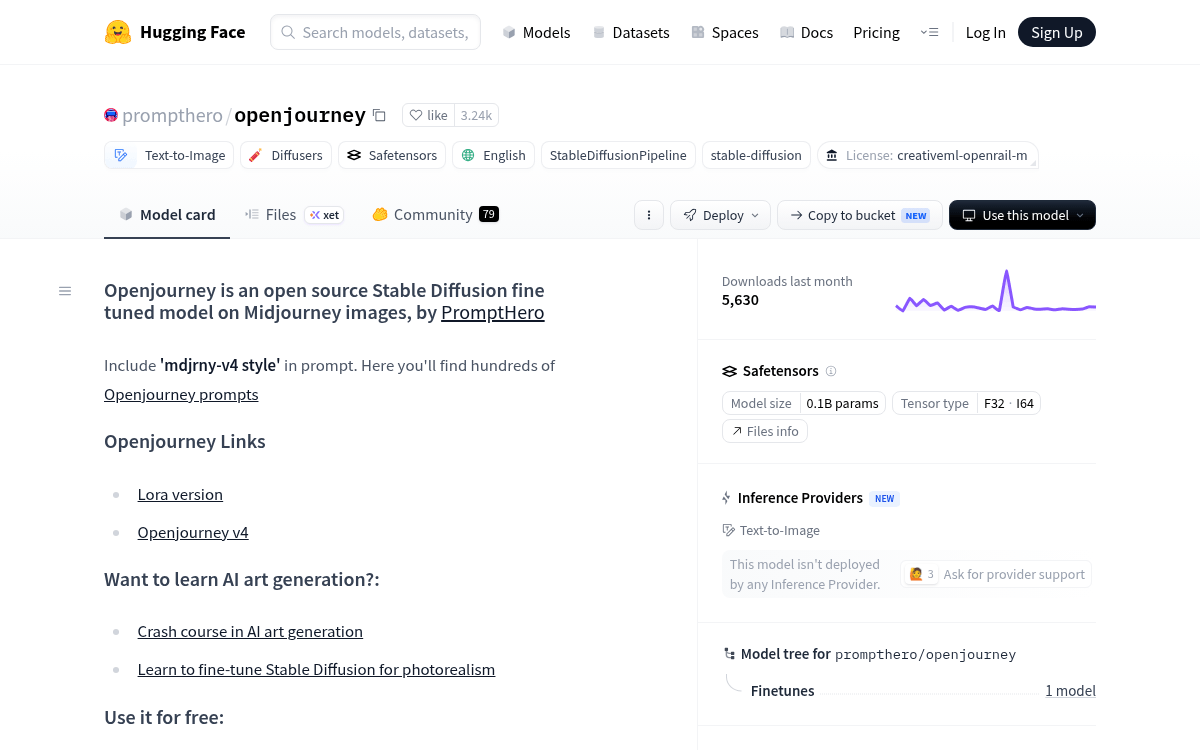
- Licensed CreativeML OpenRAIL-M with 3,200+ likes and broad diffusers, ONNX, MPS support.
If you have ever wanted Midjourney's polished, painterly aesthetic without the subscription, Openjourney from PromptHero is the closest open source approximation available. It is a Stable Diffusion 1.5 checkpoint fine-tuned on tens of thousands of Midjourney generations, and it continues to trend on Hugging Face with over 3,200 likes and thousands of monthly downloads, years after its initial release.
A free stand-in for a paid aesthetic
Openjourney aims to reproduce Midjourney's look through a Stable Diffusion fine-tune. Midjourney's images are prized for their aesthetics, but the service charges a subscription, so a checkpoint trained on its outputs offers a route to similar results without the recurring bill. The weights sit under the CreativeML OpenRAIL-M license, so you can run inference locally, self-host, or embed it in a product without per-image fees.
How it was built
PromptHero, which curates prompts and images from Midjourney, Stable Diffusion, DALL-E 2, and other models, released the first Openjourney checkpoint on Hugging Face trained on more than 60,000 Midjourney V4 generations. The successor, Openjourney v4, went further: fine-tuned from Stable Diffusion v1.5 on roughly 124,000 images across 12,400 steps and 4 epochs, totaling about 32 GPU-hours of training.
Architecturally there is no novelty. The model uses Stable Diffusion's latent diffusion backbone with CLIP text encoding, runs through the diffusers library in PyTorch, and can be exported to ONNX, MPS, or FLAX/JAX. The value lives in the dataset and the fine-tuning recipe.
Getting it running
Include mdjrny-v4 style in your prompts on the original checkpoint to trigger the intended visual style. That activation phrase was dropped in openjourney-v4, which applies the style unconditionally. A minimal call through the diffusers library looks like this:
from diffusers import StableDiffusionPipeline
import torch
pipe = StableDiffusionPipeline.from_pretrained(
    "prompthero/openjourney",
    torch_dtype=torch.float16,
).to("cuda")
prompt = "retro series of different cars, mdjrny-v4 style"
image = pipe(prompt).images[0]
image.save("cars.png")
If you would rather not manage GPUs, the model is hosted on Replicate at roughly $0.027 per run (about 37 runs per dollar) on an Nvidia A100 80GB, with predictions typically completing in under 20 seconds. Actual cost varies with input parameters.
Where it shines, where it stumbles
The fine-tuning is deep enough that the Midjourney look survives even terse prompts. Stylized artwork, character illustrations, and concept designs come out with the signature painterly rendering, saturated lighting, and cinematic framing that made the source material popular.
The weaknesses are the ones you would expect from a 0.1B-parameter SD 1.5 base:
- Multi-subject compositions, precise spatial arrangements, and legible text rendering are shaky. Prompts loaded with constraints often collapse into incoherent scenes.
- These limits are inherited from Stable Diffusion v1.5 rather than caused by the fine-tune.
- The original checkpoint has been superseded by openjourney-v4 and no longer receives active updates.
When to reach for it
Openjourney fits a specific slot in the current image generation stack. For cinematic concept art, stylized character portraits, or thumbnail-grade illustrations that need to run offline or at scale without per-generation fees, it is a strong starting point. For photorealism, accurate typography, or complex multi-subject scenes with specific staging, SDXL, Flux, or a modern DiT-based model will serve you better.
It also remains a clean baseline for learning fine-tuning workflows. Because the base is SD 1.5, LoRA training, ControlNet integrations, and inpainting pipelines all work out of the box, and there is even an Openjourney LoRA variant if you want to layer the style over another checkpoint rather than swap the whole model. For a piece of the ecosystem from the early diffusion era, it has aged well as a stylistic building block.