
Playground v2.5 Beats DALL-E 3 and Midjourney With an Open 3B Model
Playground releases an SDXL-based open weights model that beats DALL-E 3 and Midjourney 5.2 on aesthetic quality in head-to-head user studies.
 Pro
Takeaways
- Playground released Playground v2.5, a 3B parameter SDXL-architecture text-to-image model with open weights.
- User studies show it beats SDXL, PixArt-alpha, Playground v2, DALL-E 3 and Midjourney 5.2 on aesthetics.
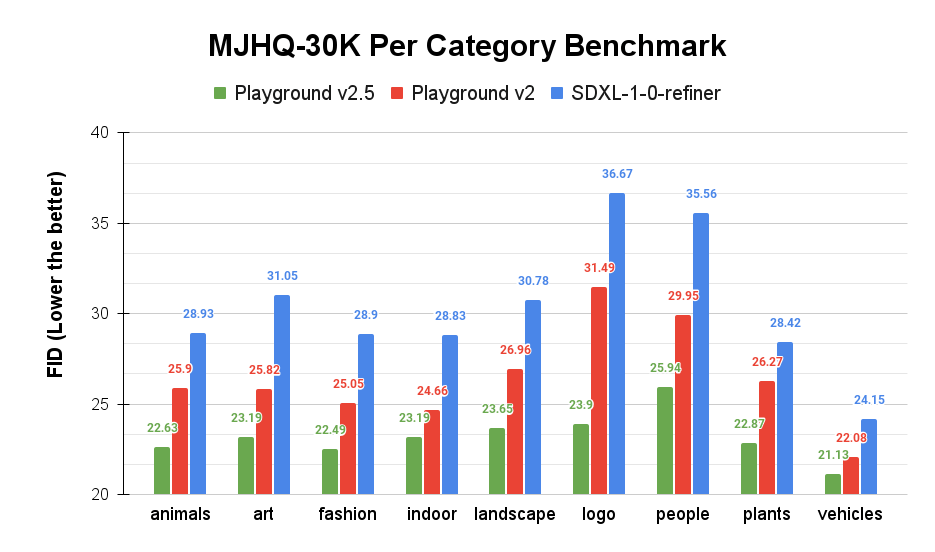
- Overall FID on MJHQ-30K drops to 4.48 from SDXL refiner's 9.55.
- Three key changes: EDM noise schedule, balanced multi-aspect-ratio training, and human preference alignment for people.
- Ships with EDMDPMSolverMultistepScheduler in Diffusers 0.27+, recommended guidance_scale=3.0.
- Released under a custom Playground v2.5 Community License, not standard open source.
Playground has released Playground v2.5, an open-weights text-to-image model that beats closed-source giants DALL-E 3 and Midjourney 5.2 on aesthetic quality in head-to-head user studies. Built on the Stable Diffusion XL architecture, it slots into existing SDXL tooling without rewriting your pipeline.
What shipped
Playground v2.5 is a 3B parameter latent diffusion model outputting 1024x1024 images plus portrait and landscape aspect ratios. It uses two fixed, pretrained text encoders (OpenCLIP-ViT/G and CLIP-ViT/L) and follows the SDXL architecture. Weights are on Hugging Face under the Playground v2.5 Community License, and the model card includes a Diffusers snippet that runs on a single CUDA GPU.
from diffusers import DiffusionPipeline
import torch
pipe = DiffusionPipeline.from_pretrained(
    "playgroundai/playground-v2.5-1024px-aesthetic",
    torch_dtype=torch.float16,
    variant="fp16",
).to("cuda")
prompt = "Astronaut in a jungle, cold color palette, muted colors, detailed, 8k"
image = pipe(prompt=prompt, num_inference_steps=50, guidance_scale=3).images[0]
The pipeline defaults to EDMDPMSolverMultistepScheduler with guidance_scale=3.0, which produces crisper fine detail. It also supports EDMEulerScheduler. Both use the EDM formulation from Karras et al., which reparameterizes noise schedules to give the model more stable gradients and sharper high-frequency output.
The numbers behind the claim
Playground ran user studies against every major competitor. On aesthetic preference, v2.5 beat SDXL, PixArt-alpha, and Playground v2 by wide margins, then held that edge against DALL-E 3 and Midjourney 5.2.

On the MJHQ-30K benchmark, v2.5 posts the strongest FID scores across the board, with notable gains in people and fashion categories:
| Model | Overall FID (1024px) |
|---|---|
| SDXL-1.0-refiner | 9.55 |
| Playground v2 | 7.07 |
| Playground v2.5 | 4.48 |
Three targeted training changes
The technical report frames v2.5 as three concrete fixes rather than a from-scratch rebuild:
- Color and contrast. Standard diffusion models trained on typical noise schedules tend to produce washed-out, mid-gray images. Adopting the EDM framework lets the model learn true blacks and whites.
- Multi-aspect-ratio generation. Training on balanced bucketed sampling across aspect ratios closes the gap that square-crop-heavy training leaves for portrait and landscape outputs.
- People alignment. Fine-tuning on human preference data for people-focused images pushes v2.5 past both SDXL and RealStock v2, a community fine-tune specifically trained on realistic people datasets.

Compatibility and tradeoffs
Keeping the SDXL architecture means existing LoRAs, ControlNets, and inference stacks are largely compatible, which matters if you already run SDXL in production. The model's strongest use cases match what the training targeted: portraits, fashion imagery, and non-square marketing assets where SDXL tends to distort.
Two limitations are worth tracking. Like SDXL, v2.5 uses CLIP-based text encoders rather than T5, so complex compositional prompts with many objects or spatial relationships remain unreliable. Some aspect ratios also produce suboptimal results, and the community license is not a standard OSS license, so commercial usage above certain thresholds requires checking the terms before shipping.
Why a targeted approach closed the gap
A focused set of training choices, EDM noise scheduling, aspect-ratio bucket balancing, and preference tuning on people, closed most of the quality gap to closed-source frontier models without scaling the architecture. For teams building on open weights, that is a cheaper path than waiting for the next foundation model. Running SDXL today for product photography, avatars, or ad creative makes v2.5 a one-line swap worth benchmarking against your own prompts.