
PaddleOCR's PP-OCRv6 Beats GPT-5.5 and Qwen3-VL-235B at 34.5M Parameters
PaddleOCR's new PP-OCRv6 beats GPT-5.5, Gemini, and Qwen3 on text detection with just 34.5M parameters, while running 5x faster on CPU
Takeaways
- PP-OCRv6 is a new OCR model family (1.5M–34.5M params) that outperforms GPT-5.5, Gemini-3.1-Pro, and Qwen3-VL-235B on text detection and recognition benchmarks.
- The medium model (34.5M params) achieves 86.2% detection Hmean and 83.2% recognition accuracy, beating the previous PP-OCRv5_server by +4.6% and +5.1% respectively.
- PP-OCRv6_medium runs 5.2× faster than PP-OCRv5_server on Intel Xeon CPU with OpenVINO, while the tiny model hits 0.13s per image on A100.
- A single unified model now supports 50 languages (Chinese, English, Japanese, and 46 Latin-script languages), replacing the need for separate per-language models.
- PP-OCRv6 scores 93.2% on a hallucination benchmark vs. 80.6% for Qwen3-VL-235B, due to its CTC+NRTR decoding architecture that never generates text auto-regressively.
- Available now on Hugging Face and via
pip install paddleocrunder Apache 2.0 license.
PaddleOCR just dropped PP-OCRv6, a new family of lightweight OCR models that does something remarkable: it outperforms billion-parameter vision-language models like GPT-5.5, Gemini-3.1-Pro, and Qwen3-VL-235B on text detection and recognition tasks, using a fraction of their compute. The largest model in the family, PP-OCRv6_medium, tops out at 34.5M parameters total, yet beats every VLM tested by a wide margin.
The VLM Problem Nobody Talks About
The OCR community has been watching large vision-language models creep into document processing pipelines. They're convenient, they're general-purpose, and they seem to work well in demos. But when you actually benchmark them on precise text localization, three problems surface fast:
- Hallucination: VLMs generate plausible-but-wrong text by leaning on language priors. If an image has a deliberate misspelling, a VLM will often "correct" it. PP-OCRv6_medium scores 93.2% on a hallucination benchmark, compared to 80.6% for Qwen3-VL-235B and 72.6% for MiniMax-M3.
- Imprecise localization: VLMs suffer from imprecise localization and prohibitive computational cost when applied to dedicated OCR scenarios. On the detection benchmark, Gemini-3.1-Pro scores 46.8% average Hmean (a standard measure of bounding box accuracy). PP-OCRv6_medium scores 86.2%.
- Cost: Running Qwen3-VL-235B for every document in a pipeline is simply not viable at scale.

Three Tiers, One Architecture
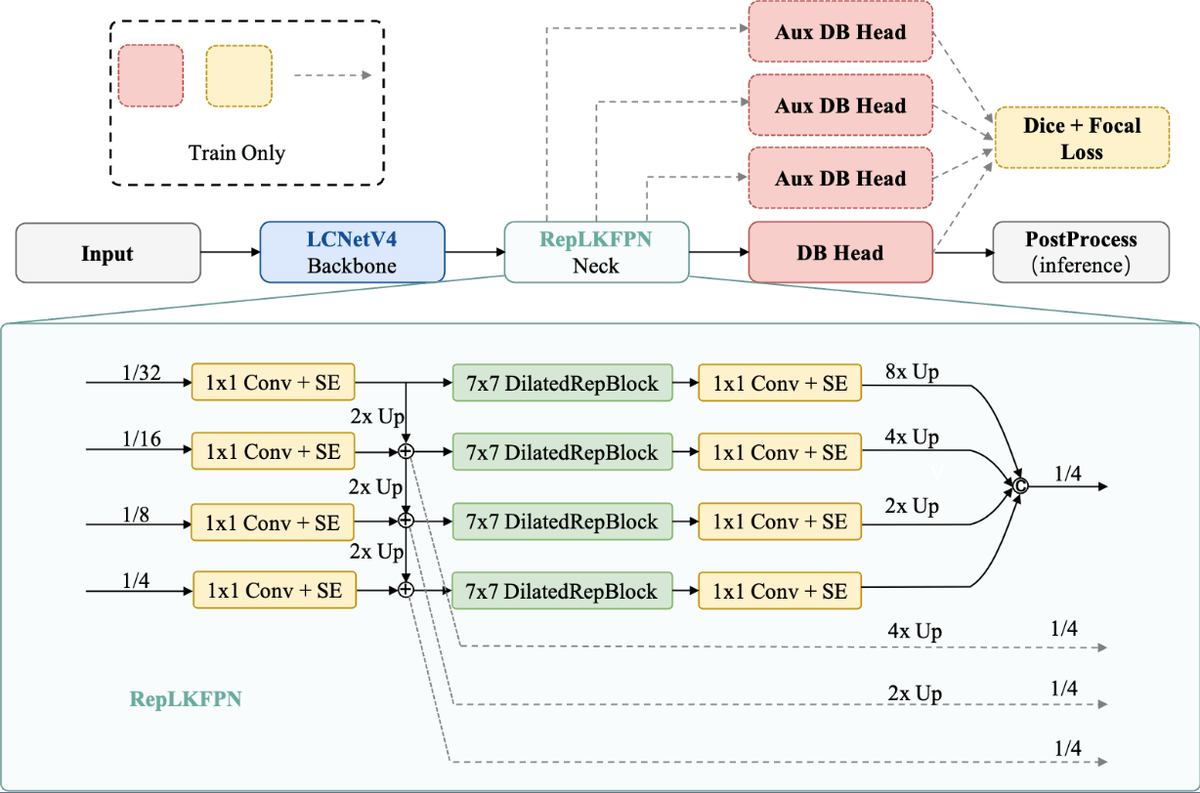
PP-OCRv6 ships as a three-tier family sharing the same underlying building blocks, so you pick the right size for your deployment target without switching codebases:
- Tiny (1.5M params total): Targets IoT and edge devices. PP-OCRv6_tiny is the fastest model across all platforms: 6.1× over PP-OCRv5_mobile on Apple M4 PaddlePaddle (0.96s vs 5.82s), 3.9× on Intel Xeon OpenVINO (0.20s vs 0.78s), reaching 0.13s on A100.
- Small (7.7M params): Mobile and desktop. PP-OCRv6_small matches PP-OCRv5_mobile in latency on most platforms with higher accuracy; 1.9× faster on Apple M4 PaddlePaddle (3.07s vs 5.82s).
- Medium (34.5M params): Server-grade. PP-OCRv6_medium matches or outperforms PP-OCRv5_server on all platforms: 1.1× faster on A100 (0.29s vs 0.32s), 1.15× on V100 ONNX Runtime (0.67s vs 0.77s), 5.2× on Intel Xeon OpenVINO (1.40s vs 7.30s).