
OTel-LLM-27B-IT Hits 88% Accuracy Quoting Telecom Standards Where LLMs Fail
A Gemma 3 27B fine-tune from the Open Telco AI initiative brings context-grounded RAG to 3GPP, O-RAN, and GSMA standards.
 Pro
Takeaways
- Farbod Tavakkoli released OTel-LLM-27B-IT, a Gemma 3 27B full-parameter fine-tune for telecom RAG.
- Part of the Open Telco AI initiative backed by AT&T, GSMA, Microsoft, Dell, AMD, and Red Hat.
- OTel model family has surpassed 18 million downloads across LLM, embedding, and reranker checkpoints.
- Trained on 326,767 curated examples from 3GPP, O-RAN, GSMA PRDs, IETF RFCs, and arXiv telecom papers.
- LLM-as-judge correctness rises from 84.5% to 88.2% over base Gemma 3 27B IT on held-out evaluations.
- Apache 2.0 licensed, English-only, designed for retrieval pipelines rather than context-free question answering.
A new open-weights model has landed on Hugging Face aimed at one of the more painful corners of enterprise AI: making an LLM reliable when it quotes from telecom standards. OTel-LLM-27B-IT, published by contributor Farbod Tavakkoli, is a full-parameter fine-tune of Google's Gemma 3 27B IT built for retrieval-augmented answering over documents like 3GPP specs, O-RAN working group outputs, and GSMA Permanent Reference Documents.
It is one entry in the broader Open Telco (OTel) AI family, a community effort with contributions from AT&T, GSMA, Microsoft, Dell, AMD, Red Hat, and several universities. The initiative describes itself as an open telecom AI resource for training, evaluating, and deploying retrieval, reranking, context-grounded generation, and abstention models for telecommunications, with derived datasets, held-out evaluation partitions, model cards, Croissant metadata, training and inference code, and a family of full-parameter post-trained telecom models.
What's actually in the box
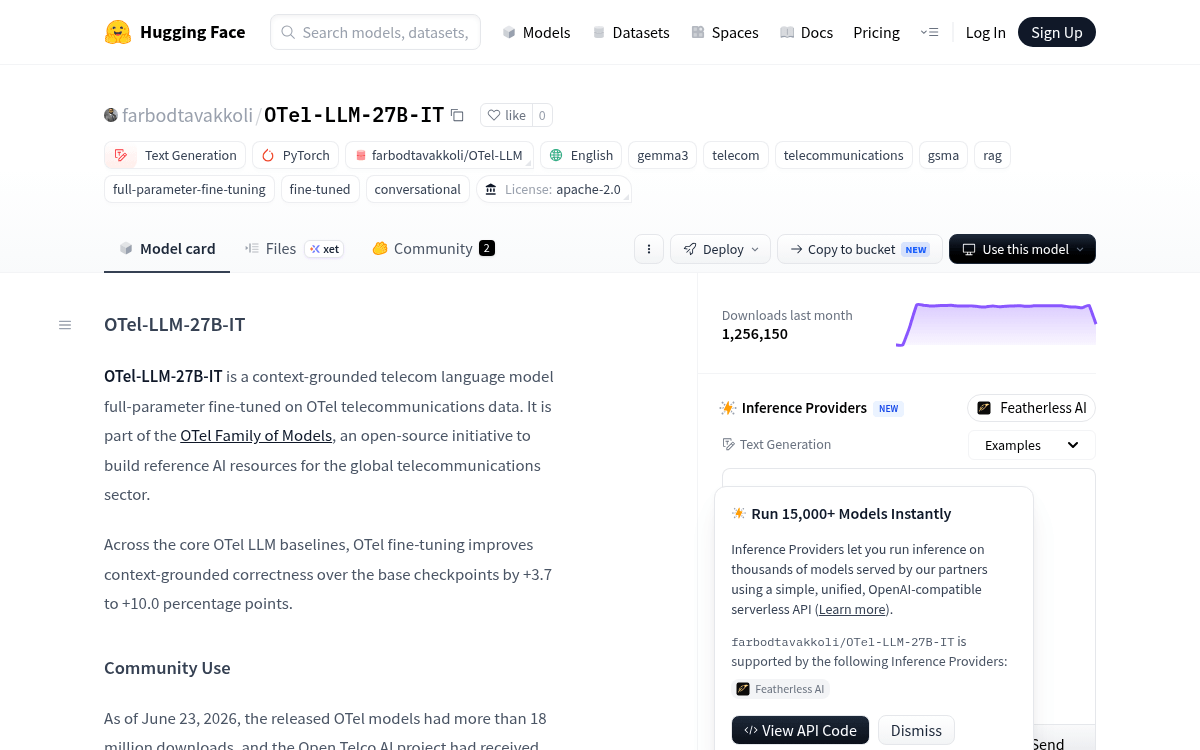
The model card frames this specific checkpoint clearly: OTel-LLM-27B-IT is a context-grounded telecom language model, full-parameter fine-tuned on OTel telecommunications data as part of a family built as an open-source reference resource for the global telecom sector. The lineage runs from google/gemma-3-27b-it through OTel post-training to the released weights, distributed under Apache 2.0.
Adoption across the family has been substantial. As of late June 2026, the released OTel models had more than 18 million downloads, and the Open Telco AI project had picked up 157+ pieces of media coverage worldwide. This single 27B checkpoint accounts for over 1.25 million of those downloads.
How it was trained
The 27B checkpoint is a full-parameter fine-tune rather than a LoRA adapter, meaning every weight was updated. Domain experts curated the data heavily, filtering roughly 1.1M raw examples down to 326,767 higher-confidence rows drawn from arXiv telecom papers, 3GPP standards, telecom Wikipedia and Common Crawl, GSMA Permanent Reference Documents, IETF RFCs, industry whitepapers, and O-RAN specifications across working groups 1 through 10.
The recipe is standard modern fine-tuning, but worth noting for anyone reproducing similar work:
- Framework: ScalarLM, running on a mix of AMD MI300X/MI325X/MI355X and NVIDIA A100/H100 GPUs
- Optimizer: 8-bit AdamW with cosine decay, 100 warmup steps, weight decay 0.01
- Precision: BF16 with Flash Attention 2 and Fully Sharded Data Parallel
- Sequence length: 1500 tokens, gradient checkpointing on
- 3 epochs for LLMs and embeddings, 2 epochs for rerankers
Built for RAG, not chat
One thing to understand before deploying this: it is a retrieval-grounded model, not a general telecom chatbot. Reported LLM results measure context-grounded answer generation from retrieved context, not unrestricted context-free telecom QA. Training rows pair a telecom question with retrieved chunks and either a grounded completion or an explicit abstention flag, so the model learns to lean on the passages it sees.
In practice, you plug it into a retriever plus reranker pipeline, ideally the matching OTel-Embedding and OTel-Reranker models, and it answers from that context. A minimal usage sketch:
from transformers import AutoModelForCausalLM, AutoTokenizer
import torch
tok = AutoTokenizer.from_pretrained("farbodtavakkoli/OTel-LLM-27B-IT")
model = AutoModelForCausalLM.from_pretrained(
    "farbodtavakkoli/OTel-LLM-27B-IT",
    torch_dtype=torch.bfloat16, device_map="auto",
)
out = model.generate(**tok(prompt, return_tensors="pt").to(model.device),
                     max_new_tokens=256)
What the numbers say
Reported gains over the base Gemma 3 27B IT checkpoint are modest but measurable on the held-out OTel evaluation split. LLM-as-judge correctness, scored by GPT-4o mini against retrieved context and a reference answer, moves from 84.5% to 88.2% plus or minus 0.4, a 3.7 point lift. The broader OTel family shows gains between 3.7 and 10.0 points depending on the base model.
Where it falls short
The authors are upfront about the limits. Answer quality depends on the retriever, reranker, context window, and prompt policy around the model, and external benchmark transfer, multilingual performance, and per-subdomain performance should be evaluated separately for production settings. The card also flags that aggregate scores hide subdomain variance: O-RAN retrieval looks comparatively strong, while academic-paper and GSMA PRD examples still need further curation.
The release is English-only, text-only, and the authors warn that generated telecom content should be verified before any operational, customer-facing, regulatory, safety, or network-configuration use. For context-free telecom QA, they point users toward a separately evaluated model rather than this RAG-oriented checkpoint.
Why this matters for domain LLMs
Telecom has been an awkward fit for general-purpose LLMs. Standards documents are dense, notation-heavy, and change frequently, and hallucinated answers about interface protocols or spec compliance carry real operational risk. A permissively licensed, full-parameter fine-tune with published datasets, evaluation splits, and Croissant-tagged Responsible AI metadata gives teams something they can audit and rebuild, rather than a black-box API call. The OTel 2.0 line already teases a Gemma 4 31B variant trained on roughly 440 billion telecom tokens, suggesting this specialization approach will keep scaling.