
Ostris Drops a Free Style Reference LoRA That Transforms Krea 2 Turbo Images
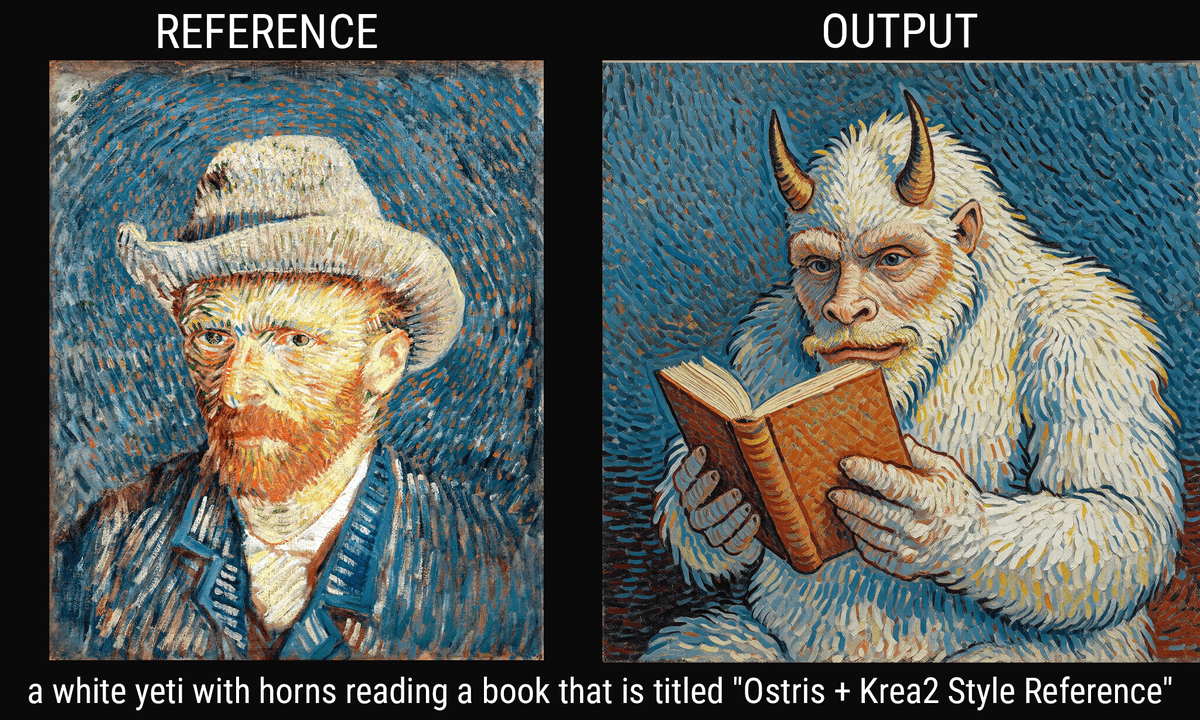
Ostris releases a free LoRA that lets Krea 2 Turbo match any visual style from one or two reference images, no trigger word needed
Takeaways
- Ostris released a free Style Reference LoRA for Krea 2 Turbo that generates images matching the style of 1-2 reference images.
- No trigger word needed; just pass a reference image and a text prompt to get styled outputs.
- Trained on thousands of hand-curated style pairs using a new experimental reference-image trainer in AI Toolkit.
- Requires ~32+ GB VRAM; runs in 40-50s on an RTX 5090 at 1024x1024 with CPU offloading.
- Supports both ComfyUI (via ComfyUI-Krea2-Ostris-Edit) and Diffusers (via the Krea2OstrisEdit community pipeline).
- The turbo training adapter and reference trainer are both open in AI Toolkit, enabling the community to train its own reference-conditioned LoRAs on Krea 2.
Ostris, the creator of AI Toolkit, just dropped what he calls his favorite thing he has ever trained: a Style Reference LoRA for Krea 2 Turbo. Drop in one or two reference images alongside a text prompt, and the model generates new images that inherit the visual style of those references. No trigger word, no elaborate prompting tricks. Just image in, styled image out.
The model behind it matters
Krea 2 Turbo is worth understanding before diving into the LoRA itself. It is a single-stream multimodal diffusion transformer with 12.9 billion parameters across 28 blocks at width 6144. The Turbo variant is distilled down to 8 inference steps and generates native 2K images in approximately 2 seconds on consumer hardware. Its text encoder is Qwen3-VL-4B-Instruct, tapped at twelve intermediate layers for text-only conditioning. That vision-language encoder is the key detail: Krea 2 was designed from the start to understand images as context, which is what makes reference-image conditioning so natural on this architecture.
Both Krea 2 Raw and Turbo are released under the Krea 2 Community License, which permits free commercial use for individuals and studios with under 50 seats. The LoRA itself is free to download on Hugging Face.
A distillation problem, and a clever workaround
Training LoRAs on distilled models is notoriously tricky. Distillation compresses a model to run in very few steps, but that compression is fragile: fine-tuning tends to break it, producing artifacts or degraded outputs. Ostris solved this with a separate turbo training adapter. This adapter is essentially a hack to significantly slow down the distillation breakdown when fine-tuning a distilled model, making it work well for shorter runs such as styles, concepts, and characters. He generated thousands of images at various sizes and aspect ratios using Krea 2 Turbo, then trained a LoRA on those images at a low learning rate (1e-5), allowing the distillation to break down while preserving the model's existing knowledge. Since this adapter has already absorbed the distillation breakdown, any new LoRA trained on top of it will not suffer the same degradation.