
OpenRouter Drops 13 Embedding Models Including BGE-M3 at $0.01 per Million Tokens
OpenRouter added 13 embedding models to its unified API, including BAAI's BGE family, priced from $0.005 per million tokens through a single OpenAI-compatible endpoint.
 Pro
Takeaways
- OpenRouter launched 13 new embedding models behind its unified OpenAI-compatible embeddings API
- BAAI's bge-base-en-v1.5 is priced at $0.005 per million tokens with 768-dim vectors and 512-token context
- BGE-M3 also available at $0.01 per million tokens with 8,194-token context and multilingual support across 100+ languages
- Lineup includes bge-large-en-v1.5, e5-large-v2, gte-large, MiniLM variants, MPNet, and multilingual-e5
- Endpoint is OpenAI-compatible, so existing embedding client code works by swapping the base URL and model slug
- Enables cheap A/B testing between open-source embedders and hosted APIs without rewriting integration code
Standing up a retrieval pipeline used to mean picking one embedding provider, negotiating rate limits, and rewriting your integration if you ever wanted to switch. OpenRouter has rolled out a batch of new embedding models behind its unified, OpenAI-compatible API, and the BAAI BGE family, one of the most-downloaded open-source embedding lineages on Hugging Face, is now part of the lineup.
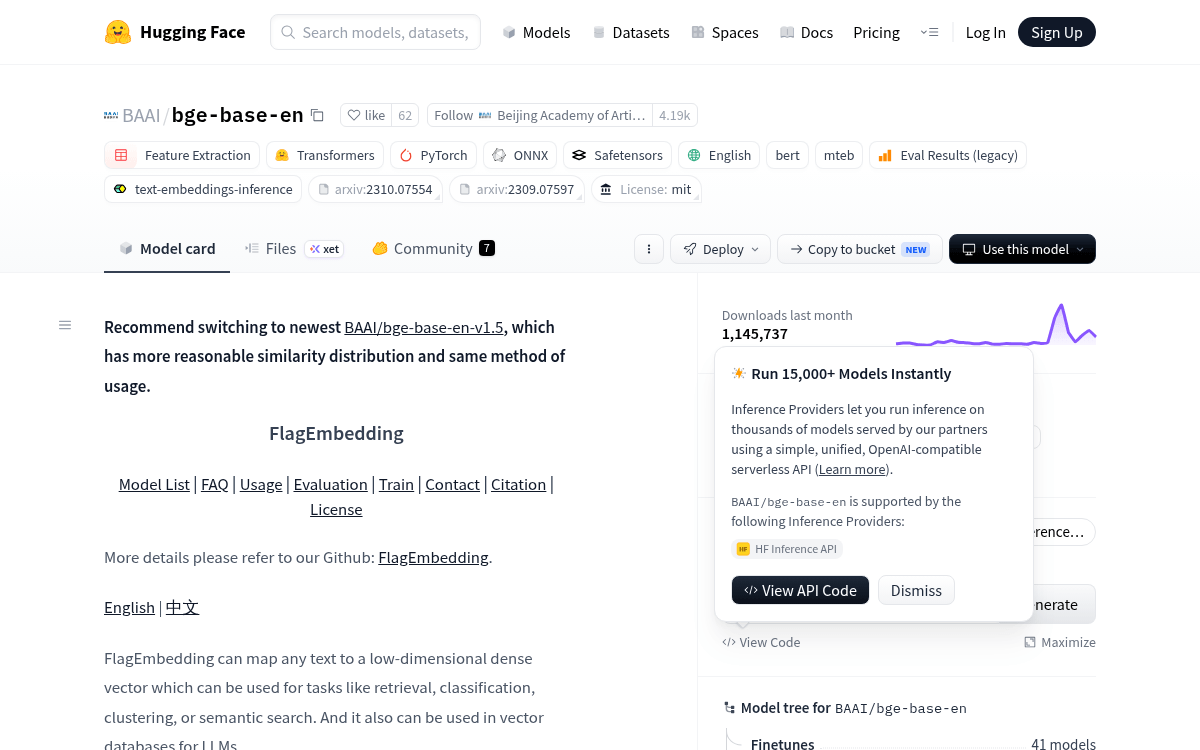
bge-base-en-v1.5 is available at $0.005 per million tokens with a 512-token context window, producing 768-dimensional dense vectors. Its bigger sibling bge-m3 is priced at $0.01 per million tokens with an 8,194-token context and 1024-dimensional output, aimed at long documents and multilingual retrieval. The endpoint speaks the OpenAI embeddings format, so most existing SDKs work by swapping the base URL.
What actually shipped
OpenRouter announced 13 new embedding models with quick guidance on when to use what. For top-tier English search, reach for bge-large-en-v1.5, e5-large-v2, or gte-large. multi-qa-mpnet targets QA retrieval. bge-m3 and multilingual-e5-large handle cross-language and long documents. paraphrase-MiniLM covers similarity and paraphrase detection. On the speed side, MiniLM-L6 and MiniLM-L12 are the small-and-fast picks, gte-base and e5-base-v2 balance size and performance, and all-mpnet-base is positioned as a reliable all-rounder.
The BGE base v1.5 listing is served by a single provider, and OpenRouter forwards requests directly with no routing decisions to make. Latency clocks in around half a second per request with near-100% uptime on the dashboard.
Why BGE earns its spot
The BGE models come from the Beijing Academy of Artificial Intelligence and have been a staple of open-source retrieval stacks for years. BGE v1 and v1.5 are encoder-only models based on BERT that achieved best-in-class performance among the models of their size at release time, with bge-large-en and bge-large-zh ranking first on the MTEB and C-MTEB benchmarks. The v1.5 refresh improved the similarity-score distribution and pushed retrieval performance up out of the box.
The broader family also includes BGE-M3, which unifies three retrieval paradigms in one model: dense vectors, sparse keyword matching, and ColBERT multi-vector scoring, across 100+ languages with 8192 token support. That makes hybrid search, mixing semantic and keyword signals, doable without running two separate models.
Where these models pull their weight
Embedding models translate text into dense vectors that capture meaning, which is the load-bearing primitive under a lot of production AI systems. Three workloads in particular benefit:
- Retrieval-augmented generation, where every chunk in your knowledge base and every incoming query needs to be embedded so cosine similarity can surface the right context
- Semantic search that catches synonyms, paraphrases, and intent that keyword search misses
- Clustering and classification for support tickets, product catalogs, or any corpus that needs to be grouped by meaning
Pricing is aggressive. At $0.005 per million input tokens, bge-base-en-v1.5 undercuts most hosted embedding APIs by an order of magnitude, and BGE-M3 at $0.01 per million tokens comes in below OpenAI's small tier while adding hybrid search and long context.
Where it falls short
BGE-base tops out at a 512-token context, which is fine for short passages and query encoding but forces aggressive chunking on long documents. It is also English-only. For multilingual or long-form embeddings, BGE-M3 or Cohere's multilingual family are better fits from the same catalog.
On raw leaderboard scores, BGE-base is no longer the frontier. NVIDIA's NV-Embed-v2, a 7.85B-parameter model with 4096-dim outputs, tops the MTEB English leaderboard with 72.31 as of mid-2026, and the original Sentence-BERT descendants like MiniLM and mpnet remain excellent baselines for cheap classification while trailing newer models on retrieval. BGE base sits in a sweet spot for cost and speed, not peak accuracy.
Calling it from your code
Because the endpoint is OpenAI-compatible, the client code is almost identical to what you already use:
from openai import OpenAI
client = OpenAI(
    base_url="https://openrouter.ai/api/v1",
    api_key="YOUR_OPENROUTER_KEY",
)
resp = client.embeddings.create(
    model="baai/bge-base-en-v1.5",
    input=["vector databases store dense embeddings"],
)
vec = resp.data[0].embedding  # 768 floats
The upshot is less about any single model and more about the aggregation layer. Getting BGE, E5, GTE, MPNet, MiniLM, and BGE-M3 behind the same request signature means you can A/B test embedders on your own corpus, then flip the model string in production when the numbers tell you to. That is the shift worth planning around, especially if you have been putting off comparing your current embedder to the open-source alternatives.