
OpenBMB's VoxCPM-0.5B Beats Larger Open-Source Voice Models Without Audio Tokens
OpenBMB drops a 0.5B tokenizer-free TTS model that beats larger open-source rivals on Seed-TTS benchmarks and runs at 0.17 RTF on a 4090.
 Pro
Takeaways
- OpenBMB released VoxCPM-0.5B, a tokenizer-free continuous-space TTS model under Apache-2.0.
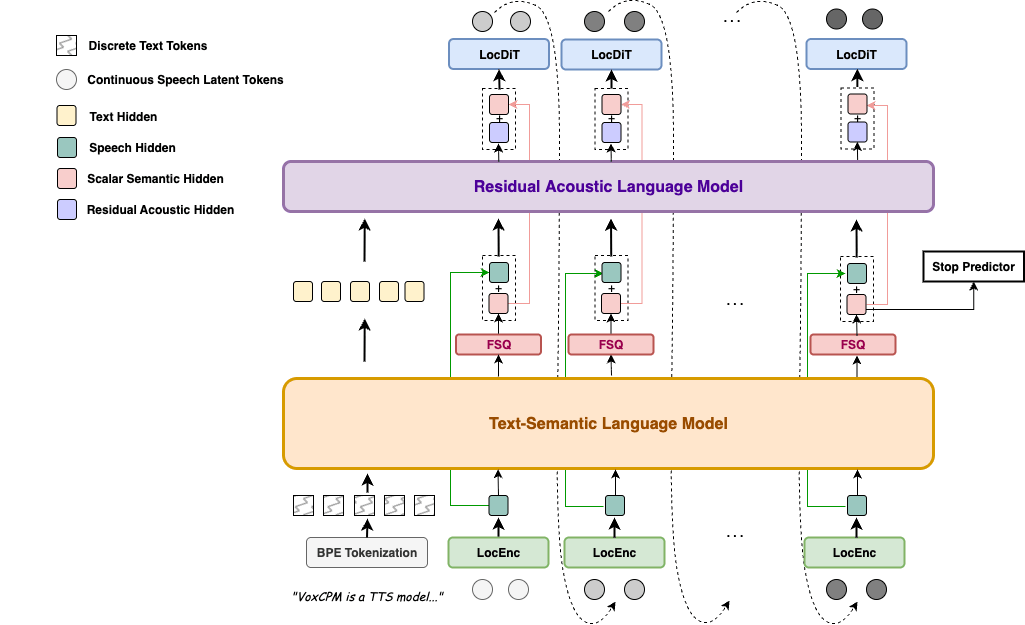
- Built on MiniCPM-4 with a diffusion autoregressive head and FSQ constraints instead of discrete audio tokens.
- Beats open-source rivals on Seed-TTS-eval: 1.85% EN WER, 0.93% ZH CER at just 0.5B params.
- Runs at 0.17 real-time factor on an RTX 4090, supporting low-latency streaming synthesis.
- Zero-shot voice cloning from short reference clips, plus context-aware prosody from text alone.
- Trained on 1.8M hours of Chinese-English audio; install via
pip install voxcpm. GitHub
OpenBMB has released VoxCPM-0.5B, a compact text-to-speech model that skips the discrete audio tokens most modern TTS systems rely on. It generates continuous speech representations directly from text using a diffusion autoregressive setup built on the MiniCPM-4 language model. The weights are Apache-2.0, installation is pip install voxcpm, and the model briefly hit number one on Hugging Face trending after launch.
Dropping the audio tokenizer
Most recent open TTS systems, including CosyVoice, SparkTTS, FireRedTTS, and F5-TTS, convert waveforms into discrete codec tokens, then train a language model to predict those tokens. VoxCPM uses an end-to-end diffusion autoregressive architecture that generates continuous speech representations directly from text, sidestepping the information loss that comes with quantization.
The architecture pairs the MiniCPM-4 backbone with implicit semantic-acoustic decoupling through hierarchical language modeling and FSQ constraints. In plain terms: the language model handles prosody planning, while a local diffusion transformer (called LocDiT in the API) fills in fine-grained acoustic detail, with Finite Scalar Quantization used as a soft bottleneck rather than a hard tokenizer.
Benchmark numbers
On Seed-TTS-eval, VoxCPM posts a 1.85% word error rate on English and 0.93% character error rate on Chinese, with speaker similarity scores of 72.9 and 77.2 respectively. Those are the best open-source figures in the reported table, edging out models several times its size:
| Model | Params | EN WER | ZH CER | EN SIM |
|---|---|---|---|---|
| VoxCPM | 0.5B | 1.85 | 0.93 | 72.9 |
| CosyVoice2 | 0.5B | 3.09 | 1.38 | 65.9 |
| F5-TTS | 0.3B | 2.00 | 1.53 | 67.0 |
| IndexTTS2 | 1.5B | 2.23 | 1.03 | 70.6 |
| HiggsAudio-v2 | 3B | 2.44 | 1.50 | 67.7 |
On an RTX 4090, VoxCPM achieves a real-time factor of 0.17, meaning one second of audio takes roughly 170 milliseconds to generate. That throughput is fast enough for live voice agents without datacenter hardware.
Training and architecture
VoxCPM-0.5B was trained on over 1.8 million hours of bilingual Chinese-English audio. The base model is MiniCPM4-0.5B, which gives the system a text-understanding prior that pure acoustic models lack. That prior drives the context-aware delivery behavior OpenBMB highlights: the model reads the sentence and selects a prosody style that fits the content rather than applying a fixed template.
Python API
A short reference clip is enough to clone a voice. Leave the prompt fields empty for plain TTS:
from voxcpm import VoxCPM
import soundfile as sf
model = VoxCPM.from_pretrained("openbmb/VoxCPM-0.5B")
wav = model.generate(
    text="Hello from VoxCPM.",
    prompt_wav_path="reference.wav",
    prompt_text="reference transcript",
    cfg_value=2.0,
    inference_timesteps=10,
    denoise=True,
)
sf.write("out.wav", wav, 16000)
Two parameters do most of the tuning work:
cfg_value: controls classifier-free guidance strength. Lower values produce more expressive, improvisational reads; higher values stay closer to the reference at the cost of naturalness.inference_timesteps: trades diffusion quality for speed. Ten is the recommended default.
Beyond the Python API, there is a CLI (voxcpm --text ... --output out.wav), batch mode from a text file, and a Gradio web demo via python app.py. Optional preprocessing hooks pull in ZipEnhancer to clean noisy reference recordings and SenseVoice-Small for automatic transcription, so you can feed in raw audio and still get a clean voice clone.
Strengths and gaps
VoxCPM handles several tasks well out of the box:
- Zero-shot voice cloning from a short clip, capturing timbre, accent, emotional tone, and pacing.
- Expressive prosody without style tags. The LM backbone reads the text and adjusts delivery for poetry, dialogue, or exclamations automatically.
- Bilingual Chinese and English with phoneme-level control available by disabling text normalization and passing bracketed phonemes like
{HH AH0 L OW1}. - Real-time streaming on a single consumer GPU.
The team is candid about current limitations. On CV3-eval hard subsets, similarity scores drop into the mid-60s, below CosyVoice3's mid-70s results. There is no direct slider for emotion or speaking style yet, long or highly expressive inputs can destabilize generation, and languages outside Chinese and English are unsupported. OpenBMB explicitly advises against production or commercial use without rigorous safety evaluation.
The most obvious risk is voice deepfake abuse. High-fidelity zero-shot cloning from a few seconds of audio is precisely what regulators and platforms are worried about. OpenBMB asks users to label AI-generated content.
Where it fits
Open TTS has consolidated around a few competing families over the past year: F5-TTS for flow matching, CosyVoice and SparkTTS for codec-token language models, and a growing continuous-space camp. VoxCPM is the strongest argument yet that skipping codec tokens entirely can still win on WER, similarity, and latency at half a billion parameters.
Community integrations are already accumulating on the official repo: NanoVLLM support for high-throughput GPU inference, an ONNX export for CPU deployment, an Apple Neural Engine backend, and ComfyUI nodes. For anyone building a voice agent, audiobook pipeline, or localization tool that needs a permissive license and offline inference, VoxCPM is now one of the strongest defaults available.