
OpenBMB's MiniCPM-V 4.6 Fits a Vision AI Model Into 500MB
OpenBMB's 1.3B multimodal model beats Qwen3.5-0.8B by 3 points on Intelligence Index while using 19x fewer tokens and runs on phones.
Takeaways
- OpenBMB released MiniCPM-V 4.6, a 1.3B multimodal model scoring 13 on Artificial Analysis Intelligence Index.
- Beats Qwen3.5-0.8B with 19x fewer tokens and outperforms the larger Ministral 3 3B.
- SigLIP2-400M vision encoder plus Qwen3.5-0.8B backbone with 262k context and 128-frame video input.
- LLaVA-UHD v4 techniques cut visual encoding FLOPs by over 50% with mixed 4x/16x token compression.
- Deployable on iOS, Android, and HarmonyOS with fully open-sourced edge adaptation code.
- Apache 2.0 license, GGUF quantizations from 505 MB, plus vLLM, SGLang, llama.cpp, Ollama support.
OpenBMB just pushed a pocket-sized vision-language model that punches well above its weight class. MiniCPM-V 4.6 is a 1.3B parameter multimodal model designed for on-device deployment, and the release includes GGUF quantizations that fit the whole thing into roughly 500 MB of memory. OpenBMB pairs it with fully open-sourced edge adaptation code for iOS, Android, and HarmonyOS, plus a free public API key.
Scoring like a model twice its size
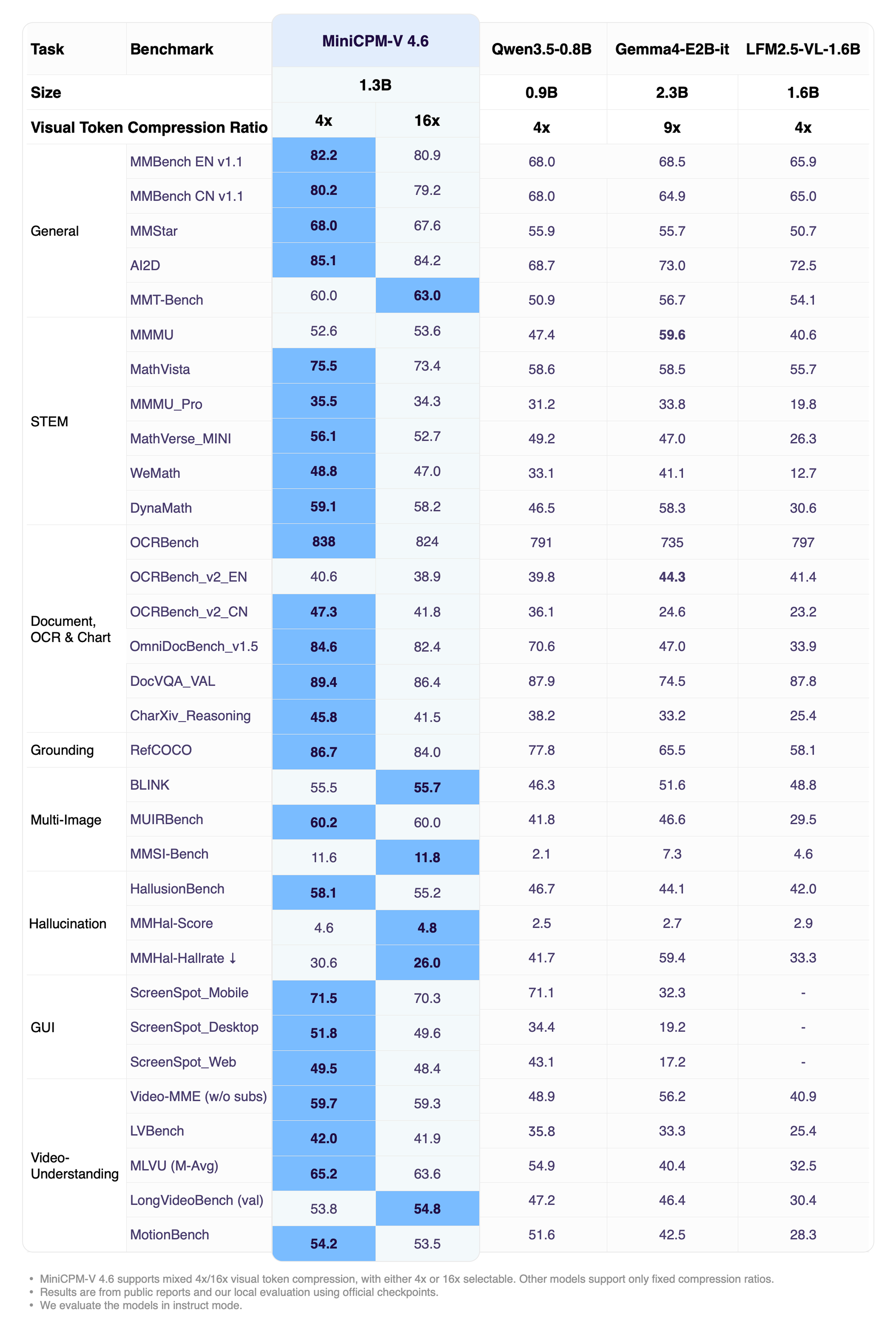
On the Artificial Analysis Intelligence Index, MiniCPM-V 4.6 sits 3 points ahead of Qwen3.5 0.8B (non-reasoning, 10) and 2 points behind Qwen3.5 2B (non-reasoning, 15), establishing a new Pareto-optimal point on the Intelligence vs. Total Parameters chart. At 1.3B parameters, it scores 13 on the Intelligence Index, the highest for any open-weights model under 2B parameters.
The efficiency numbers stand out more than the raw score. MiniCPM-V 4.6 beats Qwen3.5-0.8B's score of 10 at 19x lower token cost, and Qwen3.5-0.8B-Thinking's score of 11 at 43x lower token cost. It also outperforms Ministral 3 3B, which is roughly twice its size, on the same benchmark.
Under the hood
The model pairs a SigLIP2-400M vision encoder with a Qwen3.5-0.8B language backbone, building on the LLaVA-UHD v4 approach. The combined weights come to 1.3B parameters with a 262k-token context window. Inputs can be text, image, or video (up to 128 frames with configurable frame stacking), and output is text.