
OpenBMB's MiniCPM-V 4.5 Beats GPT-4o on Benchmarks Running on an iPad
OpenBMB's 8B parameter vision-language model beats GPT-4o on OpenCompass while running video at 10 FPS on a phone.
 Pro
Takeaways
- OpenBMB released MiniCPM-V 4.5, an 8B multimodal model built on Qwen3-8B and SigLIP2-400M.
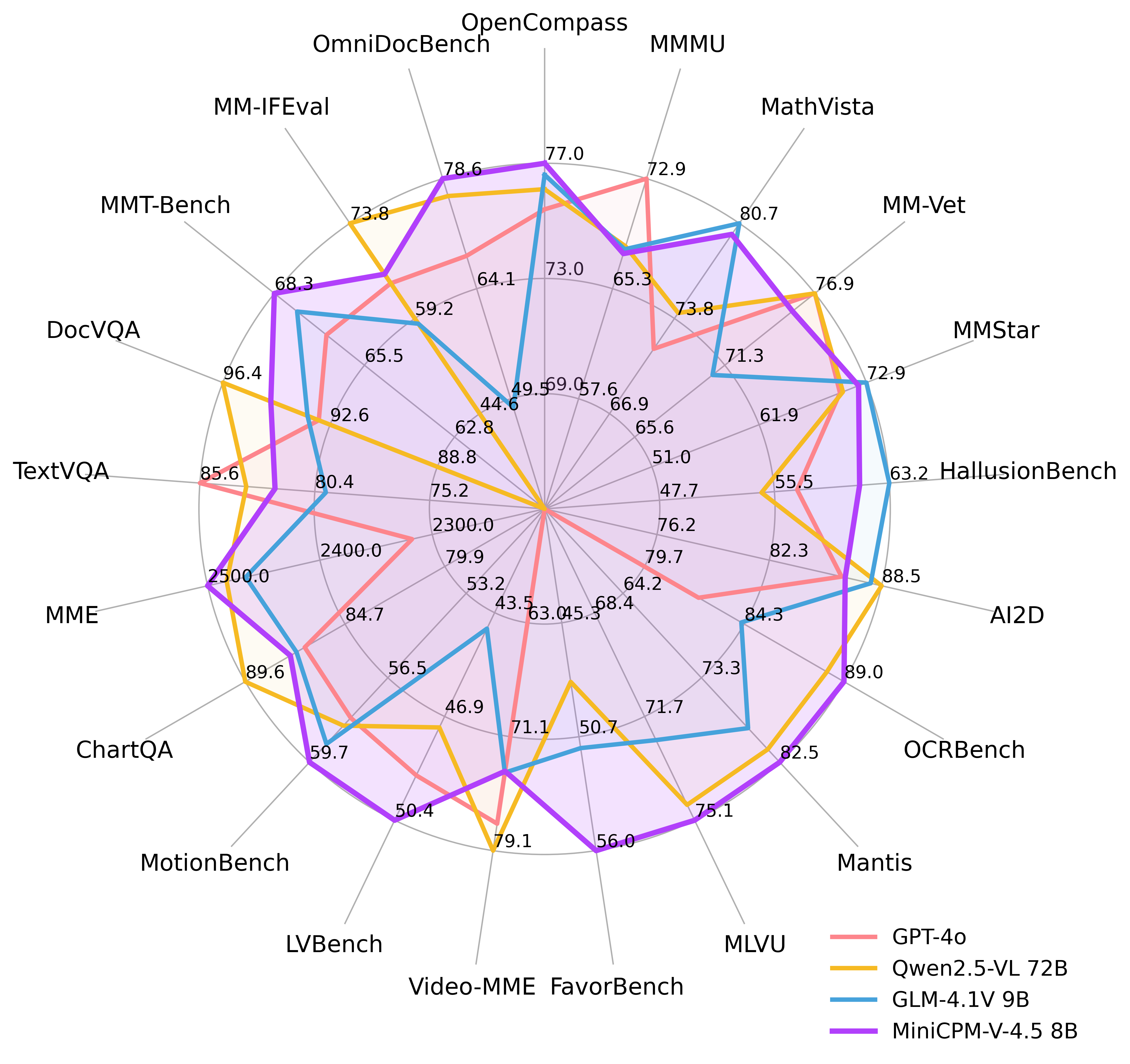
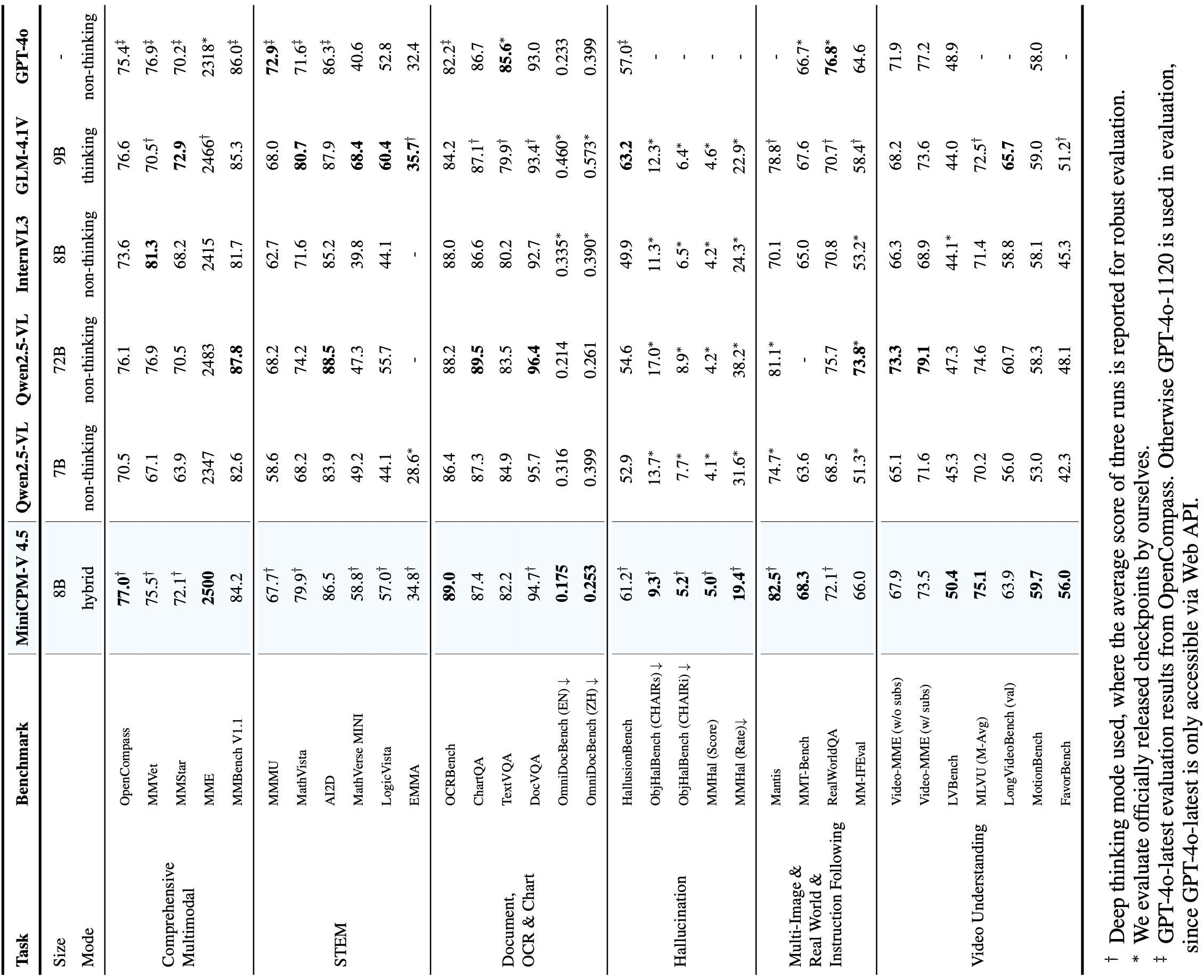
- Scores 77.0 on OpenCompass, beating GPT-4o-latest, Gemini-2.0 Pro, and Qwen2.5-VL 72B.
- New 3D-Resampler compresses 6 video frames into 64 tokens, a 96x reduction.
- Runs Video-MME in 0.26 hours vs 2.63 hours for GLM-4.1V-9B-Thinking on 8xA100.
- Supports switchable fast and deep thinking modes via
enable_thinkingflag. - Apache-2.0 licensed, ships with vLLM, SGLang, llama.cpp, Ollama, and iOS support.
OpenBMB has released MiniCPM-V 4.5, an 8B parameter multimodal model that punches well above its weight class. It scores an average of 77.0 on OpenCompass, a suite of eight popular benchmarks, surpassing widely used proprietary systems like GPT-4o-latest and Gemini-2.0 Pro, along with strong open-source contenders like Qwen2.5-VL 72B. The weights ship under Apache-2.0, and the model is small enough to run on an iPad.
MiniCPM-V 4.5 is built on Qwen3-8B and SigLIP2-400M, and arrives with three headline capabilities: strong image understanding, high-FPS video comprehension via aggressive token compression, and a switchable fast/deep thinking mode for controlling compute per query.
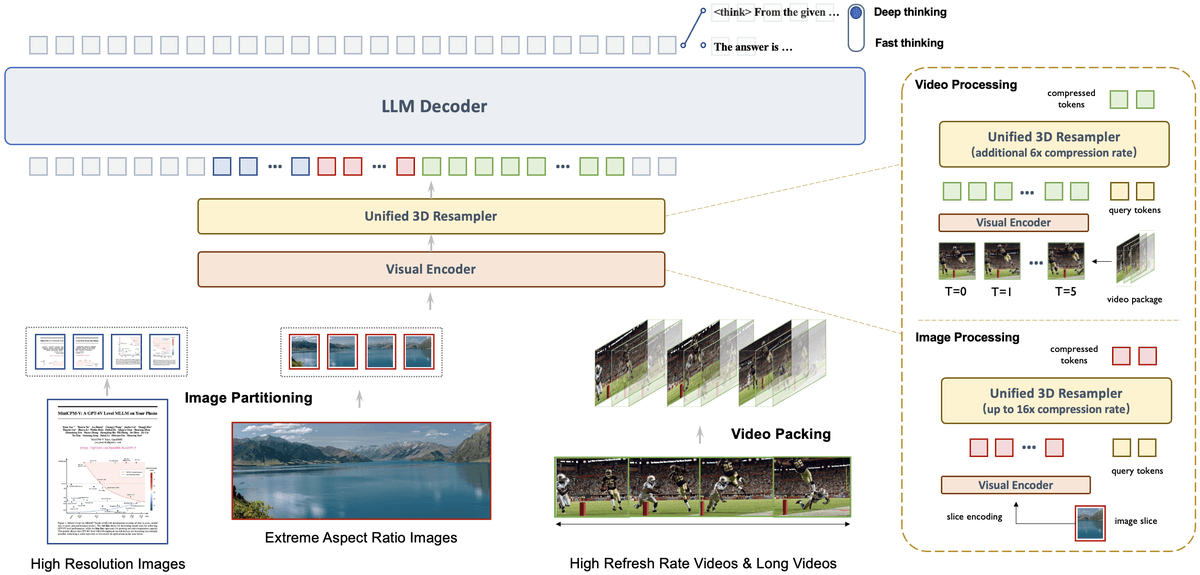
Squeezing video 96x
Video understanding has always been the token accounting nightmare of multimodal models. Each frame gets encoded into hundreds or thousands of tokens, and context windows blow up fast. MiniCPM-V 4.5 attacks this with a unified 3D-Resampler over images and video that hits a 96x compression ratio, packing six 448x448 frames into 64 tokens (most MLLMs would spend 1,536). The model can therefore see many more frames without paying for them at inference time, which unlocks high refresh rate (up to 10 FPS) and long-form video results on Video-MME, LVBench, MLVU, MotionBench, and FavorBench.
The efficiency gains are dramatic. On Video-MME, MiniCPM-V 4.5 scores 73.5 versus 73.6 for the 10.3B GLM-4.1V-9B-Thinking, but runs the full benchmark in 0.26 hours instead of 2.63 hours on 8xA100 GPUs, using 28GB of GPU memory versus 32GB. Against Qwen2.5-VL-7B-Instruct (71.6 score, 3 hours, 60GB), the gap widens further.
Fast thinking or deep thinking, your choice
Two reasoning modes ship in the same weights: a fast mode for high-frequency use with competitive quality, and a deep mode for harder problems. Enabling reasoning is a single argument in the chat call:
answer = model.chat(
    msgs=msgs,
    tokenizer=tokenizer,
    enable_thinking=True,  # deep reasoning mode
    stream=True
)
Reasoning modes usually demand a much bigger inference budget, which is where the compute numbers get interesting. On OpenCompass, MiniCPM-V 4.5 hits 77.0 in 7.5 hours of total inference time, versus 17.5 hours for GLM-4.1V-9B-Thinking (76.6) and 11 hours for MiMo-VL-7B-RL (76.4). Higher score, less than half the compute.
OCR and documents at 1.8 megapixels
Document understanding is where much practical multimodal work actually happens, and it is where MiniCPM-V 4.5 shines the brightest. Based on the LLaVA-UHD architecture, the model handles high-resolution inputs with any aspect ratio up to 1.8 million pixels (e.g., 1344x1344), using 4x fewer visual tokens than most MLLMs. It leads OCRBench, ahead of GPT-4o-latest and Gemini 2.5, and posts leading numbers on OmniDocBench for PDF parsing among general-purpose MLLMs.
How it was trained
The team calls out three specific innovations in the training recipe. The first is the 3D-Resampler mentioned above, which unifies how the model encodes single images, multi-image inputs, and video, so capabilities transfer cleanly across modalities.
The second is a clever unification of OCR and document knowledge training. Previous vision-language models learned OCR (transcribing visible text) and document knowledge (reasoning about content) as two separate objectives, often stitched together with brittle parser pipelines. MiniCPM-V 4.5 instead dynamically corrupts text regions in documents at varying noise levels and asks the model to reconstruct them. When the text is legible, the model learns accurate OCR. When it is heavily obscured, the model has to reason from surrounding context. The paper argues this removes the reliance on error-prone document parsers and reduces hallucinations from over-augmented OCR data.
The third is a hybrid reinforcement learning approach that jointly optimizes both thinking modes, combining RLPR and RLAIF-V to generalize reasoning across diverse multimodal data while suppressing hallucinations. OpenBMB reports that the resulting model outperforms GPT-4o-latest on MMHal-Bench for trustworthy behavior, and supports over 30 languages.
Deployment paths
OpenBMB clearly cares about actually shipping this model. Support is broad from day one:
- Edge inference: llama.cpp and Ollama for CPU inference on local devices
- Quantized formats: int4, GGUF, and AWQ in 16 sizes
- High-throughput serving: vLLM (0.10.2+) and SGLang
- Fine-tuning: Transformers and LLaMA-Factory
- Mobile: an optimized iOS app for iPhone and iPad
Getting started with vLLM is a two-line operation once the package is installed:
pip install vllm
vllm serve "openbmb/MiniCPM-V-4_5"
The server exposes an OpenAI-compatible chat completions endpoint, so existing tooling that talks to GPT-4o can be pointed at a local instance with minimal changes.
Why this matters
The most interesting practical claim here is that a model you can run on an iPad now matches or beats the multimodal capabilities of frontier proprietary models on general benchmarks. That reshapes several product decisions: on-device document scanners, real-time video assistants at 10 FPS, screen-recording understanding for agents, and multilingual OCR pipelines no longer obviously need a hosted API call.
The video efficiency numbers are the standout technical result. A 96x token compression ratio is not a minor optimization; it changes what fits in a context window. Long-form video QA, surveillance analysis, and multi-camera reasoning become tractable at parameter counts and memory budgets previously reserved for short clips. Paired with a permissive Apache-2.0 license and a well-documented deployment story across llama.cpp, vLLM, SGLang, and iOS, MiniCPM-V 4.5 raises the floor for what open-weight multimodal models are expected to deliver.