
OpenBMB's MiniCPM-o 4.5 Beats GPT-4o at Vision and Speech on a Laptop
OpenBMB's 9B open-source omni-model sees, hears, and speaks concurrently while approaching Gemini 2.5 Flash on vision benchmarks.
 Pro
Takeaways
- MiniCPM-o 4.5 is a 9B Apache-2.0 omni-modal model supporting vision, speech, and full-duplex streaming.
- Built on SigLip2, Whisper-medium, CosyVoice2 and Qwen3-8B via dense end-to-end hidden-state connections.
- Scores 77.6 on OpenCompass, beating GPT-4o and approaching Gemini 2.5 Flash on vision.
- State-of-the-art on OmniDocBench English document parsing, outperforming Gemini-3 Flash and GPT-5.
- Runs in int4 at 212 tokens/s using just 11GB VRAM, deployable on MacBook via llama.cpp-omni.
- Voice cloning from single reference clip surpasses CosyVoice2; supports 30+ languages and 10fps video.
OpenBMB has released MiniCPM-o 4.5, a 9B parameter omni-modal model that pushes the open-source frontier for real-time multimodal interaction. It handles vision, speech, and full-duplex live streaming in a single end-to-end architecture, with weights available under Apache-2.0.
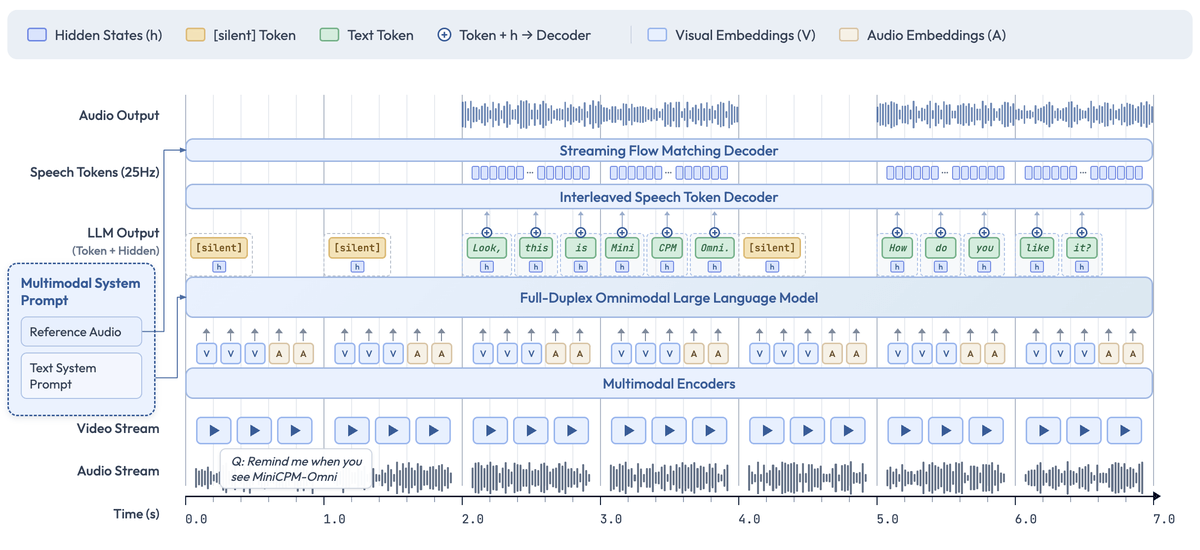
The headline claim is that it can see, listen, and speak simultaneously without any of these streams blocking each other. Most open-source stacks still emulate that capability by stitching together separate ASR, LLM, and TTS pipelines, each adding latency.
Inside the architecture
The model is built end-to-end on SigLip2, Whisper-medium, CosyVoice2, and Qwen3-8B, totaling 9B parameters. Rather than piping tokens through frozen encoders, the modality encoders and decoders are densely connected to the LLM via hidden states, which the team argues lets the backbone actually exploit multimodal knowledge during training.
Parallel streaming is where the design gets interesting. Traditional models process one modality at a time. MiniCPM-o 4.5 uses a time-division multiplexing (TDM) mechanism that syncs all input and output streams on a millisecond timeline, dividing parallel omni-modality streams into sequential info groups within small periodic time slices. The speech token decoder then interleaves text and speech tokens to keep speech generation in sync with new inputs, which also stabilizes long-form generation past the one-minute mark.
For proactive behavior, the LLM continuously monitors incoming video and audio and, at a decision frequency of 1Hz, decides whether to speak or stay silent. That lets it act more like an attentive assistant than a call-and-response bot, initiating reminders or comments based on what it sees.
Benchmarks that matter
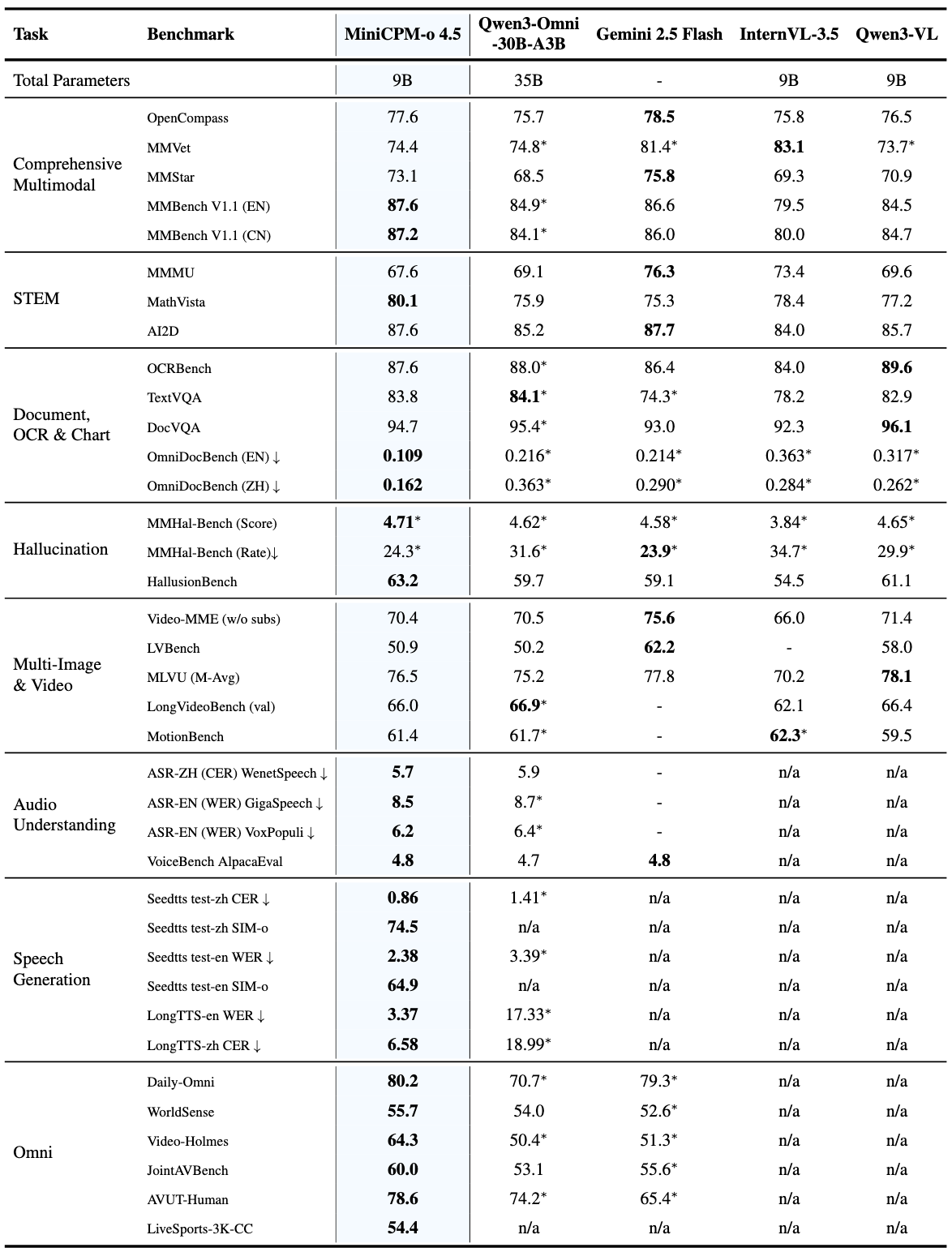
MiniCPM-o 4.5 achieves an average score of 77.6 on OpenCompass, a comprehensive evaluation across 8 popular benchmarks. With only 9B parameters, it surpasses widely used proprietary models like GPT-4o and Gemini 2.0 Pro, and approaches Gemini 2.5 Flash for vision-language capabilities. Both instruct and thinking modes ship in a single model.
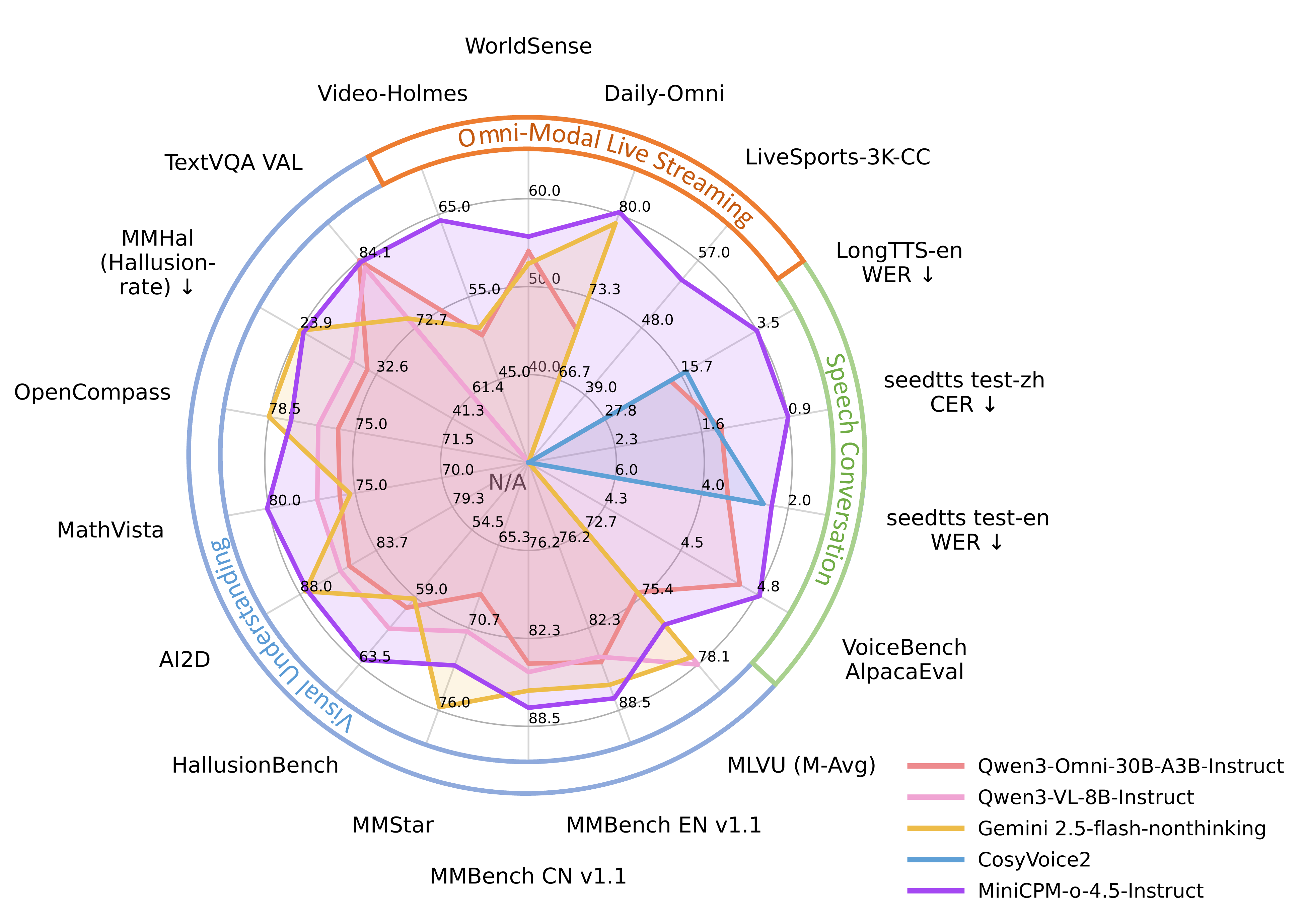
OCR results are where things get spicier. On OmniDocBench, MiniCPM-o 4.5 achieves state-of-the-art end-to-end English document parsing, outperforming proprietary models such as Gemini-3 Flash and GPT-5, along with specialized tools like DeepSeek-OCR 2. On omni half-duplex benchmarks combining audio and video, it hits an average of 68.5 across seven tests (Daily-Omni, WorldSense, Video-Holmes, JointAVBench, AVUT-Human, FutureOmni, Video-MME-Short), beating both Gemini 2.5 Flash and Qwen3-Omni-30B.
For speech generation, on the seedtts test-zh benchmark it hits 0.86% CER against CosyVoice2's 1.45%, and on long-form TTS it drops English WER to 3.37% while CosyVoice2 sits at 14.80%. Voice cloning quality reportedly exceeds CosyVoice2 from a single reference clip.
Small enough for a laptop
The efficiency numbers are what make this practical. In int4, MiniCPM-o 4.5 decodes at 212.3 tokens per second with 11GB of GPU memory and a time-to-first-token of 0.6 seconds. Qwen3-Omni-30B-A3B, by comparison, requires 20.3GB in int4 and cannot run in bf16 on the same setup.
Deployment options are surprisingly complete for a fresh release:
- PyTorch inference on an Nvidia GPU with at least 28GB VRAM for full precision
- llama.cpp-omni half-duplex realtime speech on an Apple M3/M4/M5 with 16GB RAM or a 12GB GPU
- Full-duplex omnimodal streaming on an Apple M4 Max with 24GB RAM
- vLLM and SGLang for high-throughput serving
- int4 and GGUF quantizations in 16 sizes
- FlagOS support across Nvidia, Hygon, Metax, Iluvatar, Ascend, and Zhenwu chips
Using it
Getting started with Transformers is a two-line affair. The chat API accepts either native Python objects (PIL images, numpy audio arrays) or an OpenAI-compatible structured content format.
from transformers import AutoModel
import torch
model = AutoModel.from_pretrained(
    "openbmb/MiniCPM-o-4_5",
    trust_remote_code=True,
    torch_dtype=torch.bfloat16,
    init_vision=True, init_audio=True, init_tts=True,
)
model.eval().cuda()
duplex_model = model.as_duplex()
For duplex streaming, you call streaming_prefill and streaming_generate per chunk. The generate call returns whether the model is currently listening or speaking, the text token, end-of-turn state, and an audio waveform if one was produced. That is enough to build a WebRTC pipeline without inventing your own turn-taking logic.
Where it falls short
The benchmarks reveal some soft spots worth noting:
- MMMU sits at 67.6, behind Qwen3-VL-8B and well below GPT-5's 81.8, suggesting weaker performance on college-level academic reasoning
- Math500 is 77.0, notably below the underlying Qwen3-8B's 84.0, so multimodal training likely traded some pure-math ability
- Chinese long-form TTS still trails CosyVoice2 (6.58% CER vs 5.27%)
- ASR WER on LibriSpeech test-other lands at 2.8, slightly behind Qwen3-Omni-30B and Kimi-Audio
Why this release lands
Commercial labs have been demonstrating "see, hear, and speak at once" behavior through paid live-conversation APIs. Bundling that capability into a 9B Apache-licensed model, with quantizations that run on a MacBook, closes a significant gap. Full-duplex streaming, proactive 1Hz decisions, voice cloning from a reference clip, and 10fps video at up to 1.8 million pixels per frame are all knobs you can now turn on your own hardware.
Practical fits are obvious: live tutoring agents that comment on what a student is drawing, meeting assistants that speak up when relevant, accessibility tools that describe scenes in real time, and voice-cloned character bots that hold long conversations without losing prosody. The end-to-end document parsing benchmark also makes it a plausible replacement for pipelines that currently chain a dedicated OCR model with an LLM.
Combined with the earlier MiniCPM-V 4.5 vision-only sibling, OpenBMB now covers most of the multimodal spectrum with edge-deployable open weights. Multi-vendor chip support via FlagOS suggests they are also trying to solve the deployment fragmentation problem alongside the model quality one.
