
OpenBMB's MiniCPM-o 2.6 Beats GPT-4o on Vision and Speech With 8B Parameters
OpenBMB's 8B open-source omni model matches GPT-4o on vision, beats it on speech recognition, and runs on an iPad.
 Pro
Takeaways
- OpenBMB released MiniCPM-o 2.6, an 8B any-to-any model for vision, speech, and live streaming.
- Built end-to-end from SigLip-400M, Whisper-medium, ChatTTS-200M, and Qwen2.5-7B, licensed Apache-2.0.
- Scores 70.2 on OpenCompass, beating GPT-4o-202405, Gemini 1.5 Pro, and Claude 3.5 Sonnet on single-image tasks.
- Outperforms GPT-4o-Realtime on Chinese ASR and CoVoST speech translation benchmarks.
- Encodes a 1.8M pixel image in only 640 tokens, 75% fewer than most competitors, enabling iPad-class deployment.
- Supports voice cloning, emotion control, 30+ languages; runs via Ollama, llama.cpp, and vLLM.
OpenBMB just dropped MiniCPM-o 2.6, an 8B parameter any-to-any model that handles vision, speech, and live audio/video streams in a single end-to-end network. The headline claim is bold: GPT-4o-level performance across modalities, running on consumer devices, under Apache-2.0. The benchmarks actually back most of it up.
What's inside the 8B stack
The model is built end-to-end on SigLip-400M, Whisper-medium-300M, ChatTTS-200M, and Qwen2.5-7B, totaling 8B parameters. Rather than bolting adapters onto a frozen LLM, the encoders and decoders for each modality are trained jointly with the language backbone so gradients flow through the entire pipeline.
The architecture introduces two ideas worth knowing about:
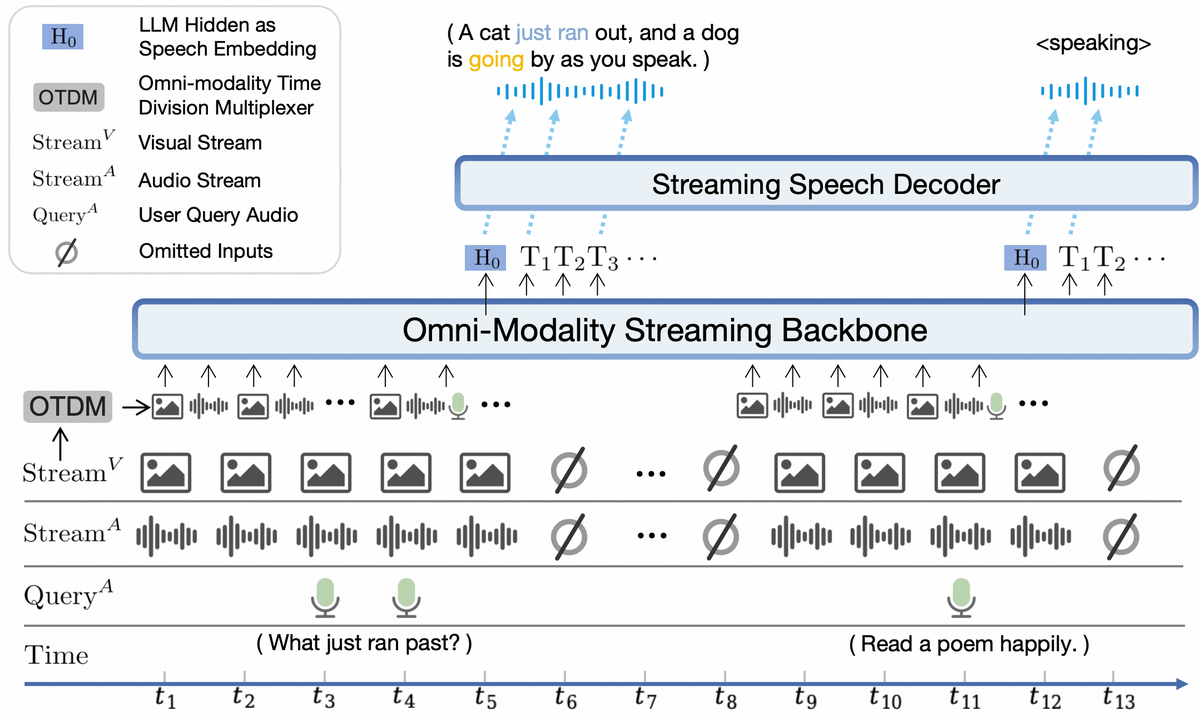
- Online encoders/decoders. The offline modality encoder/decoders are converted into online ones for streaming inputs and outputs, so the model can consume audio and video chunks as they arrive rather than waiting for a full clip.
- Time-division multiplexing (TDM). A TDM mechanism handles omni-modality streaming inside the LLM backbone. Parallel video and audio streams get chopped into small periodic time slices and interleaved into a single sequence the LLM can attend over.
- Configurable voice via audio system prompt. A separate audio system prompt controls the assistant's voice, which is what enables voice cloning and description-based voice creation without retraining.
The benchmark story
On vision, the numbers are strong for the size class. MiniCPM-o 2.6 scores 70.2 on OpenCompass, an average across 8 popular benchmarks. With only 8B parameters, it surpasses widely used proprietary models like GPT-4o-202405, Gemini 1.5 Pro, and Claude 3.5 Sonnet on single-image understanding, and lands state-of-the-art on OCRBench for models under 25B.

Speech is where things get more interesting. On audio understanding, it posts a 1.6 CER on AISHELL-1 and 4.4 on Fleurs zh, edging out GPT-4o-Realtime and Gemini 1.5 Pro on Chinese ASR. On CoVoST speech translation it hits 48.2 BLEU (en2zh) and 27.2 (zh2en), again above the GPT-4o-Realtime numbers reported in the same eval. Speech generation is a mixed picture: it beats every open-source competitor on the AudioArena ELO leaderboard but still trails GPT-4o-Realtime on overall speech QA.
Live streaming is a new capability. MiniCPM-o 2.6 accepts continuous video and audio streams independent of user queries, and supports real-time speech interaction. It outperforms GPT-4o-202408 and Claude 3.5 Sonnet on StreamingBench, a benchmark covering real-time video, omni-source (video and audio), and multimodal contextual understanding. Overall StreamingBench score comes in at 66.0 versus 64.1 for GPT-4o and 59.7 for Claude 3.5 Sonnet, though Gemini 1.5 Pro still leads at 70.3.
Why it fits on an iPad
The efficiency story hinges on token density, meaning the number of pixels encoded into each visual token. MiniCPM-o 2.6 produces only 640 tokens when processing a 1.8M pixel image, 75% fewer than most models. That directly improves inference speed, first-token latency, memory usage, and power draw, which is how the model can run multimodal live streaming on end-side devices like iPads.
For deployment, there's an int4 quantized build that fits in 7GB of GPU memory, plus GGUF variants in 16 sizes, vLLM support for throughput, and llama.cpp support for CPU-only inference. Ollama has an official OpenBMB repo, though the Ollama build currently exposes only image capabilities while the omni features stay on the PyTorch path.
Using it
Loading is a two-liner if you already have transformers==4.44.2 installed. The model exposes vision-only, audio-only, and full omni modes via init flags:
from transformers import AutoModel, AutoTokenizer
import torch
model = AutoModel.from_pretrained(
    'openbmb/MiniCPM-o-2_6',
    trust_remote_code=True,
    attn_implementation='sdpa',
    torch_dtype=torch.bfloat16,
    init_vision=True, init_audio=True, init_tts=True,
).eval().cuda()
tokenizer = AutoTokenizer.from_pretrained('openbmb/MiniCPM-o-2_6', trust_remote_code=True)
model.init_tts()
Video-plus-audio inference works by feeding <unit> markers with a frame and a one-second audio slice per step, then calling model.chat with omni_input=True. A separate streaming_prefill / streaming_generate API keeps a session's KV cache alive so you can push new chunks in real time.

Where it shines, where it stumbles
Realistic use cases where this model does well:
- On-device assistants that watch a camera feed and respond by voice, without shipping audio and video to a cloud API.
- Document and receipt OCR, where the high pixel-per-token ratio lets it handle 1344x1344 scans without slicing.
- Bilingual (English/Chinese) transcription and translation, where it beats GPT-4o-Realtime on the reported evals.
- Voice cloning and roleplay agents driven by a reference audio clip in the system prompt.
- Multi-image reasoning and few-shot ICL on visual tasks.
Weak spots worth flagging: speech generation still trails GPT-4o-Realtime on the AudioArena overall ELO (1131 vs 1200), the reported ASR-WER of 9.8 is well above GPT-4o's 2.3, and F5-TTS beats it on Seed-TTS voice cloning similarity. The Ollama route only exposes vision today, so any live-streaming demo needs the full PyTorch stack. Community reports on the Hugging Face discussions also mention rough edges around long conversations, where the assistant_default_female_voice can drift between turns.
Why this release matters
What stands out here goes beyond any single benchmark. A fully open, Apache-2.0, 8B model now covers vision, ASR, TTS, speech translation, voice cloning, and live streaming in one checkpoint that runs on a tablet. Until recently, that combination required stitching together five separate models or paying for the GPT-4o realtime API.
For anyone building agents that need eyes, ears, and a voice without a cloud round-trip, this is one of the first credible open baselines. The GitHub repo has the streaming demo code, and the technical blog covers the TDM design in more depth if you want to understand how they packed all of this into 8B parameters.