
OpenBMB's MiniCPM-Llama3-V 2.5 Beats GPT-4V on OCR Running on a Smartphone
OpenBMB's 8B vision-language model matches GPT-4V on benchmarks while running on a phone, with strong OCR and 30+ language support.
 Pro
Takeaways
- OpenBMB released MiniCPM-Llama3-V 2.5, an 8B multimodal model built on SigLip-400M and Llama3-8B.
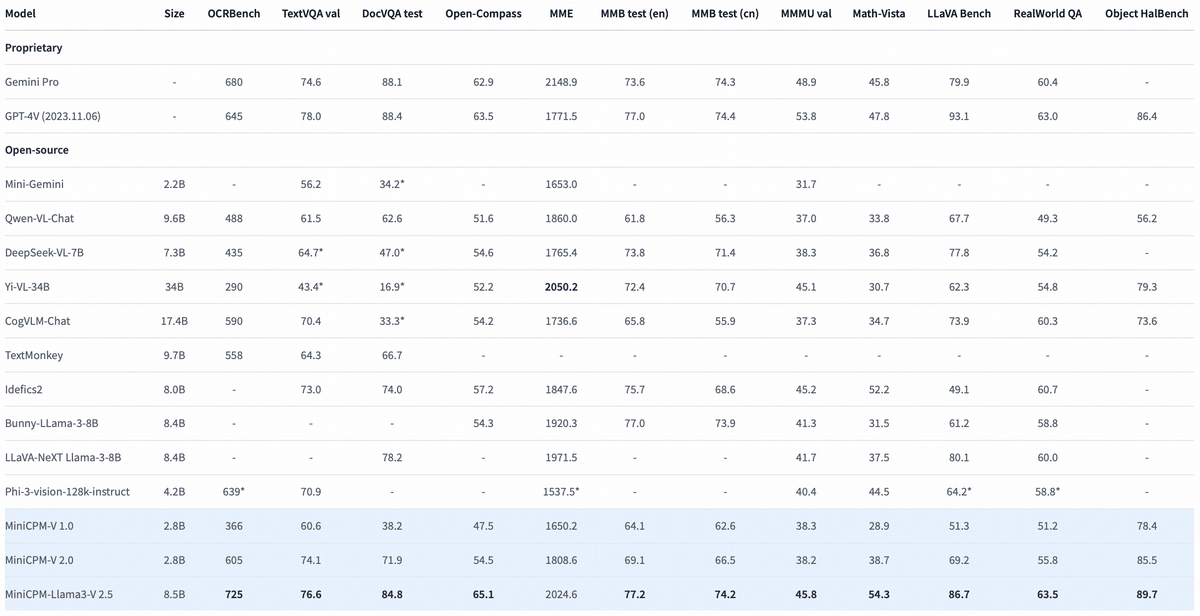
- Scores 65.1 on OpenCompass, beating GPT-4V-1106, Gemini Pro, Claude 3, and Qwen-VL-Max.
- Over 700 on OCRBench, surpassing GPT-4o and GPT-4V-0409 on document tasks.
- RLAIF-V tuning drops hallucination rate to 10.3% on Object HalBench, below GPT-4V-1106's 13.6%.
- 150x faster image encoding via QNN NPU integration into llama.cpp for Qualcomm-based phones.
- Supports 30+ languages, LoRA fine-tuning on 2 V100s, and int4 quantization fitting in 8GB VRAM.
OpenBMB has released MiniCPM-Llama3-V 2.5, an 8B-parameter multimodal LLM that claims GPT-4V-level performance while being small enough to run on a smartphone. If the benchmarks hold up, it's one of the strongest open-source vision-language models you can actually deploy on-device.
Punching above its weight class
MiniCPM-Llama3-V 2.5 scores an average of 65.1 on OpenCompass across 11 popular benchmarks. With only 8B parameters, it surpasses widely used proprietary systems including GPT-4V-1106, Gemini Pro, Claude 3, and Qwen-VL-Max, and outperforms other Llama 3-based MLLMs by a wide margin.
The architecture pairs SigLip-400M as the vision encoder with Llama3-8B-Instruct as the language backbone. That combination feeds a solid visual representation into one of the best open text models, tuned end-to-end for multimodal reasoning.
OCR is where it really shines
Document understanding is arguably the most useful capability for real applications, and it's where MiniCPM-Llama3-V 2.5 makes its biggest gains. The model handles images at any aspect ratio up to 1.8 million pixels (for example, 1344×1344) and posts a 700+ score on OCRBench, ahead of GPT-4o, GPT-4V-0409, Qwen-VL-Max, and Gemini Pro.
An independent review reports 76.6% accuracy on TextVQA and 84.8% on DocVQA. Practical OCR features also got upgrades: better full-text extraction, table-to-markdown conversion, and stronger instruction-following and complex reasoning.
Fewer hallucinations, more languages
Hallucination is the perennial multimodal problem, and OpenBMB tackled it with a preference-tuning technique called RLAIF-V, the newest addition to the RLHF-V (CVPR'24) series. On Object HalBench, MiniCPM-Llama3-V 2.5 posts a 10.3% hallucination rate, lower than GPT-4V-1106 at 13.6% and the best result in the open-source community. RLAIF-V works like RLHF, except the preference labels come from another AI model rather than humans, which scales cheaply.
Language coverage also expanded well beyond the usual Chinese-English pairing. Support now spans over 30 languages including German, French, Spanish, Italian, and Russian, using a cross-lingual generalization trick from OpenBMB's earlier VisCPM work.
The real trick: running it on your phone
OpenBMB did the engineering work to make an 8B multimodal model usable on consumer hardware. After systematic optimization, the release delivers a 150× speedup in end-side image encoding and a 3× increase in language decoding speed.
Those gains came from integrating Qualcomm's NPU acceleration framework QNN into llama.cpp, a first for multimodal LLMs. Deployment options for developers are broad:
- GGUF quantized weights in 16 sizes for llama.cpp and Ollama
- An int4 quantized version that fits in 8GB of GPU memory
- vLLM and SGLang support with an OpenAI-compatible API
- LoRA fine-tuning on just 2 V100 GPUs
- Gradio and Streamlit demo scaffolds
Basic inference is a handful of lines of Python:
from transformers import AutoModel, AutoTokenizer
from PIL import Image
import torch
model = AutoModel.from_pretrained('openbmb/MiniCPM-Llama3-V-2_5',
    trust_remote_code=True, torch_dtype=torch.float16).to('cuda')
tokenizer = AutoTokenizer.from_pretrained('openbmb/MiniCPM-Llama3-V-2_5',
    trust_remote_code=True)
image = Image.open('doc.jpg').convert('RGB')
msgs = [{'role': 'user', 'content': 'Extract the table as markdown.'}]
print(model.chat(image=image, msgs=msgs, tokenizer=tokenizer))
Where it fits, where it doesn't
Sweet-spot use cases follow directly from the strengths:
- On-device document scanning, receipt parsing, and form extraction
- Table-to-markdown pipelines that keep data off cloud APIs
- Multilingual visual question answering in mobile apps
- Fine-tuned assistants for niche vertical tasks, given the modest 2-GPU LoRA cost
The limitations are the usual ones for an 8B model. It won't beat a frontier closed model on complex multi-step visual reasoning, and video understanding isn't native here (though the successor, MiniCPM-V 2.6, addresses that). Licensing is also worth checking: weights are free for academic research and available for commercial use after registering through a questionnaire, so this isn't a fully permissive drop-in for every product.
Why this release matters
Open multimodal models have been closing the gap to frontier proprietary systems, and the parameter count needed to do so keeps falling. MiniCPM-Llama3-V 2.5 is a concrete data point: an 8B model, deployable on a Xiaomi 14 Pro, beating GPT-4V-1106 on OCR-heavy tasks with a lower hallucination rate. For anyone building document intelligence, mobile assistants, or edge vision applications, that shifts what's practical without a cloud API bill attached.