
OpenAI Ships GPT-Realtime-Whisper to Transcribe Live Audio Mid-Sentence
OpenAI introduced GPT-Realtime-Whisper, a streaming speech-to-text model that emits transcript text while audio is still arriving, priced at $0.017 per minute.
 Pro
Takeaways
- OpenAI launched GPT-Realtime-Whisper, a streaming speech-to-text model that emits transcript deltas as audio arrives.
- Two siblings ship alongside: GPT-Realtime-2 for reasoning voice agents and GPT-Realtime-Translate for live multilingual conversation.
- Priced at $0.017 per minute, roughly 2.83 times the legacy whisper-1 rate at $0.006, reflecting the streaming premium.
- Latency and accuracy are tunable via a delay setting; vocabulary and language hints are supported.
- Available through the Realtime API, which also exited beta and is now generally available.
- Diarization, timestamps, and translation still route to separate endpoints; whisper-1 stays live in the API.
OpenAI has finally given Whisper a streaming sibling. Alongside two other realtime voice models, the company shipped GPT-Realtime-Whisper, a speech-to-text model built for live audio, where the transcript needs to appear during the conversation rather than after the file is uploaded. It ships through the Realtime API, which also exited beta in the same release.
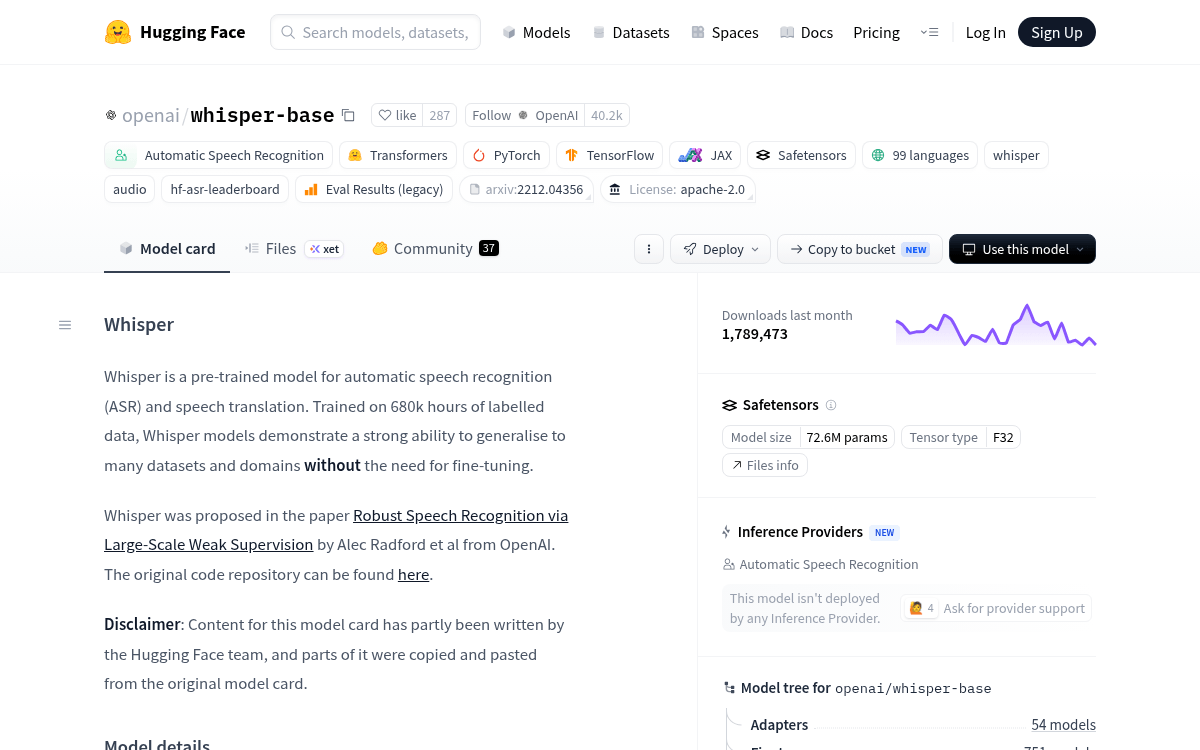
The original open-weights Whisper, the one sitting on Hugging Face with millions of monthly pulls, was never designed for streaming. It transcribes a completed file. If you wanted live captions, meeting notes that keep up, or a voice agent that reacts before the speaker stops talking, you were stitching together chunked uploads, VAD hacks, or a third-party provider. That gap is what this release closes.
What actually shipped
OpenAI introduced three audio models in the API: GPT-Realtime-2, a voice model with GPT-5-class reasoning; GPT-Realtime-Translate, which translates speech from 70+ input languages into 13 output languages while keeping pace with the speaker; and GPT-Realtime-Whisper, which transcribes speech live as the speaker talks. The three are meant to compose. You can run Realtime-Whisper alongside Realtime-Translate in the same session, one producing source-language text, the other producing the translated output.
The important design decision on the transcription side is that latency and accuracy are tunable rather than fixed. A delay setting controls how much audio the model hears before emitting text: lower values surface partial text sooner, and higher values give the model more context and improve transcript quality. You can also pass the languages you expect and vocabulary hints, so product names, acronyms, and identifiers come through correctly.
The cost of talking live
GPT-Realtime-Whisper is priced by audio duration rather than text tokens. The list rate lands at $0.017 per minute, which is 2.83 times more expensive than the four-year-old whisper-1 at $0.006 per minute. OpenAI did not retire whisper-1; both are live in the API simultaneously. The price gap is entirely the streaming premium: the new model produces tokens as they are spoken, while the legacy model produces tokens after the file finishes processing.
Here is how the current OpenAI transcription menu looks in practice:
| Model | Price / min | Mode | Best for |
|---|---|---|---|
| gpt-4o-mini-transcribe | $0.003 | Batch | High-volume clean audio |
| whisper-1 / gpt-4o-transcribe | $0.006 | Batch | Files, podcasts, recordings |
| GPT-Realtime-Whisper | $0.017 | Streaming | Live captions, voice agents |
| GPT-Realtime-Translate | $0.034 | Streaming | Live multilingual conversation |
Where it actually earns its keep
The pitch is that live speech becomes usable inside a business workflow the moment it happens. The model transcribes audio as it arrives, without waiting for the utterance to complete, and targets scenarios where delays are unacceptable, such as live captions or quality monitoring. Concrete places this shows up:
- Captions for meetings, classrooms, broadcasts, and live events
- Meeting notes and summaries generated while the conversation is still going
- Voice agents that need to understand the user continuously, not turn-by-turn
- Follow-up automation for customer support, sales, healthcare, and recruiting calls
- Source-language transcription running in parallel with GPT-Realtime-Translate for multilingual UX
A minimal way to think about the wiring, from the model docs:
from openai import OpenAI
client = OpenAI()
# Persistent streaming session, not one-shot file upload
session = client.realtime.sessions.create(
    model="gpt-realtime-whisper",
    modalities=["text"],
    input_audio_format="pcm16",
    language="en",
    vocabulary=["Orbit-742Q", "BuyAbility"],
)
# stream mic frames -> receive transcript deltas as events
Realtime transcription uses a persistent streaming session, not one-request-per-file upload, so you pick the Realtime API when you need low-latency transcript updates while audio is still in progress. That is a different integration path than the /v1/audio/transcriptions endpoint most Whisper users already have wired up.
The limits worth flagging
Two constraints worth knowing before you migrate anything. Realtime-Whisper handles transcription only. Timestamps, translation, subtitles, and speaker diarization still live on other endpoints, so specialized Whisper and GPT-4o transcription workflows remain necessary for those jobs. If you need who-said-what, you still route to gpt-4o-transcribe-diarize or bolt on pyannote.
The price gap versus batch also matters. A roughly 50x spread between a full conversational agent and offline transcription is the kind of math that breaks naive forecasts. A voice product that bundles everything on Realtime-2 will burn cash on transcription that could have run on whisper-1 for a fraction of the price. Picking the right model per task matters more than picking the right family. The straightforward rule from the field: use batch pricing when the user can wait, and use realtime pricing when the product experience depends on words appearing during the session.
Where the competitive picture sits
Streaming ASR is a crowded market now. Community benchmarking puts it this way: streaming transcription on a budget belongs on Deepgram, bulk batch transcription belongs on Groq, and the OpenAI options make sense when you want everything in one vendor or when Whisper's specific accuracy profile is what your eval needs. Early third-party evals also flag that Realtime-Whisper only earns its 2.8x markup when streaming latency is non-negotiable.
Multilingual reports look strong on the translation sibling, which is likely to matter for anyone shipping cross-border voice. GPT-Realtime-Translate supports more than 70 input languages and 13 output languages. One early tester, BolnaAI, reported in evals across Hindi, Tamil, and Telugu that Realtime-Translate delivered 12.5% lower Word Error Rates than any other model tested, along with lower fallback rates, higher task completion, and latency that sustained natural conversation. That is a data point from a design partner, not an independent benchmark, but it hints at where the new stack differentiates.
The takeaway
The open-source Whisper checkpoint that still gets millions of downloads a month is not going anywhere, and neither is whisper-1 in the API. What changed is that OpenAI now has a first-party streaming answer with a tunable latency-accuracy knob and a per-minute price, delivered through the same Realtime session you would use to run a voice agent or a live translator. If you have been running a chunked-upload workaround, or paying a third-party streaming ASR just for the delta events, this is the model to benchmark against your current setup, keeping the 2.8x markup in mind for anything that does not actually need to appear on screen mid-utterance.