
OpenAI Ships GPT-Realtime-Whisper to Replace Batch Transcription With Live Streaming
OpenAI unveiled three new realtime voice models in the API, including GPT-Realtime-Whisper, a streaming speech-to-text successor to classic Whisper.
 Pro
Takeaways
- OpenAI launched three new Realtime API voice models: GPT-Realtime-2, GPT-Realtime-Translate, GPT-Realtime-Whisper.
- GPT-Realtime-Whisper is a streaming speech-to-text successor to classic Whisper, priced at $0.017 per minute.
- GPT-Realtime-2 adds GPT-5-class reasoning, 128K context, adjustable reasoning effort, and audible tool-call narration.
- GPT-Realtime-Translate covers 70+ input languages and 13 output languages at $0.034 per minute.
- Zillow reported a 26-point call success lift; BolnaAI saw 12.5% lower WER on Indian languages.
- Open-source Whisper checkpoints remain free for batch and offline transcription workloads.
OpenAI has rolled out three new realtime audio models in its API, and one of them carries a familiar name into a new form. GPT-Realtime-Whisper is a streaming speech-to-text model that transcribes as the speaker talks, sitting alongside GPT-Realtime-2 for conversational reasoning and GPT-Realtime-Translate for live multilingual conversations. Together, they push the Realtime API past simple turn-taking toward voice interfaces that can listen, reason, translate, and act in the same session.
Developers can now build voice experiences that transcribe speech live, translate across dozens of languages mid-conversation, and hold enough context to complete real tasks. That closes a gap the classic Whisper never quite did.
Three models, three jobs
Each model targets a distinct workload rather than trying to be everything at once:
- GPT-Realtime-2: A voice model with GPT-5-class reasoning, adjustable reasoning effort (minimal through xhigh), parallel tool calls, and a context window bumped from 32K to 128K tokens.
- GPT-Realtime-Translate: Live translation covering 70+ input languages and 13 output languages, aimed at cross-border support, education, and events.
- GPT-Realtime-Whisper: A low-latency streaming transcription model for captions, meeting notes, and continuous voice agent input.
Why Whisper needed a successor
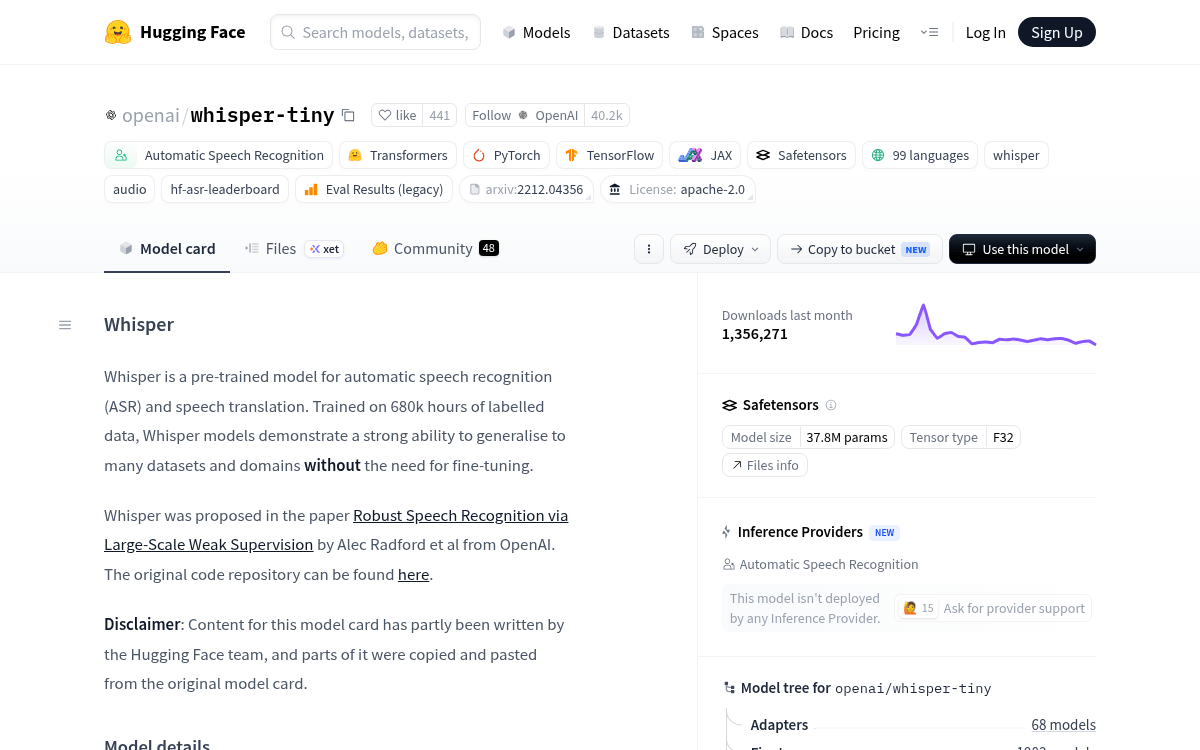
The original Whisper family was a landmark release: a pre-trained model for automatic speech recognition and speech translation, trained on 680k hours of labelled data, with strong ability to generalise across datasets and domains without fine-tuning. It was built for offline, batch-style transcription of pre-recorded audio, not for streaming.
That mismatch has become obvious in production. Independent reviews note that classic Whisper does not natively solve speaker diarisation, it can hallucinate plausible text around unclear or non-speech audio, and the original implementation is a poor fit for low-latency live transcription. Workloads have shifted too: multi-speaker meeting intelligence, contact center compliance, real-time voice agents, and global products switching languages mid-call are now the default.
GPT-Realtime-Whisper answers the streaming half of the problem. Meetings, classrooms, broadcasts, and voice agents that need continuous understanding of the user no longer have to be stitched together with chunked Whisper calls and buffering hacks.
What GPT-Realtime-2 actually changes
The conversational model is where most of the developer-facing behavior lives. A few features stand out for anyone who has shipped a voice agent and hit its ceiling:
- Preambles: The model can emit short filler phrases like "let me check that" so users know it is working, rather than sitting silent while a tool call runs.
- Audible tool transparency: It can narrate parallel tool calls out loud, saying things like "checking your calendar" while the actions execute.
- Graceful recovery: Instead of failing silently on a bad tool response, the model can say it is having trouble and move the conversation forward.
- Reasoning effort dial: Five levels from minimal to xhigh, with low as the default, letting you trade latency for deliberation per turn.
- Domain vocabulary retention: Better handling of proper nouns, healthcare terms, and specialized jargon that tend to break generic ASR.
On benchmarks that map to voice agent behavior, OpenAI reports GPT-Realtime-2 at its high setting scoring 15.2% higher on Big Bench Audio than GPT-Realtime-1.5, and the xhigh setting scoring 13.8% higher on Audio MultiChallenge for instruction following. Early testers include Zillow, whose SVP of AI reported a 26-point lift in call success rate on their hardest adversarial benchmark after prompt optimization, moving from 69% to 95%.
Translation that keeps pace
GPT-Realtime-Translate targets the case where two people speaking different languages need to keep talking without pausing for a full sentence to be processed. BolnaAI, building voice AI for India, reported that in evaluations across Hindi, Tamil, and Telugu, the model delivered 12.5% lower Word Error Rates than any other model tested. Deutsche Telekom is piloting it for multilingual customer support, and Vimeo is using it to translate product videos live as they play.
Pricing and availability
All three models are live in the Realtime API. Pricing breaks down as follows:
| Model | Price |
|---|---|
| GPT-Realtime-2 (audio input) | $32 per 1M tokens ($0.40 cached) |
| GPT-Realtime-2 (audio output) | $64 per 1M tokens |
| GPT-Realtime-Translate | $0.034 per minute |
| GPT-Realtime-Whisper | $0.017 per minute |
For reference, OpenAI's older managed whisper-1 endpoint runs at $0.006 per minute, so the streaming version costs roughly 2.8x more per minute, the premium you pay for live transcription instead of batch. The open-source Whisper checkpoints on Hugging Face remain free to self-host under Apache 2.0 if streaming is not a hard requirement.
How to try it
The fastest path is the Realtime section of the OpenAI Playground. For a code start, OpenAI is pushing a Codex-based scaffold that spins up a minimal WebRTC voice agent against gpt-realtime-2, wires up a server-side session endpoint that posts SDP to /v1/realtime/calls, and registers a sample check_calendar(date, time) function tool over the oai-events data channel.
For an existing app that already uses the classic Whisper API, swapping to GPT-Realtime-Whisper is mostly a matter of moving from a file upload to a streaming session. If you have been using the open-source repo for batch transcription of recorded audio, that path is not going away; the checkpoints are still on Hugging Face and still solid for offline workloads.
What to update in your mental model
The clearest signal is that "Whisper" is no longer one thing. It is now a brand covering an open-source batch ASR family and a proprietary streaming API model, with different strengths and different price points. A few assumptions worth revising:
- Streaming ASR is now a first-class OpenAI product, rather than something you assemble from chunked Whisper calls.
- Voice agents can reason at GPT-5 class without leaving the audio pipeline, which raises the bar for what "good enough" looks like in support and scheduling bots.
- Live translation is a discrete SKU, priced per minute, rather than a side effect of a general speech model.
- Classic Whisper still has a home for offline transcription, self-hosted deployments, and cost-sensitive batch pipelines where latency does not matter.
For teams that have been stitching together Whisper, a translation model, and a chat model into one voice product, the new Realtime lineup collapses that stack into three purpose-built endpoints. Whether that is worth the price bump depends on how much of your current complexity actually comes from the streaming and reasoning gaps these models target.