
OpenAI Ships GPT-Realtime-2 Bringing GPT-5 Reasoning to Live Voice
OpenAI shipped three new realtime voice models in the API, including GPT-Realtime-Whisper, a streaming successor to the classic Whisper line.
 Pro
Takeaways
- OpenAI released three realtime voice models: GPT-Realtime-2, GPT-Realtime-Translate, and GPT-Realtime-Whisper.
- GPT-Realtime-Whisper brings streaming speech-to-text under the Whisper name at $0.017 per minute.
- GPT-Realtime-2 has GPT-5-class reasoning, 128K context, parallel tool calls, and adjustable reasoning levels.
- GPT-Realtime-Translate covers 70+ input languages into 13 output languages for live multilingual conversations.
- Zillow reports a 26-point call-success lift on their hardest adversarial benchmark versus the prior generation.
- Open-weight Whisper large-v3-turbo remains the cheaper choice for batch transcription workloads.
OpenAI just shipped a full refresh of its voice stack in the API, and the most interesting piece for anyone still building on the original Whisper models is that streaming speech-to-text now has an official successor. The release introduces three new models aimed at moving voice apps beyond simple call-and-response into agents that can reason, translate, and transcribe live.
The lineup:
- GPT-Realtime-2, a voice model with GPT-5-class reasoning that handles harder requests and keeps a conversation moving.
- GPT-Realtime-Translate, a live translation model covering 70+ input languages into 13 output languages.
- GPT-Realtime-Whisper, a streaming speech-to-text model that transcribes as the speaker talks.
The Whisper name goes streaming
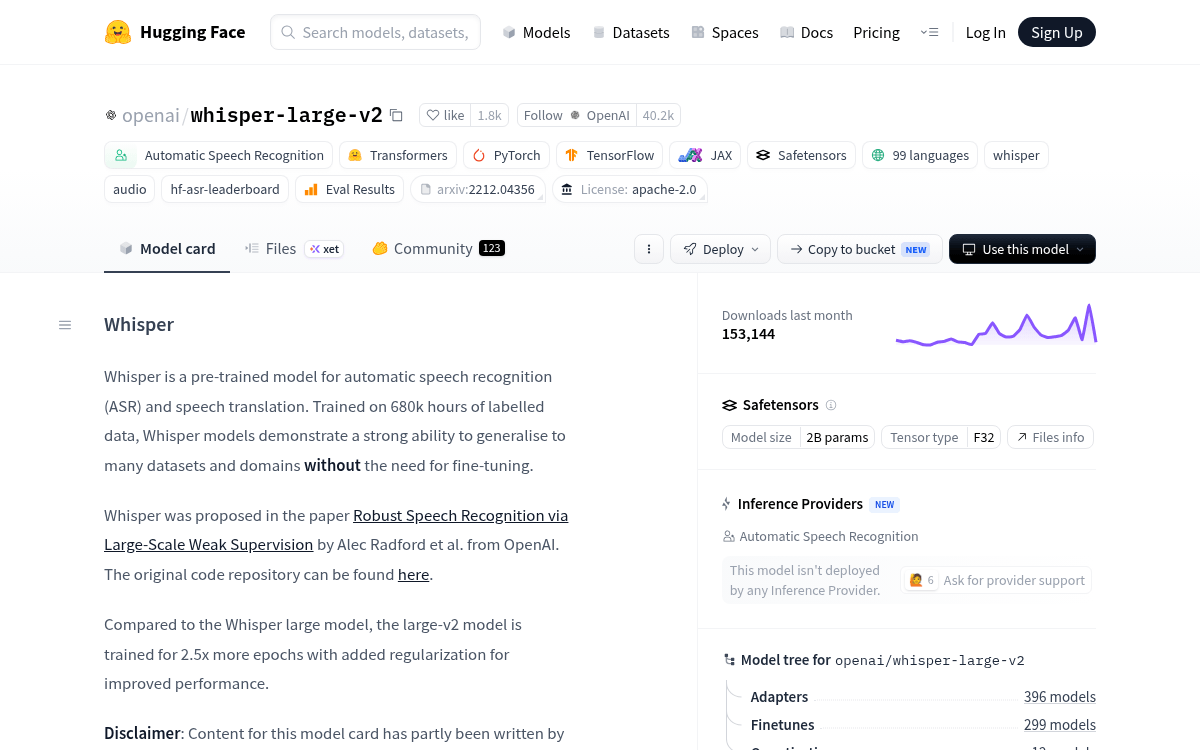
The original Whisper large-v2 and its later large-v3 and large-v3-turbo variants were batch-oriented open-weight models. They excel at chunk-based transcription of a completed audio file, but they were never built for the sub-second latency profile that voice agents and live captions need. OpenAI's hosted line now covers streaming and diarization through separate models, and GPT-Realtime-Whisper closes the streaming gap under the Whisper brand.
The pitch is straightforward: transcribe audio as people speak so live products feel faster and more responsive. That covers captions that appear in the moment, meeting notes that keep up with the conversation, and voice agents that need to understand users continuously without waiting for an utterance to finish. GPT-Realtime-Whisper slots in alongside the existing open-weight family rather than replacing it, since the open models remain the default for offline batch work and self-hosted deployments.
GPT-Realtime-2 does the heavy lifting
GPT-Realtime-2 is built for live voice interactions where the model has to reason through a request, call tools, handle interruptions, and respond in a way that fits the moment. A few features stand out for anyone building agents:
- Preambles. Short phrases like "let me check that" or "one moment while I look into it" so users know the agent is working.
- Parallel tool calls with audible narration. The model can call multiple tools at once and announce actions with phrases like "checking your calendar" while they run.
- Graceful recovery. Instead of failing silently, it can say things like "I'm having trouble with that right now."
- 128K context window. Up from 32K in the previous generation, meant for longer coherent sessions and more complex agent flows.
- Adjustable reasoning effort. Developers pick from minimal, low, medium, high, and xhigh, with low as the default to trade deliberation for latency.
On the benchmarks OpenAI published, GPT-Realtime-2 at high reasoning scored 15.2% higher on Big Bench Audio than GPT-Realtime-1.5, and the xhigh variant scored 13.8% higher on Audio MultiChallenge for instruction following. Big Bench Audio measures challenging reasoning over audio inputs; Audio MultiChallenge focuses on multi-turn dialogue skills like handling corrections and staying self-consistent. Both sit closer to production voice-agent behavior than clean word-error-rate tests, which is where the numbers actually matter for anyone shipping this.
Zillow, which is building a home-search voice assistant on the model, reported a 26-point lift in call success rate on their hardest adversarial benchmark after prompt optimization (95% vs 69%), along with stronger Fair Housing compliance guardrails. That kind of jump between generations is what makes the model interesting to teams who tried voice agents last year and gave up.
Live translation with 70+ input languages
GPT-Realtime-Translate covers more than 70 input languages and 13 output languages, and it is designed to keep pace with the speaker even when people switch context or use regional pronunciation. BolnaAI, which builds voice AI for Indian markets, reported 12.5% lower word error rates across Hindi, Tamil, and Telugu compared to any other model they tested. Vimeo is demoing the model to translate product education videos live so global customers can hear updates in their preferred language without waiting for a dubbed version.
Pricing and availability
All three models are available through the Realtime API. Pricing splits into per-token for the reasoning model and per-minute for the streaming ones:
| Model | Price |
|---|---|
| GPT-Realtime-2 audio input | $32 / 1M tokens ($0.40 cached) |
| GPT-Realtime-2 audio output | $64 / 1M tokens |
| GPT-Realtime-Translate | $0.034 / minute |
| GPT-Realtime-Whisper | $0.017 / minute |
For reference, $0.017 per minute works out to about $1.02 per hour of audio, which sits meaningfully above the cheapest hosted alternatives. Groq-hosted Whisper Large v3 Turbo at $0.04/hr is the cheapest way to transcribe at production quality, so streaming and low-latency behavior is what the premium buys, not raw transcription throughput.
Picking a model without overthinking it
The old Whisper models are not going away. They remain competitive for clean, single-speaker, single-language audio at low volume, and the open weights still make sense when you have GPUs already provisioned or need the model on your own hardware for compliance. A rough decision tree:
- Batch transcription of recorded files: open-weight Whisper large-v3 or large-v3-turbo, self-hosted or via a cheap provider.
- Live captions, meeting notes, or a voice agent's ears: GPT-Realtime-Whisper for the streaming path.
- Cross-language live conversation: GPT-Realtime-Translate.
- A voice agent that reasons, calls tools, and holds a long conversation: GPT-Realtime-2.
Why the split matters
Voice has been the awkward middle child of the LLM boom. Text agents got tools, long context, and reasoning; the voice side mostly got faster turn-taking and better TTS voices. Splitting the stack into a reasoning model, a translation model, and a streaming transcription model is an admission that one model rarely wins at all three, and it matches the shape of what teams have already been assembling out of stitched-together components.
The other subtle shift is what happens to the Whisper brand. For three years "Whisper" meant open weights, batch inference, and a permissive license. GPT-Realtime-Whisper is closed, hosted, and priced per minute. The name signals continuity with a very popular model family, though the deployment model now sits firmly on the API side. Teams building on the open Whisper weights will keep doing so; teams that need streaming without running their own inference stack finally have a first-party option that carries the name.
You can try the models today in the Realtime Playground, and the Realtime API supports EU data residency for regulated deployments.