
OpenAI's Whisper large-v3-turbo Runs 5x Faster With Half the Parameters
OpenAI shrinks Whisper large-v3's decoder from 32 layers to 4, delivering roughly 2 to 5x faster transcription with only a minor accuracy dip.
 Pro
Takeaways
- OpenAI released Whisper large-v3-turbo, a pruned and re-finetuned large-v3.
- Decoder cut from 32 to 4 layers; parameter count drops from 1.55B to 809M.
- Roughly 2 to 5x faster inference with only minor accuracy degradation reported.
- Supports 99 languages for transcription; translation task is dropped.
- Runs in Hugging Face Transformers with torch.compile and Flash Attention 2 support.
- Weaker on low-resource languages like Thai and Cantonese; MIT licensed.
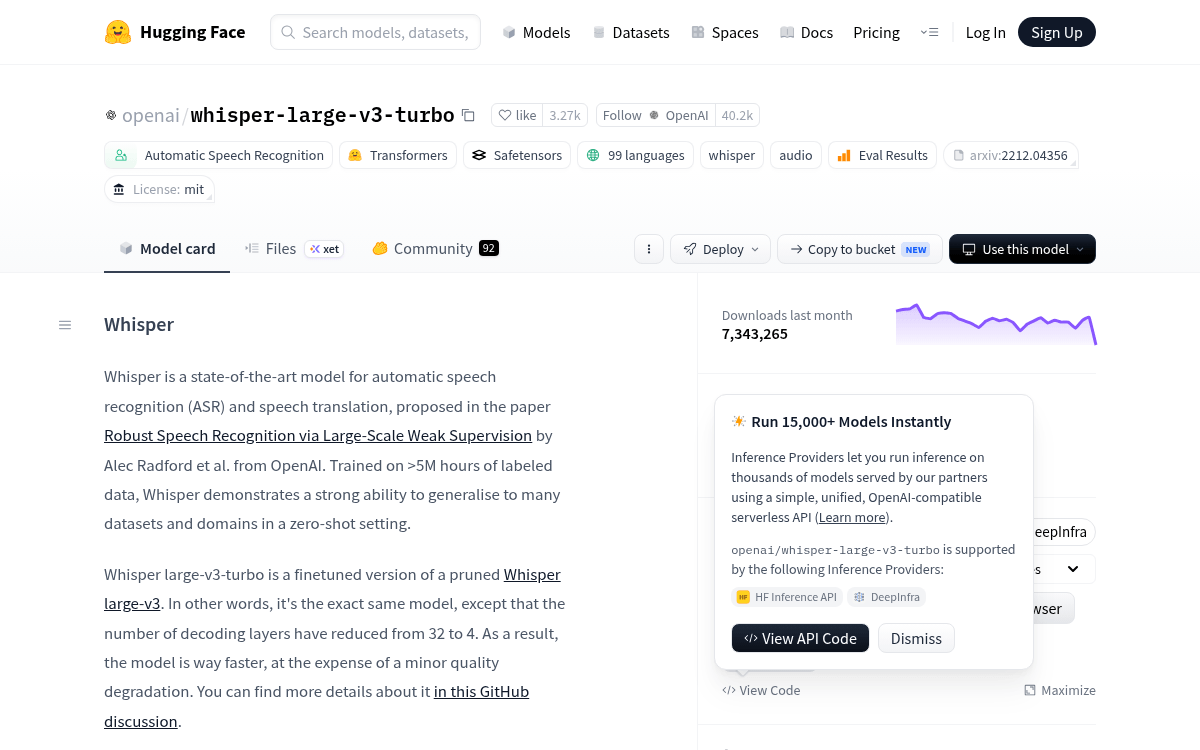
OpenAI has quietly dropped a leaner sibling to its flagship speech recognition model. Whisper large-v3-turbo keeps the same audio encoder as large-v3 but slashes the text decoder from 32 layers down to just 4, producing a model that transcribes audio dramatically faster while giving up very little accuracy. It is available on Hugging Face under an MIT license, weighs in at 809M parameters, and has already been downloaded more than seven million times.
What the pruning actually did
According to OpenAI, the new model, called turbo for short, is an optimized version of Whisper large-v3 with only 4 decoder layers, matching the tiny model and down from 32 in the large series. The encoder that turns raw audio into learned representations is untouched. Only the autoregressive text decoder, the part that generates tokens one at a time, gets radically shallower.
The approach borrows from a well-known distillation project but with a twist. Distil-Whisper showed that a smaller decoder can greatly improve transcription speed while causing minimal degradation in accuracy. Where Distil-Whisper trained a smaller student model to mimic a larger teacher, Whisper turbo was fine-tuned for two more epochs over the same multilingual transcription data used to train large-v3, excluding translation data, on which turbo is not expected to perform well.
In plain terms: OpenAI pruned the original model and continued training it directly on the same real transcription data rather than distilling from a teacher. That preserves more of the original quality signal.
Speed you can actually feel
The reported gains are large. Turbo drops to 809M parameters and runs 2-5x faster with minimal accuracy loss. On the Hugging Face Open ASR leaderboard, it records a mean word error rate of 7.83 and a real-time factor around 200, meaning it can chew through roughly two hundred seconds of audio per second of wall-clock time on suitable hardware.
There are additional levers to push it further. The forward pass is compatible with torch.compile for 4.5x speed-ups. Flash Attention 2 is also supported, and PyTorch's built-in scaled dot-product attention is enabled by default on recent versions. For long recordings, you can pick between a sequential sliding-window strategy that favors accuracy or a chunked strategy that favors throughput on single files.
How to run it
The model plugs directly into the Transformers pipeline API, so most existing large-v3 code works without changes:
import torch
from transformers import AutoModelForSpeechSeq2Seq, AutoProcessor, pipeline
model_id = "openai/whisper-large-v3-turbo"
model = AutoModelForSpeechSeq2Seq.from_pretrained(
    model_id, torch_dtype=torch.float16, low_cpu_mem_usage=True
).to("cuda")
processor = AutoProcessor.from_pretrained(model_id)
pipe = pipeline("automatic-speech-recognition", model=model,
                tokenizer=processor.tokenizer,
                feature_extractor=processor.feature_extractor,
                torch_dtype=torch.float16, device="cuda")
print(pipe("audio.mp3")["text"])
You can force a specific language with generate_kwargs={"language": "french"}, request word-level timestamps with return_timestamps="word", or batch multiple files by passing a list and a batch_size. Managed hosting is also available through inference providers like DeepInfra, with typical pricing landing around $0.000003 per second of audio.
Strengths, and where it stumbles
Turbo shines on batch transcription of clean speech across the major world languages. For most production batch transcription workloads, it becomes the default choice when you control the infrastructure, since the accuracy difference is small enough that the throughput gain usually outweighs it.
The trade-offs are worth understanding before you swap it in:
- No speech translation. Turbo excludes translation tasks from its fine-tuning, so it handles transcription only. If you were relying on Whisper's translate-to-English task, stay on large-v3.
- Uneven multilingual quality. Across languages, turbo performs similarly to large-v2, though it shows larger degradation on some languages like Thai and Cantonese.
- Hallucination risk remains. Accuracy is lower on low-resource languages, and performance varies across accents and dialects, which may include higher word error rate across speakers of different genders, races, ages, or other demographic criteria.
- Repetition loops. The sequence-to-sequence architecture makes it prone to generating repetitive texts, which can be mitigated to some degree by beam search and temperature scheduling but not perfectly.
How it stacks up against the family
| Model | Parameters | Decoder layers | Task coverage |
|---|---|---|---|
| whisper-large-v2 | 1550M | 32 | Transcription + translation |
| whisper-large-v3 | 1550M | 32 | Transcription + translation |
| whisper-large-v3-turbo | 809M | 4 | Transcription only |
Notably, turbo has the same decoder depth as the tiny model but keeps the full large-v3 encoder, which is where most of the acoustic understanding lives. That is why quality holds up so much better than a naive parameter-count comparison would suggest.
Why the recipe matters
The bigger takeaway is that in encoder-decoder ASR, the decoder is doing much less work than its parameter count implies. Chop it to an eighth of its original depth, fine-tune on the same data, and quality barely moves. That opens practical doors that were previously awkward:
- Near-real-time captioning on a single consumer GPU without exotic quantization.
- On-device transcription on modern laptops and phones, since the memory footprint is roughly half of large-v3.
- Cheaper batch pipelines for podcast archives, call centers, and video platforms, where throughput per dollar is the binding constraint.
- Faster iteration when fine-tuning on domain audio, since each training step is much cheaper.
For most teams already running large-v3 on transcription-only workloads, the migration is close to free: same tokenizer, same processor, same API surface. If you need translate-to-English, or you work heavily in Thai or Cantonese, keep large-v3 in the pipeline. For everything else, turbo is a strong new default.