
OpenAI's Whisper Large-v3 Cuts Speech Recognition Errors by 20% Across 99 Languages
OpenAI's Whisper large-v3 cuts transcription errors 10 to 20 percent across languages using 5 million hours of audio and 128 Mel bins.
 Pro
Takeaways
- OpenAI's Whisper large-v3 cuts errors 10 to 20 percent across languages versus large-v2.
- Trained on 1M hours weakly labeled plus 4M hours pseudo-labeled audio from large-v2.
- Uses 128 Mel frequency bins instead of 80 and adds a Cantonese language token.
- Same 1.55B parameters and same inference speed as large-v2, Apache-2.0 licensed.
- Supports 99 languages, translation to English, and word-level timestamps via Transformers.
- Compatible with Flash Attention 2 and
torch.compilefor up to 4.5x speedups.
OpenAI's Whisper large-v3 is the latest checkpoint of the open-source speech recognition model that has become the default choice for anyone transcribing audio without paying per-minute API fees. It keeps the 1.55B-parameter encoder-decoder architecture of large-v2 but retrains on a dramatically larger corpus and swaps in a higher-resolution audio front end, delivering meaningful accuracy gains across nearly every language it supports.
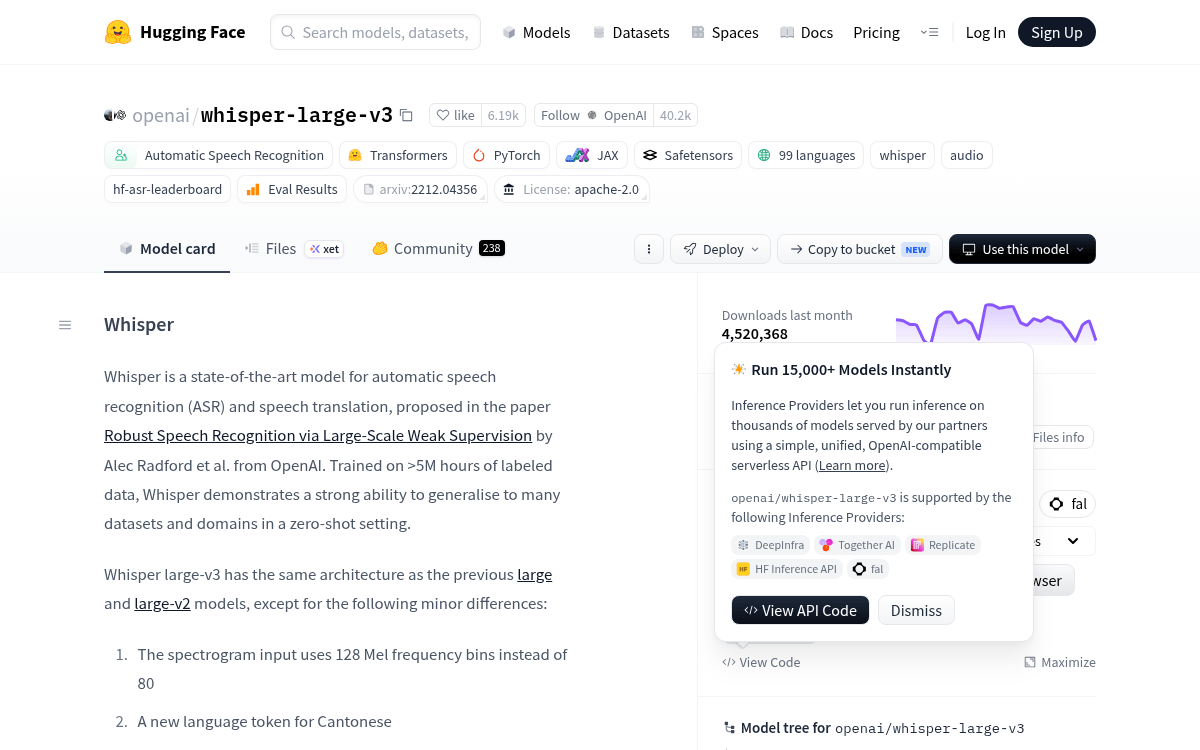
The model ships under Apache-2.0 on the Hugging Face Hub, works with the standard transformers pipeline, and covers 99 languages for transcription and any-to-English translation. Since going live, it has crossed 4.5M+ monthly downloads and picked up over 4,500 likes, making it one of the most-used ASR models in the ecosystem.
What actually changed under the hood
Architecturally, large-v3 is almost identical to its predecessors, with two small exceptions: the spectrogram input uses 128 Mel frequency bins instead of 80, and there is a new language token for Cantonese. Mel bins are the frequency buckets used to represent audio as a spectrogram, so doubling their count gives the encoder finer-grained spectral resolution before it ever sees a transformer layer.
The training recipe is where the heavy lifting happens. Large-v3 was trained for 2.0 epochs over a mixture of 1 million hours of weakly labeled audio and 4 million hours of pseudolabeled audio collected using large-v2. That pseudo-labeling step, where large-v2 transcribes unlabeled audio to bootstrap training data for its successor, is the real trick: it lets OpenAI scale the training set roughly sevenfold beyond the original 680,000-hour Whisper corpus without needing more human-labeled data.
The accuracy story
Across languages where large-v3 stays under a 60% error rate on Common Voice 15 and Fleurs, OpenAI reports a 10% to 20% reduction in errors compared to large-v2. Third-party benchmarks line up with that claim: large-v3 hits 2.1% WER on clean audio, a 12.5% improvement over large-v2, with 11–12% gains in real-world conditions.
On the Hugging Face Open ASR Leaderboard, the model posts a mean WER of 7.44 across evaluation datasets with an RTFx (inverse real-time factor) of 145.51, meaning it can transcribe roughly 145 seconds of audio in one second of wall-clock time on the reference hardware. Large-v3 maintains identical speed and resource usage to large-v2, so the accuracy jump is effectively free if you were already running v2.
Where it still stumbles
Whisper's weakly supervised training has a well-known dark side. The models perform unevenly across languages, with lower accuracy on low-resource or low-discoverability tongues where less training data exists. Performance also varies across accents and dialects within a given language, and word error rate can differ across speakers of different genders, races, ages, or other demographic groups.
Hallucinations are the other persistent issue. The sequence-to-sequence architecture makes the model prone to generating repetitive text, which beam search and temperature scheduling mitigate but do not eliminate. The behavior tends to be worse on lower-resource languages. In practice it shows up as invented phrases during silences or over background music, which is why production users typically pair Whisper with a voice-activity detector.
Running it
The model drops directly into the Transformers pipeline. Minimum viable inference looks like this:
import torch
from transformers import AutoModelForSpeechSeq2Seq, AutoProcessor, pipeline
model_id = "openai/whisper-large-v3"
model = AutoModelForSpeechSeq2Seq.from_pretrained(
    model_id, torch_dtype=torch.float16, low_cpu_mem_usage=True
).to("cuda")
processor = AutoProcessor.from_pretrained(model_id)
pipe = pipeline("automatic-speech-recognition", model=model,
                tokenizer=processor.tokenizer,
                feature_extractor=processor.feature_extractor,
                torch_dtype=torch.float16, device="cuda")
print(pipe("audio.mp3", return_timestamps=True))
A few knobs matter more than others for real workloads:
- Long audio. Whisper has a 30-second receptive field. Two strategies handle longer files: sequential sliding-window inference (more accurate, up to 0.5% WER better) and chunked inference (faster for a single file). Pass
chunk_length_s=30and abatch_sizeto activate chunking. - Translation. Set
generate_kwargs={"task": "translate"}to output English text regardless of source language. - Timestamps.
return_timestamps=Truegives sentence-level,return_timestamps="word"gives word-level. - Speed. The forward pass is compatible with
torch.compilefor 4.5x speed-ups, and Flash Attention 2 is supported on capable GPUs. - Hallucination guards. The published defaults use a temperature fallback ladder
(0.0, 0.2, 0.4, 0.6, 0.8, 1.0)with a compression-ratio threshold of 1.35 and a no-speech threshold of 0.6.
Cost and hosting options
The weights themselves are free. If you would rather not run a GPU, managed providers have wrapped the model behind pay-as-you-go APIs. Together AI lists it at $0.0015 per minute of audio, and it is also deployable to SageMaker and Azure endpoints directly from the model card. For self-hosting, a single 16GB GPU is enough for FP16 inference; with Flash Attention 2 and batch sizes of 8 to 16, throughput sits well above real-time.
Where the turbo variant fits in
OpenAI has since layered a lighter option on top of large-v3. The turbo model is an optimized version that offers faster transcription with minimal accuracy degradation. For most latency-sensitive pipelines, such as live captioning or interactive voice agents, turbo is now the pragmatic default. Large-v3 remains the accuracy ceiling when you have the compute budget or are batch-processing archives.
Why this release still matters
The practical takeaway: a single 1.55B-parameter model handles transcription for 99 languages, speech-to-English translation, language identification, and word-level timestamps, all under Apache-2.0. That combination keeps Whisper the reference point every new open ASR system (Distil-Whisper, Canary, Parakeet, SeamlessM4T) benchmarks itself against. If your stack still runs large-v2 or an older checkpoint, swapping in large-v3 is one of the highest-leverage upgrades available: same VRAM, same latency, roughly 10 to 20 percent fewer errors, plus Cantonese support you did not have before.
The best use cases remain what Whisper has always been good at: batch transcription of podcasts, meetings, and video archives, subtitle generation, voice-note search, and offline pipelines where sending audio to a third-party API is a non-starter for privacy or cost reasons. For anything requiring true streaming or sub-second latency, pair it with a VAD and chunking layer, or reach for the turbo variant.