
OpenAI's GPT-Realtime-2 Collapses Voice AI Into One Reasoning Session
OpenAI shipped three new realtime audio models in the API, including a streaming Whisper successor that transcribes speech live at $0.017 per minute.
 Pro
Takeaways
- OpenAI released three new realtime audio models: GPT-Realtime-2, GPT-Realtime-Translate, and GPT-Realtime-Whisper.
- GPT-Realtime-Whisper is a streaming successor to Whisper, transcribing live at $0.017 per minute.
- GPT-Realtime-2 brings GPT-5-class reasoning, 128K context, and adjustable reasoning effort (minimal to xhigh).
- GPT-Realtime-Translate supports 70+ input languages, 13 output languages at $0.034 per minute.
- Zillow reported a 26-point lift in call success rate on adversarial benchmarks after prompt optimization.
- Legacy
whisper-1stays live at $0.006/min for batch; Realtime-Whisper is for streaming only.
OpenAI just pushed voice AI past the call-and-response era. Three new realtime audio models landed in the Realtime API, and together they cover the full stack of live voice work: reasoning, translation, and streaming transcription. The lineup includes GPT-Realtime-2, a GPT-5-class voice model with reasoning; GPT-Realtime-Translate, which handles live speech-to-speech across dozens of languages; and GPT-Realtime-Whisper, a streaming successor to the four-year-old Whisper family that emits transcript tokens while the speaker is still talking.
For anyone who has been chaining together separate speech-to-text, LLM, and text-to-speech services to build a voice agent, this release collapses the pipeline into one session. It also puts real pressure on the ecosystem of Whisper hosts and cascade-based voice stacks.
What actually shipped
The three models each target a different piece of the live-audio workflow, and they can be composed together:
- GPT-Realtime-2 is OpenAI's first voice model with GPT-5-class reasoning that can handle harder requests and carry the conversation forward naturally. It is priced at $32 per 1M audio input tokens and $64 per 1M audio output tokens.
- GPT-Realtime-Translate is a new live translation model that converts speech from 70+ input languages into 13 output languages while keeping pace with the speaker, priced at $0.034 per minute.
- GPT-Realtime-Whisper is a streaming speech-to-text model that transcribes audio live as a speaker talks rather than waiting for utterance completion, exposed through /v1/realtime/transcription_sessions and priced at $0.017 per minute.
All three are live now in the Realtime API Playground. Existing endpoints like whisper-1 and gpt-4o-transcribe are not being retired.
A streaming-first successor to Whisper
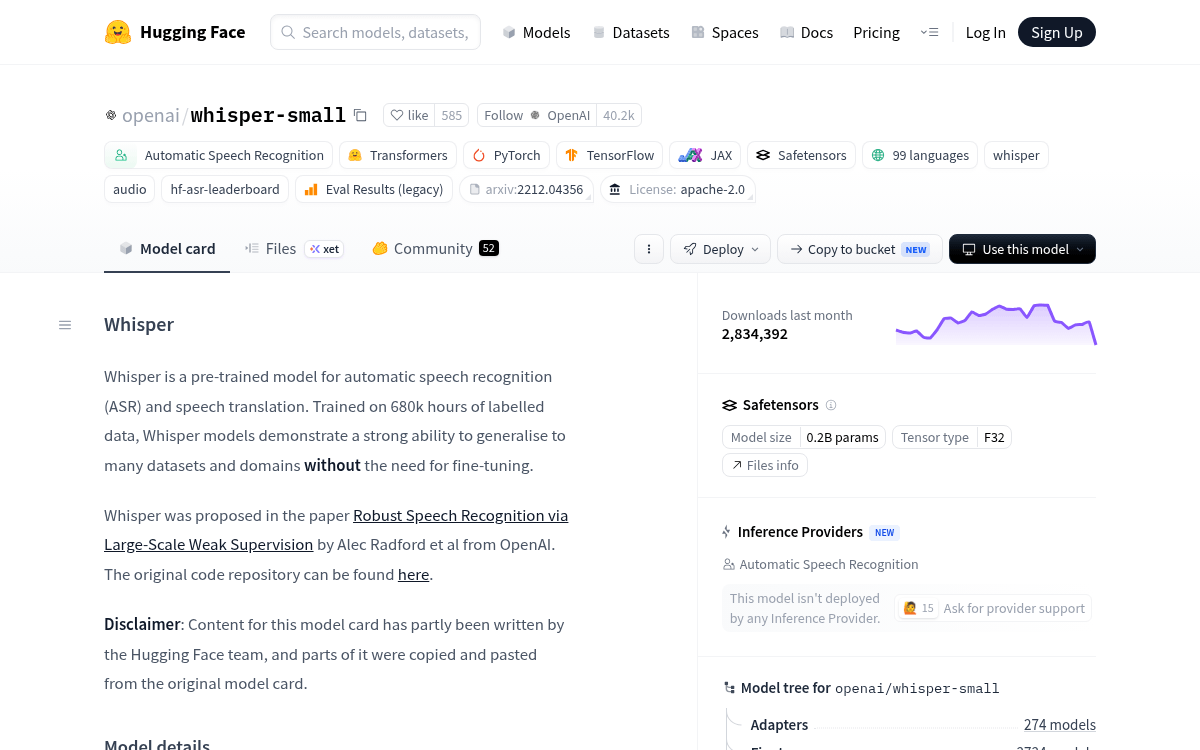
The original whisper-small and its siblings were built for batch transcription: you hand the model a complete audio file, wait for a Mel spectrogram pass, and get text back. That works for podcast archives, but it is the wrong shape for live captions, voice agents, or meeting notes that need to update as people speak.
GPT-Realtime-Whisper flips that assumption. Realtime transcription uses a persistent streaming session, not one-request-per-file upload, and is meant for low-latency updates while audio is still in progress. In practice, your server opens a WebSocket, streams audio chunks, and receives incremental transcript deltas back. The Vercel AI Gateway team notes the model returns text while audio is still arriving, with a tunable latency and accuracy tradeoff, letting developers dial in how aggressive the model is about committing to partial hypotheses.
The price is the trade. At $0.017 per minute, GPT-Realtime-Whisper costs 2.83 times more than the four-year-old whisper-1 at $0.006 per minute, and both remain live in the API simultaneously. The decision rule is straightforward: batch stays on whisper-1 or gpt-4o-mini-transcribe, and streaming moves to Realtime-Whisper when latency actually matters.
Why GPT-Realtime-2 is the headline model
GPT-Realtime-2 is where the reasoning story shows up. OpenAI is emphasizing that voice agents need to do more than sound natural, and the feature list reflects that. Notable changes:
- Preambles: the model can say things like "let me check that" before it starts a tool call, so users hear that the agent is working.
- Parallel tool calls with audible narration: it can invoke multiple tools at once and vocalize what it is doing ("checking your calendar, looking that up now").
- 128K context window, up from 32K, for longer agentic sessions.
- Adjustable reasoning effort: minimal, low, medium, high, and xhigh, with low as the default. This is the same reasoning-effort knob developers have gotten used to on the GPT-5 family, now applied to a voice model.
The benchmark gains are meaningful. OpenAI reports that GPT-Realtime-2 at high effort scores 15.2% higher on Big Bench Audio than GPT-Realtime-1.5, and at xhigh scores 13.8% higher on Audio MultiChallenge for instruction following. Zillow, an early tester, reported a 26-point lift in call success rate on their hardest adversarial benchmark (95% vs 69%) after prompt optimization.
Live translation without the cascade
GPT-Realtime-Translate is the sleeper of the three. Traditional live-translation stacks glue together an STT model, an MT model, and a TTS model, with cascading latency at every step. Doing it in one model, and keeping the output natural enough to sustain a conversation, is what makes this useful for customer support and cross-border sales.
BolnaAI, which builds voice AI for Indian languages, reported that in their evals across Hindi, Tamil, and Telugu, GPT-Realtime-Translate delivered 12.5% lower Word Error Rates than any other model they tested. Deutsche Telekom is trialing it for multilingual customer support where callers can speak in their preferred language and get translated in real time.
Where this leaves the Whisper ecosystem
The open-source Whisper models, including whisper-small and the more recent large-v3-turbo, are not going anywhere. Whisper remains competitive for clean, single-speaker, single-language audio at low volume, and self-hosting is still the right call when you need weights on your own hardware for compliance or your GPU costs beat per-minute API rates.
The competitive picture for hosted transcription has shifted, though. Groq-hosted Whisper Large v3 Turbo at $0.04/hr is roughly 9x cheaper than OpenAI's $0.36/hr hosted rate at about 228x real-time, though it inherits Whisper's hallucination behavior on silence and gets no native diarization or code-switching. OpenAI's hosted line now covers streaming and diarization through separate models, so the capability gap is narrower than it was.
Voice agents that think out loud
The concrete new capability is a voice agent that narrates its own reasoning while it works. Before this release, most voice pipelines had a dead zone: the user finishes speaking, the STT model commits, the LLM starts reasoning, and the user hears silence for one to three seconds until the TTS starts. GPT-Realtime-2 fills that gap with preambles and audible tool narration, so the interaction feels more like talking to a person who mumbles "hmm, let me look" than talking to a call-center IVR.
For teams building live-audio products, the practical use cases open up in a few directions:
- Meeting notes and captions that appear in real time instead of after the call, using Realtime-Whisper as a drop-in streaming STT.
- Voice agents with tool use that can handle interruptions, corrections, and multi-turn task flows without breaking, using Realtime-2.
- Live multilingual conversations for support, sales, and events, using Realtime-Translate.
- Hybrid pipelines where Realtime-Whisper feeds transcripts to a cheaper text LLM when full speech-to-speech reasoning is not needed.
The assumption worth updating is that voice AI remains a cascade problem you solve with three vendors. OpenAI is betting that developers will pay a premium to have reasoning, translation, and transcription live inside a single realtime session, and the pricing gap between whisper-1 and gpt-realtime-whisper makes clear that latency-sensitive work is now a first-class, separately priced product category.