
OpenAI Breaks Its Open-Source Silence With gpt-oss-20b Running on 16GB Laptops
OpenAI released a 21B open-weight reasoning model under Apache 2.0 that runs in 16GB of memory and matches o3-mini on benchmarks.
 Pro
Takeaways
- OpenAI released gpt-oss-20b, a 21B mixture-of-experts model with 3.6B active parameters under Apache 2.0.
- MXFP4 quantization lets it run within 16GB of memory on consumer hardware, laptops included.
- Benchmarks put it near o3-mini, with 73.6 on MMLU-Pro and 67.1 on GPQA Diamond with tools.
- Native support for function calling, browsing, Python execution, and structured outputs via the Harmony format.
- Configurable reasoning effort (low, medium, high) with full chain-of-thought exposed for debugging.
- Runs on Ollama, LM Studio, vLLM, SGLang, Transformers, and fine-tunes on a single consumer GPU.
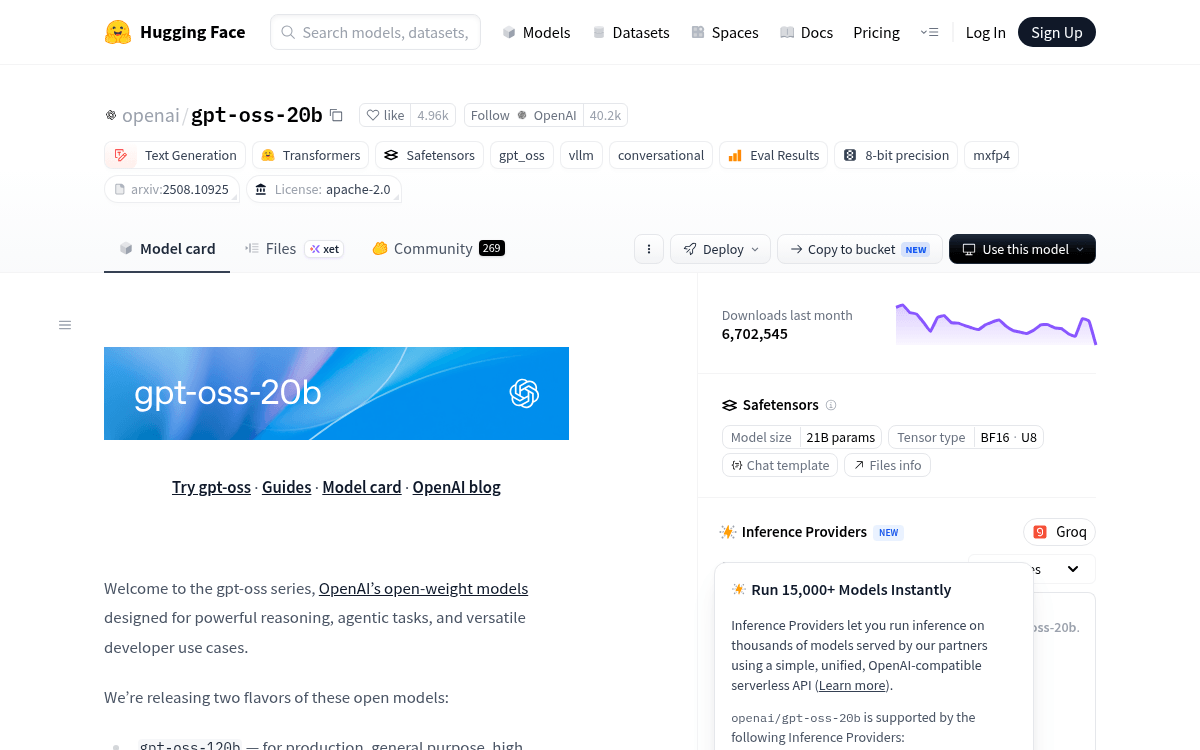
OpenAI has broken a long silence on open weights. gpt-oss-20b is a 21B parameter mixture-of-experts model, released under Apache 2.0, that fits into 16GB of memory and ships with the same reasoning and tool-use scaffolding as OpenAI's closed frontier stack. Alongside it comes gpt-oss-120b, but the 20B variant is the one that actually lands on a laptop.
This is the first meaningful open-weight drop from OpenAI since GPT-2, and both sizes ship under Apache 2.0, which permits free commercial and research use. No copyleft, no patent tripwires, no proprietary API in front of it.
Inside the box
gpt-oss-20b uses a mixture-of-experts architecture with 3.6B active parameters per forward pass. Only a small slice of the network fires on any given token, so a 21B model behaves closer to a 3-4B model at inference time. Training happens in OpenAI's Harmony response format, and the model supports configurable reasoning effort, fine-tuning, function calling, structured outputs, and agentic tool use.
The other big engineering choice is quantization. The MoE layer uses native MXFP4, a 4-bit floating point format that keeps a small shared exponent per block of weights, preserving more dynamic range than plain int4. The important consequence: all published evals were run at MXFP4, so what you download is what benchmarks measured. Reasoning effort is exposed as a low, medium, or high setting, letting callers trade quality against latency.
How it was built
The training recipe pulls directly from OpenAI's closed models, mixing reinforcement learning with techniques informed by internal frontier systems including o3. gpt-oss-120b reaches near-parity with o4-mini on core reasoning benchmarks while running on a single 80GB GPU. gpt-oss-20b tracks o3-mini on common evals and runs on edge devices with just 16GB of memory.
OpenAI also introduced a new prompt structure to go with the models. The Harmony Chat Format is a role-aware, message-based structure that uses labeled roles like System, Developer, User, Assistant, and Tool to enforce a hierarchy when resolving conflicting instructions. It also defines channels called analysis, commentary, and final that separate reasoning traces, tool calls, and user-facing answers. Skip Harmony and the model misbehaves. The Transformers chat template applies it automatically, but if you call model.generate directly you need the openai-harmony package.
Running it
The 20B checkpoint is genuinely portable. It runs on Ollama, LM Studio, vLLM, SGLang, plain Transformers, and a PyTorch/Triton reference implementation in the official repo. For a quick local test:
ollama pull gpt-oss:20b
ollama run gpt-oss:20b
For a serving stack with an OpenAI-compatible API, vLLM is the recommended path:
uv pip install --pre vllm==0.10.1+gptoss \
    --extra-index-url https://wheels.vllm.ai/gpt-oss/ \
    --extra-index-url https://download.pytorch.org/whl/nightly/cu128 \
    --index-strategy unsafe-best-match
vllm serve openai/gpt-oss-20b
Reasoning effort is controlled through the system prompt. You literally write Reasoning: high to switch modes, and the model spends more tokens deliberating in its analysis channel before answering. The full chain-of-thought is exposed, which is unusual for a shipping model, and OpenAI positions it as a debugging and trust aid rather than something to surface to end users.
What it is good at
The benchmark story is favorable for a 21B model. On the arXiv model card, it scores 66 on GPQA Diamond at medium reasoning without tools, 67.1 with tools, and 73.6 on MMLU-Pro. Despite its size, gpt-oss-20b matches or exceeds o3-mini on these evals, and beats it on competition mathematics and health. The practical sweet spots:
- Local reasoning assistants where you want the chain-of-thought visible for debugging
- Agentic loops with function calling, browsing, and Python execution as first-class citizens
- Fine-tuning for domain tasks on a single consumer GPU
- High-throughput structured-output workloads where latency and cost dominate
- Edge deployment on a 16GB laptop or a single mid-range server card
The repo also ships two system tools for the model, a browser and a Python container, along with a terminal chat application showing how to wire them into Harmony alongside the PyTorch, Triton, and vLLM implementations. That is a real difference from most open releases, which leave tool integration as an exercise for the reader.
Where it falls short
The 20B model is not a frontier model, and it shows outside of reasoning benchmarks. gpt-oss-20b offers tool use, function calling, a 131K context window, and very low serving cost, but its general intelligence and agentic scores restrict it to routine automation. The economics still suit high-volume structured tasks. Independent trackers place it below the top open models on general knowledge and coding, so anything that needs long autonomous coding sessions or nuanced multi-step planning points toward the 120B sibling or a closed frontier model.
Harmony is also a small tax. Existing prompt pipelines built around plain chat templates will need updating to use the analysis and commentary channels correctly, and the model produces garbage if you feed it raw chat without the format.
Why this release actually matters
The headline is Apache 2.0 weights from OpenAI. The deeper shift is that a distillation of o3-era training techniques now sits on Hugging Face with no gatekeeper. Organizations can deploy, fine-tune, and scale these models on-premises or in private clouds with full control over performance, cost, and data.
A few assumptions worth revisiting after this drop:
- Serious reasoning models no longer require a data-center GPU. A 16GB card is enough for the 20B variant at MXFP4.
- Open weights from OpenAI are back on the table, which reshapes the competitive picture around Llama, Qwen, DeepSeek, and Mistral rather than only Meta against the closed labs.
- Fine-tuning frontier-class reasoning behavior is now within reach on consumer hardware, with the 20B variant tuned for lower latency and local or specialized deployment.
- Chain-of-thought transparency is being normalized as a feature rather than a leak, with the caveat that raw CoT should not be surfaced to end users.
The practical calculus for a small team is straightforward. If you were paying for hosted inference of an o3-mini-class model to power an agent, a chatbot, or a batch reasoning pipeline, this release is a plausible drop-in that you can run, fine-tune, and audit yourself. The 20B model will not replace the closed frontier for the hardest problems, but it redraws the line for what counts as a reasonable local default.