
One Open Model Quietly Covers 200 Million Indonesian Speakers
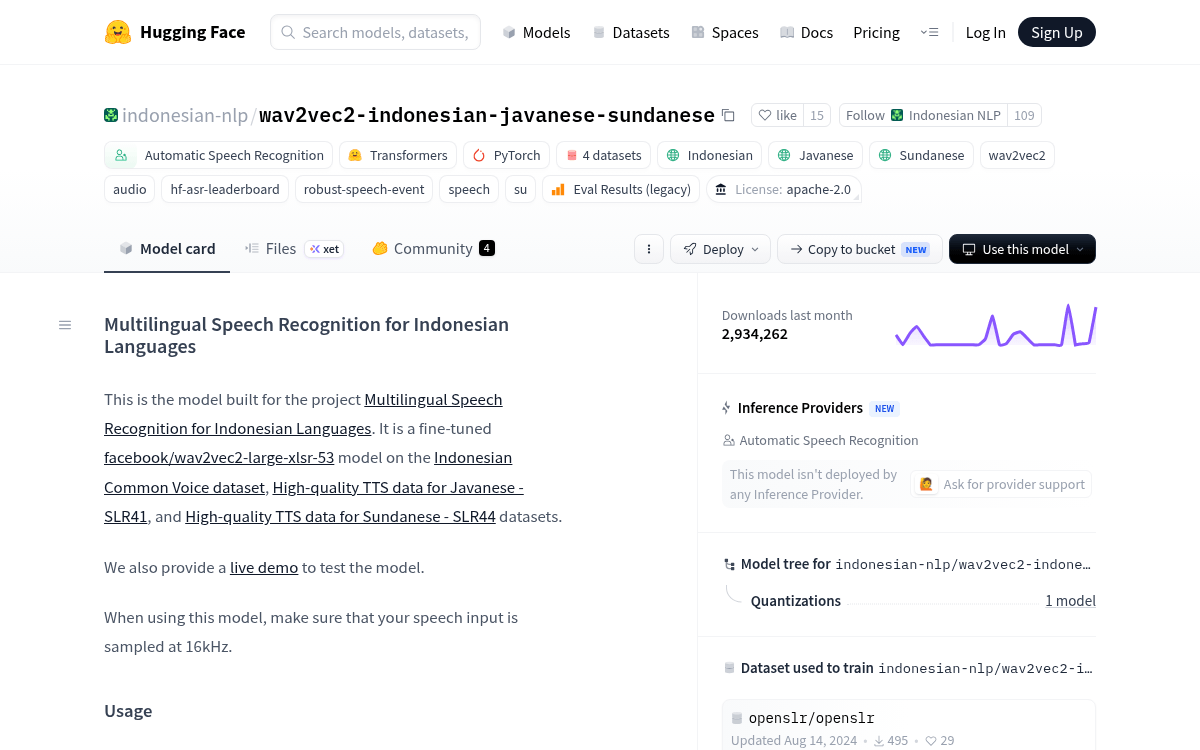
A fine-tuned XLSR-53 model for Indonesian, Javanese, and Sundanese hits 4.2M downloads with a 4.05 percent word error rate on Common Voice.
 Pro
Takeaways
- The wav2vec2-indonesian-javanese-sundanese model has surpassed 4.2 million downloads on Hugging Face.
- Fine-tuned from facebook/wav2vec2-large-xlsr-53 on Common Voice and OpenSLR Javanese and Sundanese TTS data.
- Reports 4.056 percent WER on Common Voice 6.1 Indonesian and 4.492 percent on Common Voice 7.
- Handles clean 16 kHz audio well; noisy real-world audio pushes WER above 48 percent.
- Apache 2.0 licensed, roughly 3.5 GB, works with the standard Transformers ASR pipeline.
- Ships with an included KenLM-style language model directory for optional CTC rescoring.
Speech recognition for Southeast Asian languages has long been a gap in the open model ecosystem, which is dominated by English, Mandarin, and a handful of European tongues. A community project called wav2vec2-indonesian-javanese-sundanese has quietly become one of the most downloaded automatic speech recognition checkpoints on Hugging Face, crossing four million downloads while covering three of Indonesia's most spoken languages in a single model.
The checkpoint fine-tunes facebook/wav2vec2-large-xlsr-53 on the Indonesian Common Voice dataset alongside the OpenSLR high-quality TTS datasets for Javanese (SLR41) and Sundanese (SLR44). It ships under Apache 2.0, weighs in at around 3.5 GB, and includes a bundled language model directory for CTC decoding with an external n-gram.
One model, three languages, 200 million speakers
Indonesian, Javanese, and Sundanese together cover the primary spoken languages of more than 200 million people, but each has traditionally been treated as its own low-resource ASR problem. The XLSR-53 backbone was designed for exactly this scenario: a wav2vec2 encoder pretrained on raw audio from 53 languages that transfers well when fine-tuned on small labeled sets. The resulting checkpoint handles all three languages in a single forward pass, runs without an external language model, and expects 16 kHz mono input.
The numbers
The self-reported evaluation results are unusually strong for a low-resource multilingual checkpoint. On Common Voice Indonesian test splits, the model reports:
- Common Voice 6.1: 4.056 percent WER, 1.472 percent CER
- Common Voice 7: 4.492 percent WER, 1.577 percent CER
- Robust Speech Event dev data: 48.94 percent WER
- Robust Speech Event test data: 68.95 percent WER
The gap between the Common Voice numbers and the Robust Speech Event numbers tells the interesting story. Clean, read speech from Common Voice lands at near production-grade accuracy, while noisy, spontaneous audio in the Robust Speech Event benchmark degrades sharply. That is a useful signal about where this checkpoint fits and where it does not.
What it is good at, and where it breaks
- Strong at: Clean 16 kHz recordings, read speech, dictation-style transcription, and voice-command interfaces in Indonesian.
- Weaker at: Conversational audio, background noise, code-switching, and far-field microphones, where WER climbs above 50 percent.
- Neutral: Javanese and Sundanese coverage rides on TTS-derived data from OpenSLR, which is cleaner than natural conversation and biases the model toward standard pronunciations.
Using it in a few lines
The model plugs directly into the standard Transformers ASR pipeline. Input must be resampled to 16 kHz, and no language model is required for a first pass.
from transformers import pipeline
pipe = pipeline(
    "automatic-speech-recognition",
    model="indonesian-nlp/wav2vec2-indonesian-javanese-sundanese",
)
print(pipe("sample_id.wav"))
For lower-level control, you can load Wav2Vec2ForCTC and Wav2Vec2Processor directly, run inference to get logits, and use torch.argmax followed by processor.batch_decode to produce text. The repository also includes a language_model folder for KenLM-style rescoring if you want to squeeze more accuracy out of the CTC head.
Where it fits in the stack
Whisper and newer multilingual encoders have raised the bar for zero-shot ASR, but they carry two costs that keep this wav2vec2 checkpoint relevant: model size and licensing friction for edge deployments. At roughly 3.5 GB with Apache 2.0 licensing and a CTC head that runs cheaply on CPU or a modest GPU, this model is a practical choice for:
- On-device transcription for Indonesian-language mobile apps
- Batch transcription pipelines for call centers, media archives, and government records
- A fine-tuning starting point for domain-specific Indonesian ASR, such as medical or legal dictation
- Research baselines for Javanese and Sundanese, where labeled data remains scarce
The checkpoint has not been updated in years, and the download counter keeps climbing anyway. That says something about how much demand there still is for solid, no-strings-attached models in languages that sit outside the frontier lab spotlight. If you are building anything voice-driven for the Indonesian market, this is the baseline to beat before reaching for a heavier proprietary system.