
One Developer's wav2vec2 Model Became the Go-To Persian Speech AI With 1.7M Downloads
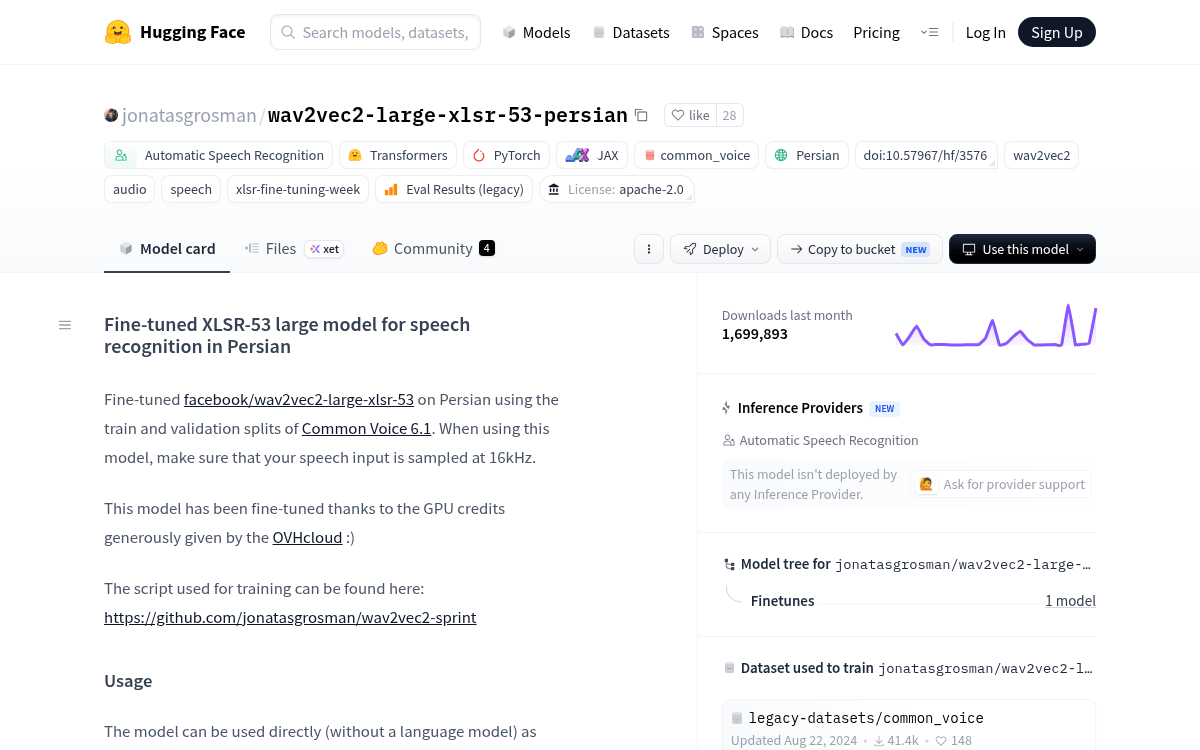
A community fine-tune of Facebook's XLSR-53 has quietly become the default Persian speech-to-text model, with 1.7M downloads and 30% WER on Common Voice.
 Pro
Takeaways
- Persian ASR fine-tune of facebook/wav2vec2-large-xlsr-53 has hit 1.7M+ downloads on Hugging Face
- Reports 30.12% WER and 7.37% CER on Common Voice 6.1 Persian test set
- Apache 2.0 licensed, works via standard
transformerspipeline at 16kHz - Trained during XLSR fine-tuning week using OVHcloud GPU credits, script on GitHub
- Beat other public Persian XLSR fine-tunes by 3-4 WER points in author's evaluation
- Companion library HuggingSound handles batch transcription and resampling
Persian speech recognition has a de facto open-source default, and it did not come from a big lab. Jonatas Grosman's wav2vec2-large-xlsr-53-persian has crossed 1.7 million downloads on Hugging Face, making it one of the most widely used automatic speech recognition (ASR) models for Farsi. It carries an Apache 2.0 license, runs on a single GPU, and plugs directly into the transformers pipeline API.
A fine-tune that filled a gap
The checkpoint is a fine-tune of facebook/wav2vec2-large-xlsr-53 on Persian using the train and validation splits of Common Voice 6.1, with speech input expected at 16kHz. XLSR-53 is Facebook's cross-lingual speech representation model, pretrained on raw audio across 53 languages so that downstream fine-tuning needs relatively little labeled data per language. That matters for languages like Persian, where large annotated speech corpora are scarce.
Training happened during the community XLSR fine-tuning week on GPU credits donated by OVHcloud. The recipe lives in the author's wav2vec2-sprint repository, so the pipeline is fully reproducible.
The accuracy numbers
On the Persian test split of Common Voice, the model reports a Word Error Rate of 30.12% and a Character Error Rate of 7.37%. In the author's own head-to-head evaluation, it beat the other publicly available Persian XLSR fine-tunes at the time:
| Model | WER | CER |
|---|---|---|
| jonatasgrosman/wav2vec2-large-xlsr-53-persian | 30.12% | 7.37% |
| m3hrdadfi/wav2vec2-large-xlsr-persian-v2 | 33.85% | 8.79% |
| m3hrdadfi/wav2vec2-large-xlsr-persian | 34.37% | 8.98% |
A 30% WER is far from production-perfect. Looking at the sample predictions in the model card, clean utterances come out verbatim, while noisier or more colloquial phrases degrade badly, with entire words dropped or replaced. The character error rate around 7% is a better signal for how the model performs at the phoneme level, which is often what matters for downstream tasks like keyword spotting or forced alignment.
Drop it into a pipeline
The simplest path is the standard Transformers pipeline, no custom code needed:
from transformers import pipeline
pipe = pipeline(
    "automatic-speech-recognition",
    model="jonatasgrosman/wav2vec2-large-xlsr-53-persian",
)
text = pipe("audio.wav")["text"]
For batch transcription across files, the author maintains HuggingSound, a thin wrapper that handles resampling and batching. Either way, audio must be mono 16kHz PCM. It is a CTC model with no built-in language model, so pairing it with a KenLM n-gram decoder is the standard trick to shave several points off WER without retraining.
Where it fits, and where it does not
Good candidates for this model:
- Prototyping Persian voice interfaces without paying per-minute API fees
- Offline or on-prem transcription where audio cannot leave the network
- Bootstrapping a labeled dataset by transcribing then correcting
- Research baselines for Persian ASR papers and leaderboards
- Further fine-tuning on domain audio such as call center, medical, or broadcast
Where it struggles:
- Noisy, far-field, or heavily accented audio outside the Common Voice distribution
- Long-form audio without external chunking and stitching
- Real-time streaming, since wav2vec2 CTC is not natively streaming-friendly
- Domain jargon, numbers, and named entities without a language model
Why the checkpoint still earns its downloads
Newer architectures like Whisper cover Persian out of the box, but this model remains attractive for three reasons: it is small enough to fine-tune on a single consumer GPU, its CTC output is easy to align at the character level, and its permissive license leaves no ambiguity for commercial use. The surrounding ecosystem is also unusually healthy for a lower-resource language, with the checkpoint showing up in Common Voice Persian leaderboard comparisons and powering multiple community Spaces, including a dedicated open Persian ASR leaderboard.
The broader signal is worth noting. A single independent contributor, given a week of donated GPU time and a public multilingual base model, produced what became the most-downloaded Persian ASR checkpoint on the hub. That is the payoff of releasing strong pretrained backbones like XLSR-53 openly, and it is a pattern that keeps repeating for languages that the frontier model providers do not prioritize.