
One Developer's wav2vec2 Fine-Tune Became Bengali Speech Recognition's Backbone
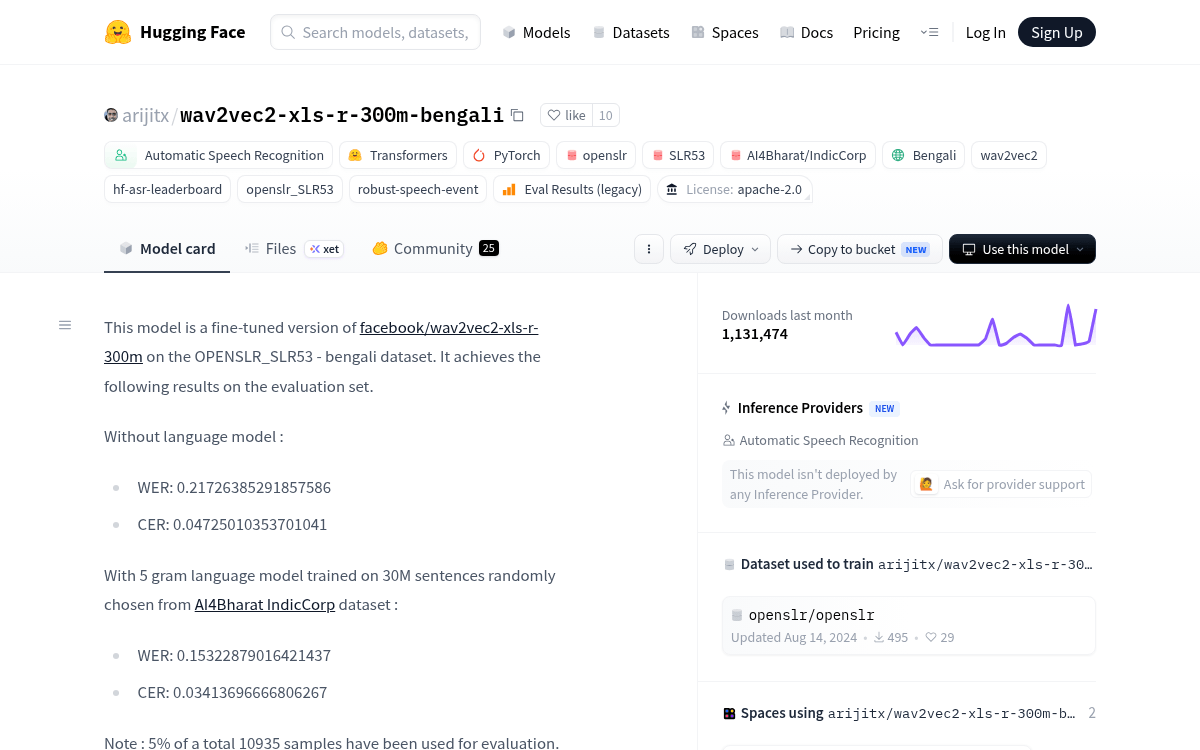
A community fine-tune of Meta's XLS-R backbone by developer arijitx has quietly become the default starting point for Bengali speech recognition, crossing 1.4M downloads.
 Pro
Takeaways
- Community fine-tune arijitx/wav2vec2-xls-r-300m-bengali crosses 1.4M downloads on Hugging Face.
- Adapts Meta's
facebook/wav2vec2-xls-r-300mbackbone to Bengali using OpenSLR SLR53 data. - Reports WER 0.217 without LM and 0.153 with a 5-gram LM on IndicCorp.
- Trained for 180k steps, Apache 2.0 licensed, works with standard Transformers pipeline.
- Used as starting point by winning Kaggle DL Sprint entries and multiple Bangla ASR papers.
- Weakness: domain shift on crowd-sourced Common Voice audio versus clean OpenSLR recordings.
Bengali is spoken by roughly 230 million people, yet it remains a low-resource language for speech recognition, largely absent from Common Voice and multilingual LibriSpeech at the time most speech models were trained. A community-contributed fine-tune on Hugging Face, arijitx/wav2vec2-xls-r-300m-bengali, has stepped into that gap and now sits at over 1.4 million cumulative downloads, quietly becoming the default backbone that researchers and Kaggle competitors reach for when they need Bangla ASR.
The checkpoint adapts Meta AI's facebook/wav2vec2-xls-r-300m for Bengali, published by an individual contributor rather than by Meta itself. It ships under Apache 2.0 and runs through the standard Transformers pipeline in a couple of lines of Python.
What the model actually is
XLS-R is Meta's cross-lingual self-supervised speech encoder. The 300M parameter variant was pretrained by Facebook AI on 436k hours of unlabeled speech across 128 languages, drawing from VoxPopuli, MLS, CommonVoice, BABEL and other multilingual corpora. Arijit's fine-tune adapts that general acoustic representation to Bengali using labeled data from OpenSLR SLR53.
The author is explicit about the motivation: Bengali speech data was not available from Common Voice or the LibriSpeech multilingual set, so OpenSLR53 stepped in. There was a language-shaped hole in the ecosystem, and this checkpoint filled it.
Numbers on the leaderboard
Reported evaluation results, measured on the last 5% of the SLR53 split held out from training, are competitive for a 300M parameter model on a low-resource language:
- Without a language model: WER 0.217, CER 0.047
- With a 5-gram LM trained on 30M sentences from AI4Bharat IndicCorp: WER 0.153, CER 0.034
Roughly 5% of the 10,935 total samples went to evaluation, with training on the first 95% and evaluation on the last 5%. Training stopped after 180k steps. The language model is decoded on top at inference time rather than baked into the acoustic model, a standard pattern for wav2vec2-CTC pipelines that yields a meaningful WER drop essentially for free.
How to actually use it
Loading it looks like any other Transformers ASR model. The high-level pipeline is enough for quick experiments:
from transformers import pipeline
pipe = pipeline("automatic-speech-recognition",
                model="arijitx/wav2vec2-xls-r-300m-bengali")
result = pipe("sample_bn.wav")
print(result["text"])
For more control, such as pairing with a KenLM decoder, you can load the processor and CTC head directly with AutoProcessor and AutoModelForCTC. Inputs should be 16 kHz mono audio, matching the sample rate of the underlying XLS-R pretraining.
Why researchers keep reaching for it
The download count is one signal. The more telling one is that the model has become a research base rather than an endpoint. In work applying wav2vec2 to the Bengali Common Voice dataset, most contenders picked arijitx/wav2vec2-xls-r-300m-bengali as their starting point, noting that it was already fine-tuned for 180,000 steps on OPENSLR-SLR53-Bengali and reusing those weights via transfer learning. In practice, Kaggle DL Sprint contestants could skip a very expensive warm-up phase.
One winning submission on the BUET CSE Fest 2022 DL Sprint took this route explicitly. That solution, shahruk10/wav2vec2-xls-r-300m-bengali-commonvoice, extends arijitx's checkpoint on Common Voice 9.0 Bengali, training on ~300 hours of 16 kHz audio in a Bangladesh accent using splits from the Kaggle competition, and placed first on both the public and private leaderboards.
Where it falls short
Researchers who probed the model past OpenSLR found real limits. The Bengali Common Voice Speech Dataset has higher median voice segments per second, higher dynamic range, and shorter pauses between voice segments than OpenSLR-Bengali, and Common Voice is crowd-sourced in a more uncontrolled environment. A model tuned only on SLR53 audio will hit a domain-shift wall on noisier, in-the-wild recordings.
A nuance also matters for anyone planning to build on top of this checkpoint. One follow-up paper reports that after preliminary testing on two starting points, a self-supervised pretrained model (facebook/wav2vec2-large-xlsr-53) and an already fine-tuned model (arijitx/wav2vec2-xls-r-300m-bengali), further fine-tuning the already convergent model slightly degrades performance on the target dataset. Depending on how different your target domain is from OpenSLR53, starting from the raw XLS-R backbone may occasionally beat starting from this fine-tune. Benchmark both.
Practical use cases
This is a reasonable pick when you need Bangla speech-to-text and either cannot use a hosted API or want something you can adapt further. Concrete scenarios include:
- Transcribing read-style Bengali audio close to the OpenSLR53 domain, such as audiobooks or scripted content
- Serving as a warm start for domain-specific fine-tuning on call center, broadcast, or educational audio
- Pairing with a KenLM n-gram model on your own corpus to shave WER without any additional acoustic training
- Running on-device or on-prem where sending audio to a third-party ASR API is not an option
The broader story here is about how open-source ecosystems fill gaps that big labs leave behind. Meta released a strong multilingual backbone. An individual contributor did the unglamorous work of adapting it to a specific language with a specific dataset, published the weights under Apache 2.0, and the download counter has been climbing steadily ever since. For anyone building Bangla voice interfaces, that quiet contribution has probably saved a lot of GPU hours.