
One Developer's Czech Speech Model Hits 1.5M Downloads With 7% Error Rate
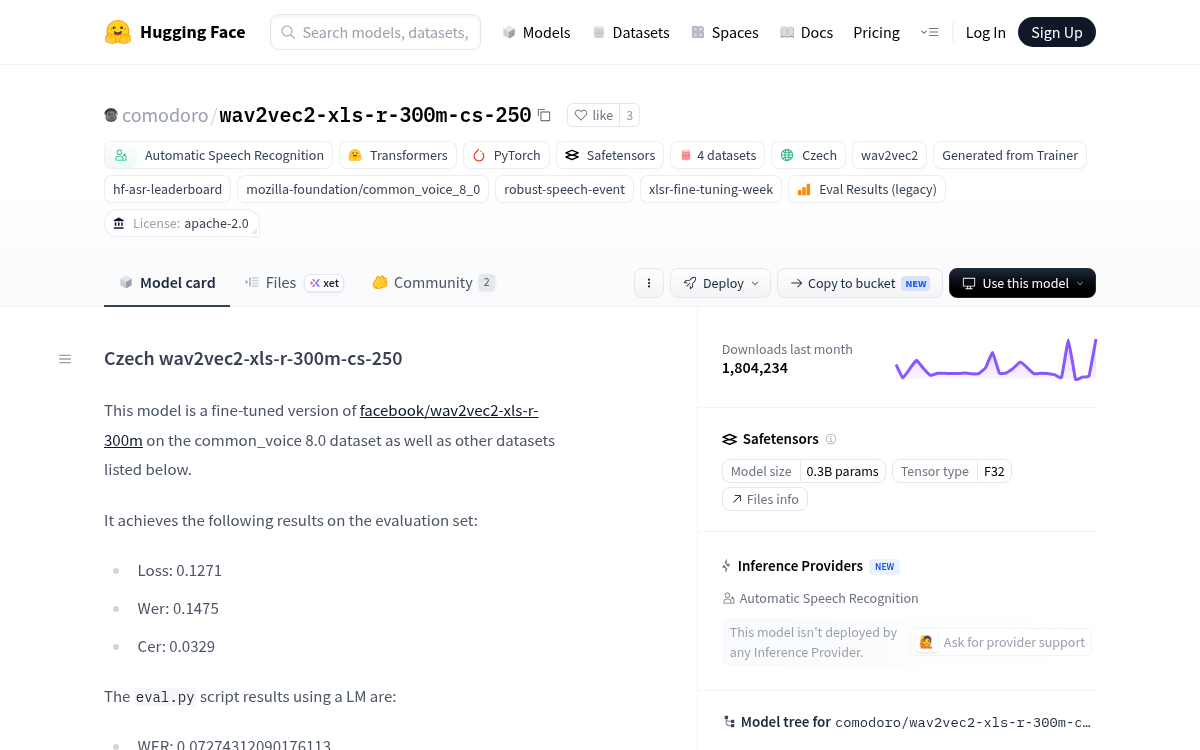
A community fine-tune of Facebook's XLS-R 300M for Czech has quietly racked up 1.5M monthly downloads, hitting 7.3% WER on Common Voice.
 Pro
Takeaways
- Community fine-tune wav2vec2-xls-r-300m-cs-250 crossed 1.5M downloads last month.
- Built on Meta's XLS-R 300M, pretrained on 436k hours across 128 languages.
- Hits 7.3% WER and 2.1% CER on Common Voice 8 Czech with a language model.
- Trained on Common Voice plus OVM, Czech Parliament Meetings, and Vystadial 2016.
- Weak on noisy audio: 38.5% WER on Robust Speech Event test set.
- Apache-2.0, 300M params, drop-in with the Transformers ASR pipeline.
A single-developer speech recognition checkpoint for Czech has become one of the busiest models on Hugging Face this month, with more than 1.5 million downloads in the last thirty days. The model, wav2vec2-xls-r-300m-cs-250, is a community fine-tune published by user comodoro that adapts Meta's multilingual XLS-R backbone into a production-usable Czech transcription system, and its download counter suggests it quietly powers a large share of Czech-language ASR pipelines worldwide.
A 7% WER Czech workhorse
The checkpoint starts from facebook/wav2vec2-xls-r-300m, a 300M-parameter self-supervised speech model pretrained on 436k hours of unlabeled audio, including VoxPopuli, MLS, CommonVoice, BABEL, and VoxLingua107, using the wav2vec 2.0 objective across 128 languages. Meta pitches XLS-R as a foundation, noting the model should be fine-tuned on a downstream task like Automatic Speech Recognition, Translation, or Classification. Comodoro's release is that downstream step, done well enough for Czech that the community has largely stopped rolling their own.
On the standard Czech evaluation slice, the numbers do the talking. Without any language model, the checkpoint reports a Word Error Rate of 0.1475 and Character Error Rate of 0.0329 on the evaluation set. Plug in a language model at decode time and those drop to a WER of 0.0727 and a CER of 0.0212, competitive with monolingual research systems trained on far more Czech-specific data.
How it was actually built
The training recipe is refreshingly boring, which is part of why it reproduces so well. The Common Voice 8.0 Czech train and validation splits were combined with three additional Czech corpora: OVM (the Otázky Václava Moravce political interview show), Czech Parliament Meetings, and Vystadial 2016. Fine-tuning ran for 5 epochs on top of the frozen-then-unfrozen XLS-R encoder using these hyperparameters:
- Learning rate: 1e-4, linear scheduler with 800 warmup steps
- Train batch size: 32, eval batch size: 8
- Optimizer: Adam, betas (0.9, 0.999), epsilon 1e-8
- Mixed precision: native AMP
- Seed: 42
The training log shows a clean descent from a WER of 1.0 at step 800 down to 0.1475 by step 24,800, without the plateau-and-collapse pattern that often plagues CTC fine-tunes on smaller languages.
Why a Czech-only checkpoint matters
Czech sits in an awkward middle band for speech tech, with enough labeled data to make fine-tuning worthwhile but not enough attention from big labs to get first-class treatment in general-purpose ASR APIs. The academic community has responded by pretraining monolingual variants. Lehečka et al. report pretraining Czech monolingual audio transformers from a corpus of more than 80 thousand hours of unlabeled speech, showing that monolingual Wav2Vec 2.0 models can compete with state-of-the-art LVCSR systems. Comodoro's checkpoint hits a different tradeoff: it inherits the cross-lingual acoustic priors from XLS-R's 128-language pretraining, then specializes cheaply on a few thousand hours of Czech transcripts.
That approach works because the base wav2vec2-xls-r-300m already performs well on low-resource languages thanks to its multilingual pretraining, and a five-epoch fine-tune sits well within reach of a single-GPU workflow.
Where it holds up and where it breaks
The reported eval numbers come with a caveat that the model card is honest about. On clean Common Voice 8 test audio, the checkpoint clocks 7.3% WER and 2.1% CER. On the Robust Speech Event evaluation, which mixes accents, noise, and out-of-domain content, WER jumps to 43.4% on dev and 38.5% on test. Translation: this model is very good at clean read speech and degrades sharply on noisy or spontaneous audio. If you are transcribing call center audio or street interviews, plan on a domain adaptation pass.
Practical fit looks like this:
- Good for: voice assistants with close-talking mics, podcast and lecture transcription, dictation apps, subtitling for scripted Czech content.
- Marginal for: telephony, noisy field recordings, heavy dialect or code-switching with Slovak.
- Not free lunch: the model expects 16 kHz mono audio, and a KenLM or similar n-gram LM roughly halves WER, so the LM decode path is worth wiring up.
Three lines to production
The model is Apache-2.0 licensed and works with the standard Transformers pipeline API, no custom code required:
from transformers import pipeline
pipe = pipeline("automatic-speech-recognition",
                model="comodoro/wav2vec2-xls-r-300m-cs-250")
print(pipe("sample_cs.wav"))
For lower-level control, AutoProcessor and AutoModelForCTC load the same weights and let you plug in a language model decoder or batch across long recordings. At 300M parameters in F32, the checkpoint fits comfortably on a single consumer GPU, and it quantizes further for CPU inference, which explains why it keeps showing up in production Czech ASR stacks despite newer Whisper variants being available.