
NVIDIA Squeezes MiniMax-M3 Into Half the GPU Memory With Almost No Accuracy Loss
NVIDIA quantizes MiniMax-M3 to NVFP4, halving memory needs for a 428B multimodal MoE with 1M-token context on Blackwell GPUs
Takeaways
- NVIDIA quantized MiniMax-M3 to NVFP4 4-bit precision, cutting disk size from 854 GB (BF16) to ~256 GB with only ~1-point accuracy drop.
- MiniMax-M3 is a 428B MoE model with 1M-token context, native multimodal (text/image/video), and ~23B active parameters per token.
- MiniMax Sparse Attention (MSA) delivers 9x faster prefill and 15x faster decode vs. M2 at 1M context, reducing per-token compute to 1/20th.
- NVFP4 is Blackwell-native: hardware-accelerated 4-bit floating point with two-level scaling, unlike older INT4 formats that require dequantization.
- Deployment requires vLLM nightly with
--tensor-parallel-size 8; SGLang, TensorRT-LLM, and NVIDIA Dynamo also supported for production scale. - Available now on Hugging Face for non-commercial use; base weights at MiniMaxAI/MiniMax-M3.
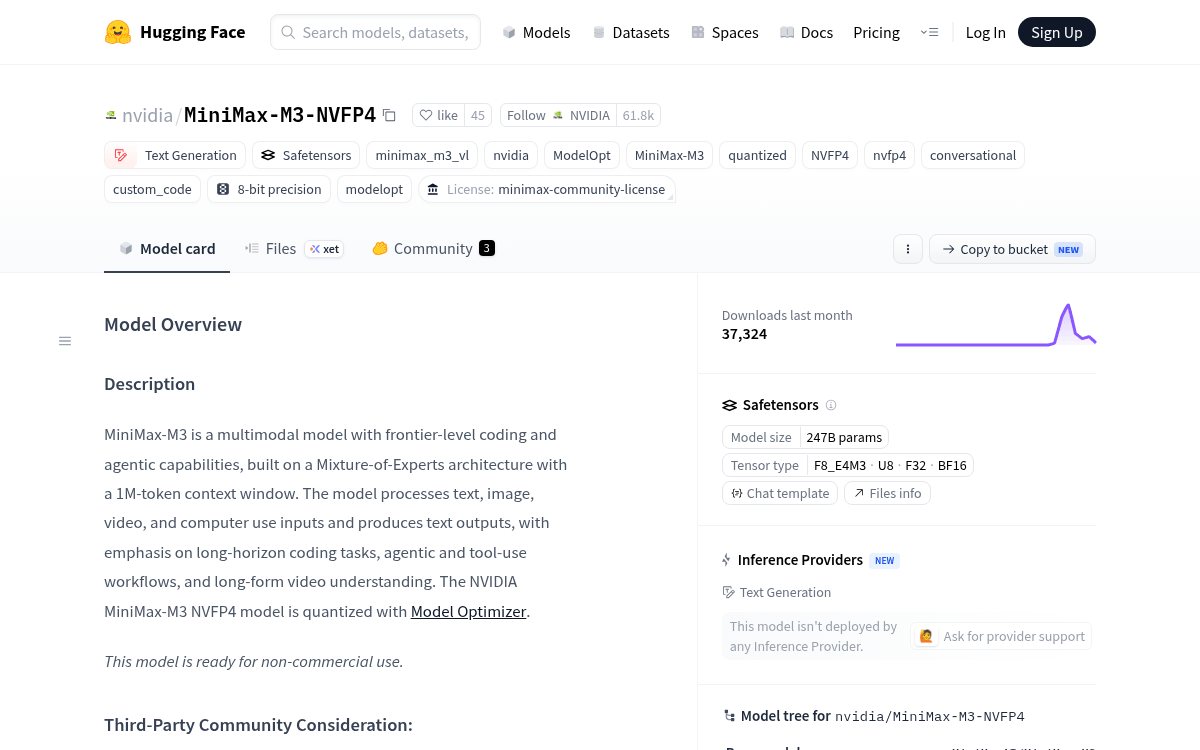
NVIDIA's MiniMax-M3-NVFP4 is a freshly quantized version of MiniMax's flagship open-weight model, compressed from 8-bit down to 4-bit precision using NVIDIA's own NVFP4 format. The result: a 428-billion-parameter multimodal reasoning model that fits into roughly half the GPU memory of its FP8 predecessor, with benchmark scores that barely budge.
What just landed, and why it's a big deal
MiniMax released M3 as the first open-weight model to combine frontier-level coding, a 1-million-token context window, and native multimodal capabilities in a single model. That alone was a significant moment. Now NVIDIA has taken those weights and applied its NVFP4 quantization pipeline, making the model dramatically cheaper to serve on Blackwell hardware.
This model was obtained by quantizing the weights and activations of MiniMax-M3 to the NVFP4 data type, reducing the number of bits per parameter from 8 to 4 and cutting disk size and GPU memory requirements by approximately 2x. In practice, the quantized checkpoint lands at roughly 256 GB on disk, compared to 854 GB in BF16 and 444 GB in MXFP8, and can be served on two B300/GB300 GPUs with significant KV cache headroom.
The model underneath the quantization
MiniMax-M3 is a multimodal vision-language model built on a Mixture-of-Experts architecture for long-context reasoning, agentic workflows, and creative tasks. It processes text, image, and video inputs and produces text outputs, with emphasis on long-form video understanding, long-horizon coding, and design workflows.
The architecture has a few key numbers worth knowing:
- 428B total parameters, with only ~23B active per token (MoE routing keeps inference costs manageable)
- 1M-token context window , not a soft cap; the context length is 1,048,576 tokens, and this is not a soft cap with degraded quality at the edges.
- 128 experts total, 4 activated per token
- 600M parameter vision encoder (ViT) for image and video
- Supports long-form video up to 30 minutes and long-horizon coding tasks of 8+ hours. The model also supports two reasoning modes switchable per request: thinking mode for complex reasoning and agentic tasks, and non-thinking mode for latency-sensitive scenarios.