
NVIDIA's Parakeet TDT Transcribes 60 Minutes of Audio per Second, Beating Whisper
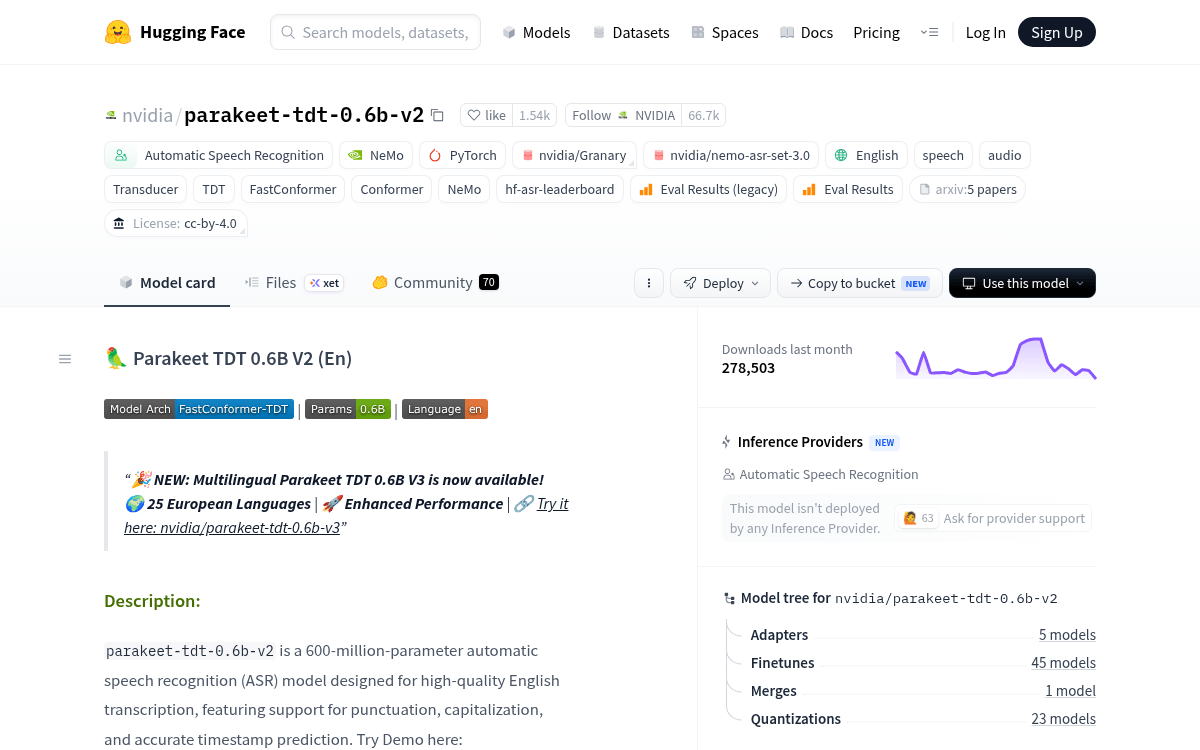
NVIDIA's 600M-parameter Parakeet TDT v2 tops the Hugging Face Open ASR Leaderboard at 6.05% WER while transcribing an hour of audio in one second.
 Pro
Takeaways
- NVIDIA released Parakeet TDT 0.6B v2, an open English ASR model with 600M parameters.
- Tops Hugging Face Open ASR Leaderboard at 6.05% average WER with greedy decoding.
- Hits RTFx of 3386, transcribing 60 minutes of audio in roughly one second on GPU.
- FastConformer encoder plus TDT decoder handles up to 24 minutes in a single pass.
- CC-BY-4.0 licensed, commercial use permitted, with word-level timestamps and punctuation built in.
- Free hosted API available at build.nvidia.com alongside NeMo toolkit integration.
NVIDIA quietly dropped a speech recognition model that upends the price-performance curve for English transcription. Parakeet TDT 0.6B v2 is a 600-million-parameter open model that claims the top spot on the Hugging Face Open ASR Leaderboard while running fast enough to transcribe an hour of audio in roughly a second on a single GPU. It ships under CC-BY-4.0, so commercial deployment is fair game.
What makes the release notable is how aggressively it undercuts larger, closed alternatives. On the leaderboard, Parakeet posts the lowest WER recorded among open-source models, sitting well above comparable systems like OpenAI's Whisper and other community-driven efforts.
What is actually in the box
Parakeet TDT 0.6B v2 handles English transcription with punctuation, capitalization, and word-level timestamp prediction out of the box. Architecturally, it pairs NVIDIA's FastConformer encoder with a Token-and-Duration Transducer (TDT) decoder. The XL variant is trained with full attention, so it can transcribe audio segments up to 24 minutes in a single pass.
The TDT decoder is the interesting bit. A standard RNN-Transducer emits one token at a time and has to keep asking whether the next frame contains speech or silence. TDT jointly predicts a token and how many audio frames that token covers, so the decoder can skip ahead across long stretches of audio instead of grinding through every frame. That explains a lot about the throughput numbers.
The speed number that grabs attention
NVIDIA reports an RTFx (Real-Time Factor) of 3386.02 at batch size 128 on GPU-accelerated hardware, which puts the model at the top of the Hugging Face throughput charts. Translated: one second of GPU compute produces about 3,386 seconds of transcript, or roughly 60 minutes of audio per wall-clock second at that batch size. That is more than 50x faster than many existing open ASR models. Batch size matters, but even at smaller batches the model stays competitive for real-time and streaming workloads.
Accuracy across the leaderboard suite
Parakeet averages 6.05% Word Error Rate across the leaderboard datasets. The per-dataset breakdown shows where it shines and where it still struggles:
| Dataset | WER (%) |
|---|---|
| LibriSpeech test-clean | 1.69 |
| LibriSpeech test-other | 3.19 |
| SPGI Speech | 2.17 |
| TEDLIUM-v3 | 3.38 |
| VoxPopuli | 5.95 |
| GigaSpeech | 9.74 |
| Earnings-22 | 11.15 |
| AMI (meetings) | 11.16 |
Clean, prepared audio like LibriSpeech is essentially solved. Meeting recordings and earnings calls, with overlapping speakers, cross-talk, and financial jargon, remain the hard cases at just above 11% WER. Noise robustness follows a predictable curve: the model holds up well down to roughly 5 dB SNR, then accuracy degrades sharply as noise overtakes signal. For telephony (8 kHz mu-law), WER rises from 6.05% to 6.32%, a small penalty for call-center workloads.
How it was trained
The training recipe is unusually transparent for a leaderboard-topping release. The model was initialized from a FastConformer SSL checkpoint pretrained with a wav2vec-style objective on LibriLight, then trained for 150,000 steps on 64 A100 GPUs. A short second-stage fine-tune of 2,500 steps on 4 A100s followed, using roughly 500 hours of high-quality human-transcribed data.
Supervision came from the Granary dataset: approximately 120,000 hours of English speech, of which 10,000 hours are human-transcribed material from NeMo ASR Set 3.0. All transcriptions preserve punctuation and capitalization. The Granary corpus will be released publicly after its presentation at Interspeech 2025. The remaining 110,000 hours come from pseudo-labeled sources including YouTube-Commons, YODAS, and LibriLight, so the bulk of supervision was model-generated transcripts that were then filtered and cleaned.
Using it in five lines
The path of least resistance is the NeMo toolkit. Install and load:
pip install -U nemo_toolkit["asr"]import nemo.collections.asr as nemo_asr
asr_model = nemo_asr.models.ASRModel.from_pretrained("nvidia/parakeet-tdt-0.6b-v2")
output = asr_model.transcribe(["audio.wav"], timestamps=True)
print(output[0].text)
for seg in output[0].timestamp["segment"]:
print(f"{seg['start']}s - {seg['end']}s : {seg['segment']}")Passing timestamps=True returns char, word, and segment-level timings without a separate forced-alignment step, a meaningful quality-of-life improvement over stitching alignments onto Whisper output. To skip GPU rental entirely, NVIDIA hosts a free API at build.nvidia.com, accessible through the nvidia-riva-client Python package.
Where it fits
Obvious deployment targets:
- Batch transcription of large audio archives where throughput dominates cost
- Subtitle and caption generation, aided by native word-level timestamps
- Call-center analytics, given the small telephony penalty
- Voice assistants and conversational AI needing low-latency English ASR
- Meeting notes and podcast pipelines where punctuation and capitalization matter
Limits worth flagging: English only (the newly released v3 covers 25 European languages), single-channel 16 kHz input, and no built-in diarization. The model also expects reasonably complete utterances. Word-for-word or fragmented input degrades accuracy because the decoder leans on linguistic context to resolve ambiguity.
Why this matters
Two assumptions in the ASR stack need updating. The first is that leaderboard-topping accuracy requires multi-billion-parameter models. A 600M-parameter transducer with a strong encoder and a clean pseudo-labeling pipeline is enough. The second is the throughput ceiling set by Whisper-class architectures, which TDT decoding blows past by an order of magnitude. Both come wrapped in a commercially permissive CC-BY-4.0 license, which puts it in play for enterprises and indie developers building paid transcription features. Combined with the AWS Marketplace listing and the fine-tuning recipes NVIDIA and partners have published, Parakeet TDT v2 is a credible drop-in replacement for closed transcription APIs in English-only workloads, and a strong base checkpoint for anyone adapting ASR to a specialized domain.
 Aws Fine-tuning NVIDIA Nemotron Speech ASR on Amazon EC2