
NVIDIA's Parakeet CTC Beats Whisper on Speed With a C++ Runtime
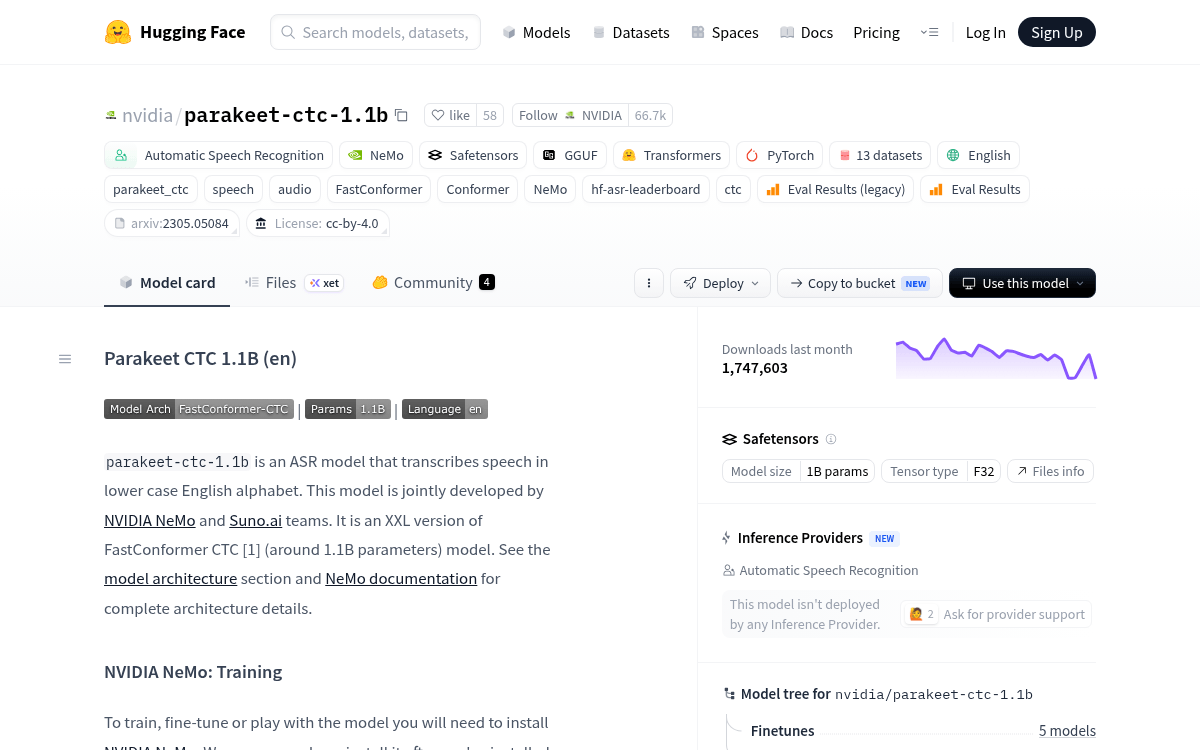
NVIDIA's 1.1B parameter English speech model now runs natively in Transformers and ships GGUF weights for local C++ inference.
 Pro
Takeaways
- NVIDIA's Parakeet CTC 1.1B now supports native Hugging Face Transformers loading with no NeMo dependency.
- GGUF quantized weights published for lightweight local inference via the new NeMo-Speech.cpp C++ runtime.
- Non-autoregressive FastConformer CTC architecture, 1.1B parameters, English only, lowercase output with no punctuation.
- Mean WER of 7.4 on the Open ASR Leaderboard with RTFx above 2,700 on reference hardware.
- Trained on 64K hours of English speech from LibriSpeech, Common Voice, People's Speech and NVIDIA/Suno private data.
- CC-BY-4.0 license, over 1.7M Hugging Face downloads, positioning it as an open Whisper alternative.
NVIDIA's Parakeet CTC 1.1B has quietly become one of the most downloaded speech recognition models on Hugging Face, and a recent refresh makes it much easier to plug into everyday pipelines. The model card now ships GGUF quantized weights, native Hugging Face Transformers support, and a lightweight C++ runtime called NeMo-Speech.cpp for local inference. If Whisper has been your default, Parakeet is worth a look.
The model under the hood
Parakeet CTC 1.1B is an English automatic speech recognition model jointly developed by NVIDIA NeMo and Suno.ai, built as an XXL FastConformer CTC variant with roughly 1.1B parameters. It transcribes speech into lowercase English text and is small enough to run entirely on-device while still hitting state-of-the-art accuracy.
The non-autoregressive design is what makes it fast. Rather than running a decoder token by token, Parakeet projects encoder states directly to token logits and uses CTC decoding, so most compute sits in a single parallel encoder pass and decoding stays cheap. That structural choice is why the Parakeet family regularly outruns similarly sized Whisper models by an order of magnitude on throughput benchmarks.
What just changed
The model card update adds three concrete things developers care about:
- Native Transformers integration. Load Parakeet through the standard
pipeline("automatic-speech-recognition")orAutoModelForCTCAPIs, no NeMo install required. - GGUF weights. Quantized checkpoints like
parakeet-ctc-1.1b.q8_0.ggufnow sit alongside the safetensors, matching the pattern popularized by llama.cpp. - NeMo-Speech.cpp. A new native C++ runtime transcribes with the GGUF file directly, useful for edge devices and desktop apps.
Getting started with the C++ path looks like this:
hf download nvidia/parakeet-ctc-1.1b \
  parakeet-ctc-1.1b.q8_0.gguf \
  --local-dir models
nemo-speech transcribe audio.wav \
  --model models/parakeet-ctc-1.1b.q8_0.gguf
For Python users who want zero NeMo dependencies, the Transformers route is now a two-liner. The model accepts 16 kHz mono WAV audio and returns transcribed text.
How good is it, really
Parakeet's Open ASR Leaderboard numbers are where it earns its reputation. Mean word error rate sits at 7.4 across the leaderboard suite, and the real-time factor (RTFx) clocks in at 2,728, meaning it processes audio thousands of times faster than real time on the reference hardware. The per-dataset WER breakdown from the model card:
| Dataset | WER (greedy, no LM) |
|---|---|
| LibriSpeech test-clean | 1.83 |
| SPGI Speech | 3.54 |
| VoxPopuli | 3.54 |
| TED-LIUM v3 | 4.20 |
| Common Voice | 6.53 |
| GigaSpeech | 10.27 |
| Earnings-22 | 13.69 |
| AMI (meetings) | 15.62 |
Read speech and clean broadcast audio are essentially solved. Meetings and noisy financial calls remain harder, which is consistent across the field.
The limits worth knowing
Parakeet CTC 1.1B is English only, and outputs lowercase text with no punctuation or capitalization. When you need casing and punctuation baked in, the sibling checkpoint parakeet-tdt_ctc-1.1b handles both and is a drop-in alternative. Speaker diarization and timestamp alignment are not part of the base model either, though the NGC collection bundles those as separate models.
Parakeet versus Whisper
Parakeet competes with other open-weight ASR models like OpenAI Whisper large-v3 (1.5B parameters) and Meta's Wav2Vec2-XLSR-53. Whisper uses a transformer encoder-decoder with autoregressive decoding, while Parakeet CTC uses a connectionist temporal classification head. Whisper wins on multilingual coverage and free punctuation. Parakeet wins on English accuracy and raw speed, and the addition of GGUF plus a C++ runtime closes the portability gap that llama.cpp opened up for LLMs.
Where it fits in your stack
Consider Parakeet CTC 1.1B when:
- You need high-throughput English transcription for podcasts, call centers, meeting archives, or video captioning pipelines.
- You want on-device inference on laptops or edge boxes without shipping a full Python and PyTorch environment.
- You are building a streaming or real-time captioning feature where autoregressive decoding latency is a bottleneck.
- You need a permissive license, since the weights ship under CC-BY-4.0.
The weights are free to download, and the model has already crossed 1.7 million downloads on Hugging Face, so infrastructure and community tooling around it is unusually mature for a research-lab release. For teams currently paying per minute for cloud transcription APIs, running quantized Parakeet on a single consumer GPU or even CPU is now a realistic swap.