
NVIDIA's Parakeet Beats Whisper on Apple Silicon at 50x Real-Time Speed
NVIDIA's chart-topping 600M parameter ASR model now runs natively on Apple Silicon via MLX, transcribing an hour of audio in about a minute.
 Pro
Takeaways
- NVIDIA's Parakeet-TDT 0.6B v2, top of the Open ASR Leaderboard, ported to Apple Silicon via MLX.
- Transcribes an hour of audio in about a minute on M3 MacBook Pro, fully offline.
- Install with
pip install parakeet-mlx, use via CLI or Python. - CC-BY-4.0 license permits commercial use; 2.47 GB, needs ~2GB unified memory.
- Outputs txt, srt, vtt, json with punctuation, capitalization, and word-level timestamps.
- English only, requires macOS 15+; multilingual v3 covers 25 European languages.
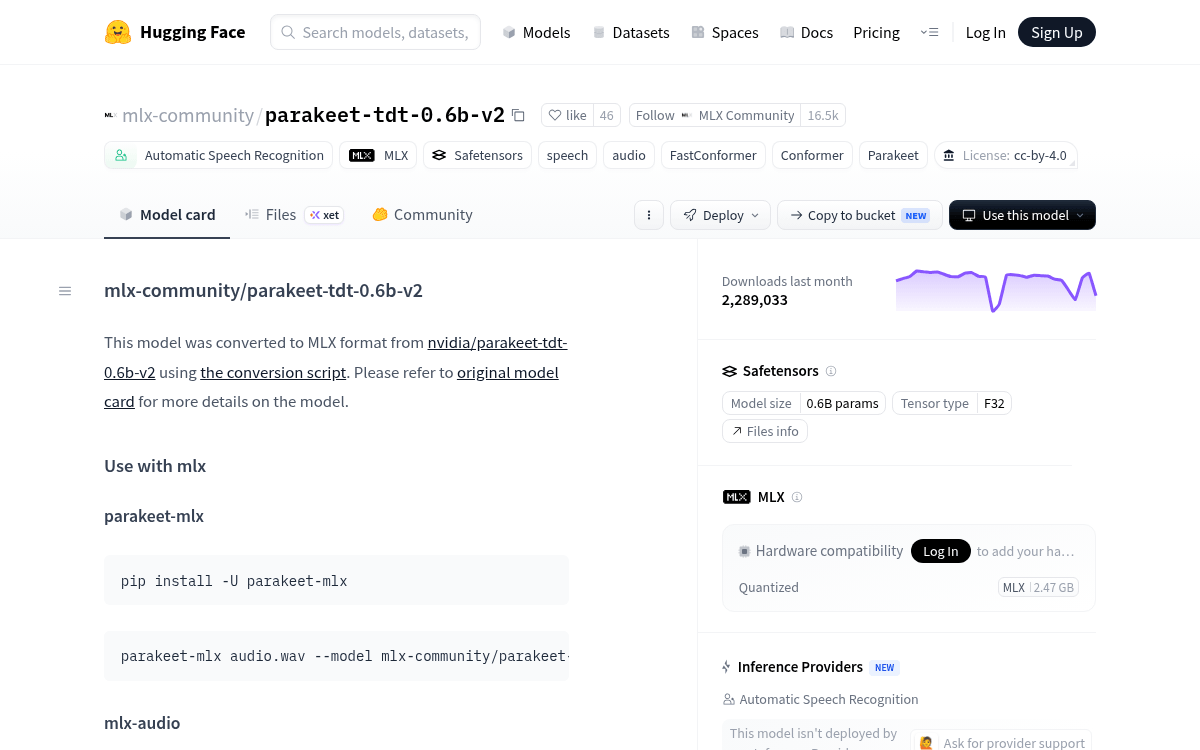
NVIDIA's Parakeet speech recognition model has been ported to Apple Silicon, and it runs fast enough to make Whisper feel sluggish. The mlx-community/parakeet-tdt-0.6b-v2 release converts NVIDIA's chart-topping English ASR model into MLX format so it runs natively on M-series Macs, and it has already crossed 2.2 million downloads on Hugging Face.
The original has been sitting at the top of the Open ASR Leaderboard, but it was built for CUDA. This port makes it a first-class citizen on Apple hardware, unlocking on-device transcription that is both accurate and absurdly quick.
What actually shipped
The upload is a straight MLX conversion of nvidia/parakeet-tdt-0.6b-v2, weighing 2.47 GB and licensed under CC-BY-4.0, which permits commercial use. Parakeet-TDT-0.6B-v2 is a 600-million-parameter English ASR model, and despite its modest size compared to multi-billion parameter alternatives, it delivers strong results across a wide range of benchmarks.
The name breaks down like this: Parakeet is NVIDIA's family of ASR models, TDT refers to the Token-and-Duration Transducer architecture, 0.6B is the parameter count, and v2 is the second iteration. The TDT decoder is what makes the model unusually fast. It predicts both the next token and how long that token lasts, so decoding can skip ahead across silent or repetitive frames instead of stepping through the audio one frame at a time.
Getting it running
The easiest path is through parakeet-mlx, a CLI and Python library from Senstella that wraps the model. It handles basic transcription, batches of files with word-level timestamps as VTT subtitles, and can generate every output format in a single pass.
pip install -U parakeet-mlx
parakeet-mlx audio.wav --model mlx-community/parakeet-tdt-0.6b-v2
A few things to know before installing:
- ffmpeg must be installed on your system first, otherwise the CLI won't work properly.
- Devices running macOS 14 cannot run parakeet-mlx. It crashes on the newResidencySetWithDescriptor API, which is only available in macOS 15.
- The 0.6B model needs a minimum of 2GB of unified memory, which is small enough to work on 8GB MacBook Airs (users have confirmed this).
- Output formats include txt, srt, vtt, json, or all at once.
Speed is the headline
On NVIDIA hardware the numbers are eye-watering. The model achieves a Real-Time Factor of 3380 on the HF-Open-ASR leaderboard with a batch size of 128, meaning it processes over 3000 seconds of audio per second of wall time. Under optimal conditions, 60 minutes of audio transcribe in roughly 1 second.
On a Mac the results are more modest but still striking. One developer reported that an hour of audio took just over a minute to transcribe on an M3 MacBook Pro using parakeet-mlx. That works out to roughly 50x real-time on a laptop, with no cloud round-trip and no API bill.
What it is good at
Beyond raw throughput, the model handles the small things that matter for production transcription work:
- Punctuation and capitalization out of the box, no post-processing needed.
- Accurate word-level timestamps, which is what makes SRT and VTT export useful.
- Robust performance on challenging content, handling spoken numbers and song lyrics with high accuracy.
- A footprint small enough (2.47 GB) that it fits comfortably alongside other models in memory.
Where it falls short
The obvious limitation is language coverage. v2 is English-only. For multilingual work, NVIDIA has already released parakeet-tdt-0.6b-v3, a 600-million-parameter model that extends v2 to 25 European languages with automatic language detection.
Streaming is another gap. The parakeet-mlx port doesn't have a direct audio streaming feature yet, though it is listed as a to-do item. The model clearly processes audio much faster than it arrives in real time, but implementing low-latency streaming with accurate voice activity detection and intelligent merging of text segments is non-trivial. A streaming demo gist is floating around, but production-grade live captioning still requires extra plumbing.
Compatibility is also strict: macOS 15 or newer, Apple Silicon only. Intel Macs are out.
How it was trained
The model was trained on the Granary dataset, roughly 120,000 hours of English speech, including 10,000 hours from human-transcribed NeMo ASR Set 3.0. All transcriptions preserve punctuation and capitalization. The FastConformer encoder is a heavily optimized descendant of the Conformer architecture, paired with the TDT transducer decoder that jointly predicts tokens and their durations.
Why this matters for Apple developers
Until recently, high-quality on-device ASR on Macs meant Whisper or one of its derivatives. Parakeet-TDT changes the tradeoff calculus. It is smaller than Whisper large-v3, meaningfully faster, and it tops the Open ASR Leaderboard for English. Getting it onto MLX means the Apple ecosystem now has a competitive alternative that runs entirely offline.
The Swift community has already picked up on this. A Swift port built on top of parakeet-mlx targets iOS and macOS apps, and a free notarized macOS transcription app has been built around it. For anyone shipping meeting recorders, podcast tools, accessibility features, or voice-driven interfaces on Apple hardware, this is now one of the strongest offline options available, and it costs nothing beyond the disk space.