
NVIDIA's NVLM-D-72B Beats GPT-4o on OCR While Boosting Its Own Text Skills
NVIDIA open-sourced a 72B decoder-only vision-language model that matches GPT-4o on multimodal benchmarks and improves at text-only tasks after training.
 Pro
Takeaways
- NVIDIA open-sourced NVLM-D-72B, a 72B decoder-only multimodal model built on Qwen2-72B-Instruct plus InternViT-6B.
- Matches or beats GPT-4o on OCRBench (852), MathVista (65.2), DocVQA (92.6) and AI2D (94.2).
- Text-only MATH and HumanEval scores improve by 4.3 points on average after multimodal training.
- 128K context, dynamic image tiling at 448px, ships with Megatron training code.
- Runs via vLLM, SGLang, or Transformers on multi-GPU H100 setups; needs about 150GB VRAM in bf16.
- Licensed CC-BY-NC-4.0, restricting the release to non-commercial research and evaluation.
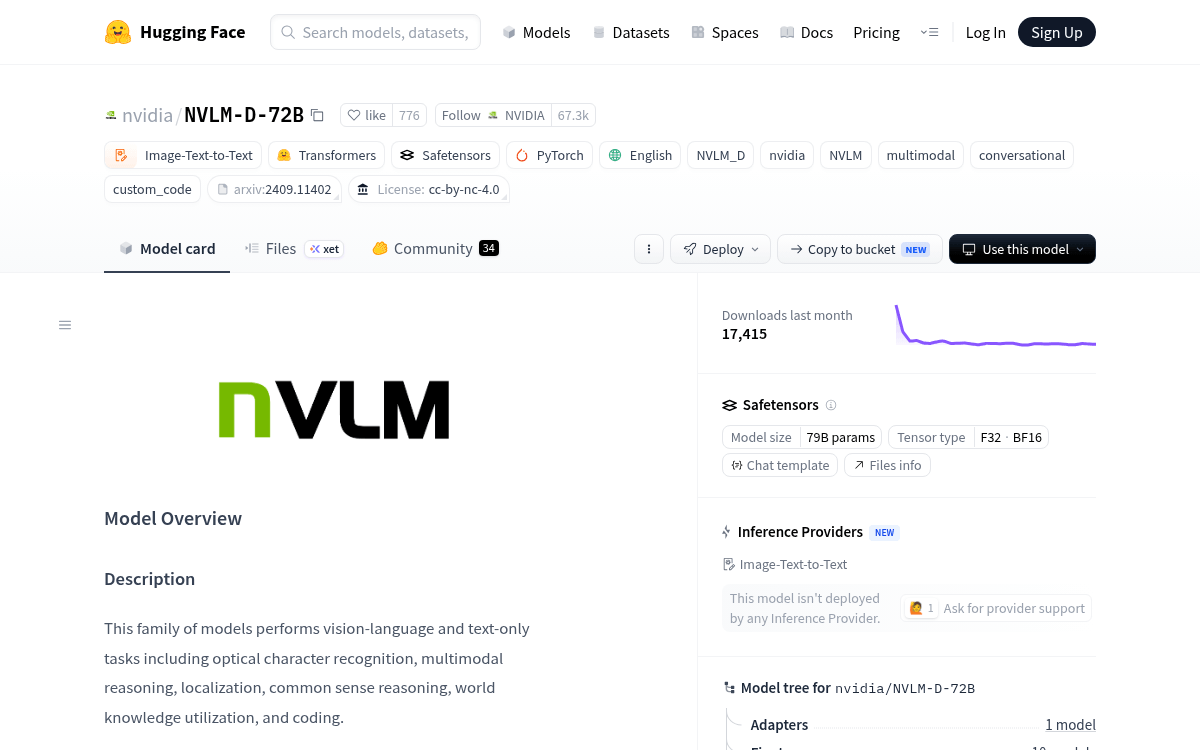
NVIDIA has released NVLM-D-72B, a 72-billion-parameter multimodal model with weights and inference code freely available on Hugging Face. The model matches or beats GPT-4o on several vision-language benchmarks, but the more surprising result is what happens to its text performance after multimodal training: rather than degrading, it improves.
Text gets better after vision training
Bolting a vision encoder onto a strong text LLM typically degrades language performance. InternVL2-Llama3-76B drops noticeably on text benchmarks after multimodal training. Llama 3-V avoids that by freezing the LLM backbone entirely during training. NVLM takes a different path: joint training on a curated multimodal dataset appears to act as reasoning supervision, lifting scores rather than suppressing them. The Qwen2-72B-Instruct backbone scores 59.7 on MATH and 86.0 on HumanEval before multimodal training. After NVLM training, those rise to 73.1 and 89.0, an average gain of 4.3 points across text-only math and coding benchmarks. The multimodal model outperforms its own text-only starting point.
Vision benchmark results
On the standard vision-language benchmark suite, NVLM-D-72B lands in the same range as GPT-4o, Claude 3.5 Sonnet, and Llama 3-V 405B:
- MMMU (val): 58.7, versus 69.1 for GPT-4o and 68.3 for Claude 3.5 Sonnet
- MathVista: 65.2, beating GPT-4o's 63.8
- OCRBench: 852, ahead of GPT-4o (736), Claude 3.5 Sonnet (788), and Gemini 1.5 Pro (754)
- DocVQA: 92.6, essentially tied with GPT-4o at 92.8
- ChartQA: 86.0, within the 85–90 range of leading proprietary models
- AI2D: 94.2, matching GPT-4o exactly
NVLM leads on OCR-heavy and document tasks, trails on the harder college-level reasoning of MMMU, and roughly matches on charts and diagrams.
Architecture and training
NVLM-D is the decoder-only member of a family that also explored cross-attention designs. It combines the Qwen2-72B-Instruct text backbone with the InternViT-6B-448px-V1-5 vision encoder. The vision encoder processes tiles at 448×448 resolution using dynamic tiling to preserve aspect ratio, splitting high-resolution inputs into up to twelve sub-images plus a thumbnail. Context length is 128K tokens, which accommodates multi-page documents or many image tiles in a single pass. NVIDIA published both weights and Megatron-LM training code, alongside the dataset recipe in the accompanying paper.
Running the model
The 79B-parameter model in bf16 requires roughly 150 GB of GPU memory, so plan on multiple H100s. The Hugging Face model card includes a split_model() helper that reserves the first GPU for the vision tower and shards the 80 language-model layers across the rest. The simplest serving path is vLLM:
pip install vllm
vllm serve "nvidia/NVLM-D-72B"
That exposes an OpenAI-compatible endpoint accepting image URLs in the chat payload. SGLang works the same way. For direct PyTorch usage, the model exposes a chat method:
from transformers import AutoModel, AutoTokenizer
model = AutoModel.from_pretrained("nvidia/NVLM-D-72B",
    torch_dtype=torch.bfloat16, trust_remote_code=True).eval()
tokenizer = AutoTokenizer.from_pretrained("nvidia/NVLM-D-72B", trust_remote_code=True)
response = model.chat(tokenizer, pixel_values, "<image>\nDescribe this.", gen_config)
Licensing limits commercial use
The weights are released under the Creative Commons Attribution-NonCommercial 4.0 license, and the Qwen2-72B-Instruct backbone carries its own terms. Shipping NVLM inside a paid product is out; research, internal evaluation, and academic benchmarking are fine. Teams building commercial document pipelines will need to negotiate with NVIDIA and Alibaba directly or look elsewhere.
Where it performs best
Given the benchmark profile, the practical sweet spots are:
- Document and OCR pipelines: the 852 OCRBench score beats every proprietary model in the comparison, and DocVQA sits at GPT-4o level
- Chart and diagram understanding: AI2D and ChartQA numbers make it a credible option for analytics tooling
- Math with visual inputs: MathVista 65.2 beats GPT-4o, and the text-only MATH jump to 73.1 confirms the reasoning generalizes beyond visual pattern matching
- Research on multimodal training dynamics: weights, inference code, training code, and dataset recipes are all published, making this a useful reference for anyone studying how vision data affects text reasoning
The harder reasoning benchmarks remain a weak spot: the 10-point gap to GPT-4o on MMMU is real. The noncommercial license rules out production deployment for most teams regardless of capability.
What changes for the field
Two assumptions take a hit here. Multimodal training has generally been understood to hurt text performance unless the backbone is frozen; NVLM shows that the right data mix can lift math and code scores instead. And frontier multimodal quality has mostly required closed weights; NVLM ships everything needed to reproduce and build on it. For teams working on vision-language systems, the complete release makes NVLM-D-72B a reference implementation as much as a model to deploy. The commercial license keeps it out of production for most, but as a public artifact showing how to close the gap with GPT-4o on OCR and document tasks using open components, few frontier-scale releases have been this transparent.